
相关资源
探索丰富的全球公民教育资源,深化理解,促进研究、倡导、教学与学习。
共找到2,162条结果
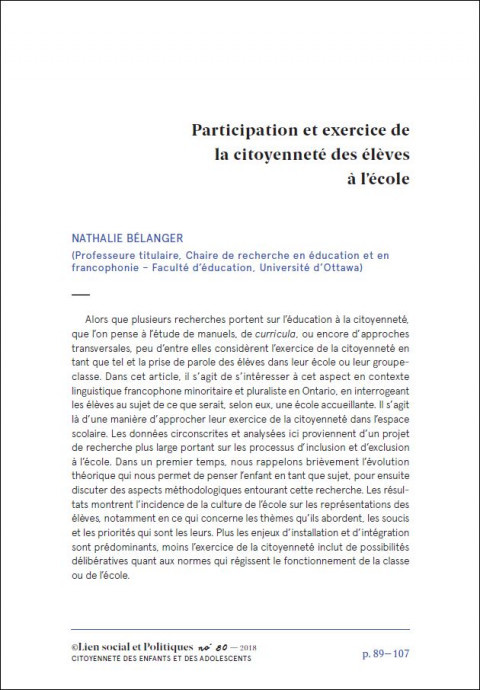 Participation and Exercising Pupils’ Citizenship at French-Language Elementary School in Ontario 出版年份: 2018 作者: Nathalie Bélanger 机构作者: Lien social et Politiques This article first describes the evolution which allowed the child to be considered as an actor. In this vein, citizenship education programs at school are discussed, although they do not often take into account exercising citizenship in the school context and children’s voice. Research results from a broader project on how students represent their school experience in French-language schools in Ontario are analyzed specifically with respect to what a welcoming school means for them. The methodology uses an inductive approach and the data were gathered from administering a questionnaire designed for children, observation and semi-directed interviews. The results show the impact of school culture and school form on the exercise of students' citizenship, the topics they address, their concerns and priorities. The greater the predominance of settlement and integration issues are, the less the exercise of citizenship includes deliberative opportunities regarding school functioning. Participation et exercice de la citoyenneté des élèves à l’école 出版年份: 2018 作者: Nathalie Bélanger 机构作者: Lien social et Politiques Cet article retrace les courants théoriques qui permettent de penser l’enfant en tant que sujet et donne la parole aux enfants au sujet de leur expérience scolaire. Dans ce contexte, des programmes d’éducation à la citoyenneté sont apparus, sans toutefois que l’exercice de la citoyenneté des élèves et leur prise de parole soient pris en compte et valorisés. Pour y remédier, il s’agit d’interroger des élèves au sujet de ce que représente pour eux une école accueillante. La méthodologie recourt à une approche inductive et les données ont été recueillies à partir de l’administration d’un questionnaire conçu pour des enfants, d’observation et d’entretiens semi-dirigés. Les résultats montrent l’incidence de la culture de l’école et de la forme scolaire sur l’exercice de la citoyenneté des élèves, sur les thèmes qu’ils abordent, les soucis et les priorités qui sont les leurs. Plus les enjeux d’installation et d’intégration sont prédominants, moins l’exercice de la citoyenneté inclut de possibilités délibératives quant au fonctionnement scolaire.
 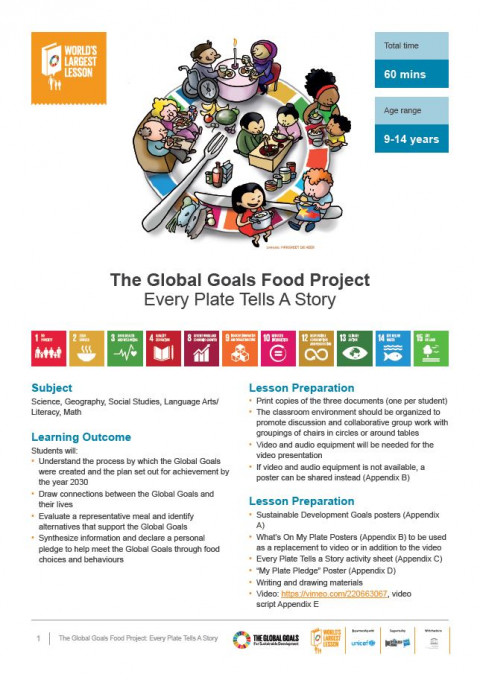 The Global Goals Food Project: Every Plate Tells a Story 出版年份: 2017 机构作者: World’s Largest Lesson This lesson plan, “Every Plate Tells a Story,” provides a guided activity for teachers and students to work together in efforts to bring the Global Goals to classrooms and learning.The lesson begins by broadly introducing the term “goal” and invites students to make personal connections to people, places, and environments by considering goals in their lives. Learners build knowledge as they integrate understanding of the Global Goals and the processes in which they were designed.During the lesson, students will engage in a process of inquiry through dialogue, collaboration, and research and will establish concrete realizations of the sustainability of the food they eat. Multiple sources of evidence/formative assessments can be used throughout the lesson to document learning, guide conversation, and inform future instruction.
  [Video] Citizenship and Human Rights Education for Change 出版年份: 2019 机构作者: Global Campus of Human Rights In increasingly selective, violent and intolerant times, it becomes crucial to reinforce our capacities to deal with topical, controversial and contested issues undermining our human dignity and to promote the supportive values of non-discrimination, democracy, intercultural dialogue and peace. Teaching and learning about democratic citizenship, human rights and EU common values represents an opportunity to react and counter the negative forces of our time.This MOOC aims to foster the promotion of Human Rights Education and EU common values through the transfer of knowledge about the definitions, frameworks and content of Human Rights Education as well as the analysis of existing and innovative practices on teaching styles, approaches and methods.
  Programme d’éducation à la citoyenneté mondiale (PÉCM) 出版年份: 2018 机构作者: Ministère des Relations internationales et de la Francophonie La solidarité est l’un des volets prioritaires de la Politique internationale du Québec. Le PECM favorise une action cohérente et renforce le rayonnement international des actions du gouvernement du Québec en solidarité internationale.Il appuie les organismes de coopération internationale (OCI) et leurs activités d’ECM visant à sensibiliser le public québécois aux Objectifs de développement durable (ODD) et à la solidarité internationale, tout en favorisant l’acquisition de connaissances, de valeurs et de comportements qui contribuent à la mise en place d’un monde plus juste, durable et équitable.
  Éducation à la citoyenneté et à la solidarité internationale en classe de seconde : Guide pédagogique à l’usage des enseignants de sciences économiques et sociales dans le cadre d’un enseignement d’exploration 出版年份: 2016 作者: Denis Bousquet | Hugo Cassagnaud | Benjamin Leger | Agathe Procar 机构作者: Bourgogne Coopération L’éducation met aujourd'hui de plus en plus l’accent sur les valeurs, les attitudes et les compétences des élèves, complétant ainsi une approche fondée sur l'acquisition de connaissances et le développement de capacités cognitives. Partout, dans les institutions, les collectivités locales, les établissements scolaires ou les associations, une attention grandissante est donnée à la compréhension et à la résolution des problèmes mondiaux, qu'ils soient sociopolitiques, économiques, environnementaux ou culturels.Dans ce contexte, l'éducation apparaît comme l'un des piliers du développement des sociétés contemporaines, globalisées et interdépendantes, garant de la promotion des droits de l'homme, de la cohésion sociale ou encore du succès de la lutte contre le réchauffement climatique.Ce guide pédagogique présente le contenu détaillé d'un enseignement dédié à l'éducation à citoyenneté et à la solidarité internationale (ECSI) proposé initialement au lycée Hilaire de Chardonnet de Chalon-sur-Saône.Il s'appuie sur le programme national de l'enseignement d'exploration de sciences économiques et sociales proposé en classe de seconde. Enseigné aux moyens de méthodes spécifiques, il est enrichi par de nombreux outils, ressources et témoignages de chercheurs, de professionnels, de responsables associatifs et d'enseignants.Principalement à destination des enseignants en sciences économiques et sociales, ce guide s'adresse également à tous les enseignants du secondaire qui souhaitent aborder de nouvelles thématiques. Acteurs associatifs, responsables institutionnels ou élus locaux y trouveront une initiative inspirante pour promouvoir l'ouverture au monde et à la citoyenneté.
  Didactique de l’éducation à la citoyenneté 出版年份: 2016 机构作者: Haute école pédagogique Vaud L’UER Didactiques des sciences humaines de la HEP Vaud assure l’enseignement et la recherche liés à la didactique de l’éducation à la citoyenneté.Comment concevoir une éducation à la citoyenneté pour tous les élèves, quelles que soient leurs origines et leurs nationalités ? Longtemps limitée à la connaissance des institutions politiques et de leur fonctionnement, l’éducation à la citoyenneté invite aujourd’hui également à former les élèves aux pratiques participatives et délibératives constitutives d’une démocratie. Introduite à l’origine sous le terme d’instruction civique et centrée sur la connaissance des institutions politiques comme principal moteur d’insertion dans la collectivité nationale, l’éducation à la citoyenneté est aujourd’hui bien plus conçue, dans les plans d’études, comme une éducation au pouvoir (son fonctionnement, son exercice) et aux pratiques délibératives. Dans le contexte politique et économique actuel, il semble en effet de moins en moins pertinent d’enseigner une citoyenneté figée autour de règles préétablies et visant l’insertion dans une seule communauté d’appartenance.
  Éducation à la citoyenneté 3e année (Ressources pour l’éducation à la citoyenneté : L’enseignement intentionnel et direct des compétences essentielles à la citoyenneté) 机构作者: Concentus Fondation pour L'education a la citoyennete Les citoyens engagés remettent en question, examinent de manière critique, soutiennent et défendent les droits et responsabilités d’une démocratie sur des plans multiples. Ils travaillent à comprendre les problèmes, dissimulés ou manifestes, qui relèvent des enjeux de la citoyenneté et d’élaborer les plans d’action appropriés pour y apporter des solutions. Ils développent aussi leur compréhension des avantages et de la richesse que la diversité et le multiculturalisme apportent aux Canadiens.Les citoyens engagés s’efforcent d’aborder les questions depuis une variété de points de vue. Les élèves vont commencer à explorer les méthodes de résolution des conflits et à examiner et à pratiquer les actions qui contribuent à la paix et à l’ordre. L’exploration du raisonnement critique dans ce domaine de la citoyenneté encourage les élèves à essayer de comprendre un point de vue différent du leur.
 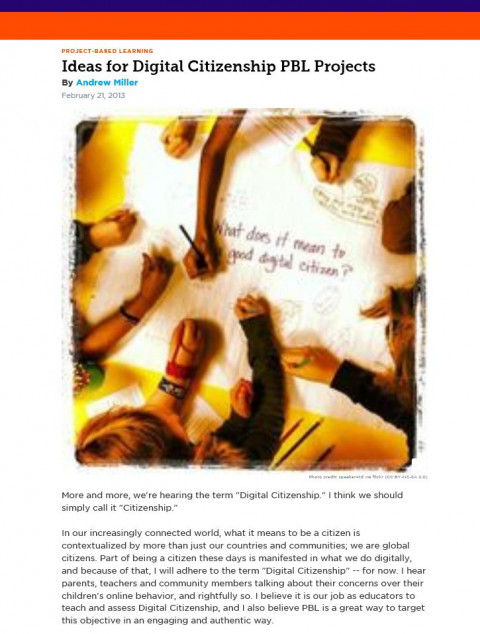 Ideas for Digital Citizenship PBL Projects 出版年份: 2013 作者: Andrew Miller In our increasingly connected world, what it means to be a citizen is contextualized by more than just our countries and communities; we are global citizens. Part of being a citizen these days is manifested in what we do digitally, and because of that, I will adhere to the term "Digital Citizenship" -- for now. I hear parents, teachers and community members talking about their concerns over their children's online behavior, and rightfully so. I believe it is our job as educators to teach and assess Digital Citizenship, and I also believe PBL is a great way to target this objective in an engaging and authentic way.
  Media and Information Literacy for the Sustainable Development Goals (The MILID Yearbook 2015) 出版年份: 2015 作者: Jagtar Singh | Alton Grizzle | Sin Joan Yee | Sherri Hope Culver 机构作者: International Clearinghouse on Children, Youth and Media (Sweden) In the year 2000, governments and development partners all over the world agreed on eight global development targets called the Millennium Development Goals (MDGs). The year 2015 is a pivotal year as it marks the end of the period during which the MDGs were to be reached and the year in which new global development targets are to be set. These new targets are referred to as the Post-2015 Sustainable Development Goals (SDGs). This process is in its highest gear with ongoing debates and consultative meetings/initiatives globally both online and offline. While much progress has been made, achievement of the MDGs has been mixed across countries. The centrality of information and communication to development is irrefutable. The MILID Yearbook provides a case for media and information literacy (MIL) as a tool for open and inclusive sustainable development.The 2015 edition of the MILID Yearbook displays how media and information literacy can be helpful in facilitating progress and achievement of the sustainable development goals. It is sincerely hoped that the articles in this yearbook will go a long way to sensitize the stakeholders about the role and value of MIL in sustainable development of one and all across frontiers.