
相关资源
探索丰富的全球公民教育资源,深化理解,促进研究、倡导、教学与学习。
共找到1,405条结果
 Working knowledge: symbiosis of programmes in science teaching, environmental education, and technical and vocational education 出版年份: 2006 作者: Saif R. Samady 机构作者: UNESCO UNESCO’s work in science teaching began shortly after the Organization was established. After the Second World War, many schools in Europe were in great need of science equipment. To meet this need, the Organization sponsored the publication of a small volume entitled Suggestions for Science Teachers in Devastated Countries. The book was further developed to include a wide range of guidelines for simple equipment and science experiments and published in 1956 as the UNESCO Source Book for Science Teaching. Over the years, the Source Book was revised several times and translated into more than twenty-five languages. During five decades, the Organization promoted worldwide exchange of information and innovations in science education and assisted many Member States, especially the developing countries, in setting up science teacher training programmes, curriculum development centres, and projects for design and development of science equipment. Education pour le développement durable: bonnes pratiques en matière de changement climatique 出版年份: 2012 机构作者: UNESCO Since the beginning of the UN Decade of Education for Sustainable Development (DESD, 2005-2014), the DESD Secretariat at UNESCO Headquarters in Paris has received numerous requests for case studies and descriptions of good practices in Education for Sustainable Development (ESD). These requests have increasingly included issues of providing an educational response to climate change. The increasing number of requests is only one indicator that climate change education is increasingly recognized in the broader education community as an essential part of ESD and life-long learning. ESD is a complex and evolving subject, and how it is applied and implemented is a challenge for all countries. The Decade aims to see ESD implemented in thousands of local situations on the ground, involving its integration into a multitude of different learning situations. These initiatives can be catalysts for action and contribute to the goals and objectives of the Decade. In such ways, organizations, local communities and individuals can be actors within the global movement for sustainable development. To support the growing interest in climate change issues and ESD, UNESCO is publishing this volume containing 17 examples of programmes addressing climate change in ESD settings and practices. These good practices and shared experiences, which were provided by a range of different stakeholders, are concrete examples of successful implementation of ESD in different fields and sectors, from the political to the school level, and including formal, nonformal and informal learning situations. Education for sustainable development: good practices in addressing climate change 出版年份: 2012 机构作者: UNESCO Since the beginning of the UN Decade of Education for Sustainable Development (DESD, 2005-2014), the DESD Secretariat at UNESCO Headquarters in Paris has received numerous requests for case studies and descriptions of good practices in Education for Sustainable Development (ESD). These requests have increasingly included issues of providing an educational response to climate change. The increasing number of requests is only one indicator that climate change education is increasingly recognized in the broader education community as an essential part of ESD and life-long learning. ESD is a complex and evolving subject, and how it is applied and implemented is a challenge for all countries. The Decade aims to see ESD implemented in thousands of local situations on the ground, involving its integration into a multitude of different learning situations. These initiatives can be catalysts for action and contribute to the goals and objectives of the Decade. In such ways, organizations, local communities and individuals can be actors within the global movement for sustainable development. To support the growing interest in climate change issues and ESD, UNESCO is publishing this volume containing 17 examples of programmes addressing climate change in ESD settings and practices. These good practices and shared experiences, which were provided by a range of different stakeholders, are concrete examples of successful implementation of ESD in different fields and sectors, from the political to the school level, and including formal, nonformal and informal learning situations. International implementation scheme for the UN decade of education for sustainable development, 2005-2014 出版年份: 2005 机构作者: UNESCO In December 2002, the UN General Assembly adopted a resolution to put in place a UN Decade of Education for Sustainable Development, lasting from 2005 to 2014. UNESCO was tasked with leading the Decade and developing an International Implementation Scheme (IIS). Decenio de las Naciones Unidas de la educación para el desarrollo sostenible (2005-2014): plan de aplicación internacional 出版年份: 2005 机构作者: UNESCO The International Implementation Scheme (IIS) sets out a broad framework for all partners to contribute to the Decade. It is a strategic document that focuses primarily on what nations have committed to achieve through the DESD and under UNESCO’s leadership. It summarizes the goals and objectives of the Decade, and its relationship to other key education movements. It emphasizes the importance of partnership in the eventual success of the Decade and outlines how these might contribute at all levels – community, national, regional, and international. It outlines UNESCO’s leadership tasks. The IIS also lists key milestones for the DESD. It then lays out seven strategies for moving forward with ESD and describes how this wide range of partners can develop contributions based on their particular contexts. Those not familiar with the background of the Decade or Education for Sustainable Development are referred to Annex I of this document, which provides a succinct summary of key trends as well as other important background information. The IIS should foster collective ownership of the DESD. The IIS describes pathways forward in the hope that it will stimulate imagination, creativity, and energy to make the DESD a success. It is envisaged that regions and nations will create plans, strategic approaches, and timetables on the basis of the framework provided by this International Implementation Scheme. Décennie des Nations Unies pour l'éducation en vue du développement durable (2005-2014): plan international de mise en oeuvre 出版年份: 2005 机构作者: UNESCO The International Implementation Scheme (IIS) sets out a broad framework for all partners to contribute to the Decade. It is a strategic document that focuses primarily on what nations have committed to achieve through the DESD and under UNESCO’s leadership. It summarizes the goals and objectives of the Decade, and its relationship to other key education movements. It emphasizes the importance of partnership in the eventual success of the Decade and outlines how these might contribute at all levels – community, national, regional, and international. It outlines UNESCO’s leadership tasks. The IIS also lists key milestones for the DESD. It then lays out seven strategies for moving forward with ESD and describes how this wide range of partners can develop contributions based on their particular contexts. Those not familiar with the background of the Decade or Education for Sustainable Development are referred to Annex I of this document, which provides a succinct summary of key trends as well as other important background information. The IIS should foster collective ownership of the DESD. The IIS describes pathways forward in the hope that it will stimulate imagination, creativity, and energy to make the DESD a success. It is envisaged that regions and nations will create plans, strategic approaches, and timetables on the basis of the framework provided by this International Implementation Scheme.
  United Nations decade of education for sustainable development (2005-2014): international implementation scheme 出版年份: 2005 机构作者: UNESCO The International Implementation Scheme (IIS) sets out a broad framework for all partners to contribute to the Decade. It is a strategic document that focuses primarily on what nations have committed to achieve through the DESD and under UNESCO’s leadership. It summarizes the goals and objectives of the Decade, and its relationship to other key education movements. It emphasizes the importance of partnership in the eventual success of the Decade and outlines how these might contribute at all levels – community, national, regional, and international. It outlines UNESCO’s leadership tasks. The IIS also lists key milestones for the DESD. It then lays out seven strategies for moving forward with ESD and describes how this wide range of partners can develop contributions based on their particular contexts. Those not familiar with the background of the Decade or Education for Sustainable Development are referred to Annex I of this document, which provides a succinct summary of key trends as well as other important background information. The IIS should foster collective ownership of the DESD. The IIS describes pathways forward in the hope that it will stimulate imagination, creativity, and energy to make the DESD a success. It is envisaged that regions and nations will create plans, strategic approaches, and timetables on the basis of the framework provided by this International Implementation Scheme.
  Reaching the Unreached: Indigenous Intercultural Bilingual Education in Latin America 出版年份: 2009 作者: Luis Enrique López 机构作者: UNESCO The paper focuses on the educational situation of the most marginalized children and adolescents in Latin America: those belonging to indigenous homes and communities. To illustrate indigenous marginalization and exclusion as well as the development of intercultural bilingual education (IBE) six countries have been chosen: Bolivia, Ecuador, Guatemala, Mexico, Paraguay and Peru. Atteindre les exclus: indigène éducation interculturelle bilingue en Amérique latine 出版年份: 2009 作者: Luis Enrique López 机构作者: UNESCO Le document met l'aCECnt sur la situation de l'éducation des enfants les plus marginalisés et les adolescents en Amérique latine: ceux appartenant à des foyers et des communautés autochtones. Pour illustrer la marginalisation et l'exclusion des autochtones ainsi que le développement de l'éducation interculturelle bilingue (BIE) six pays ont été choisis: la Bolivie, l'Equateur, le Guatemala, le Mexique, le Paraguay et le Pérou.
 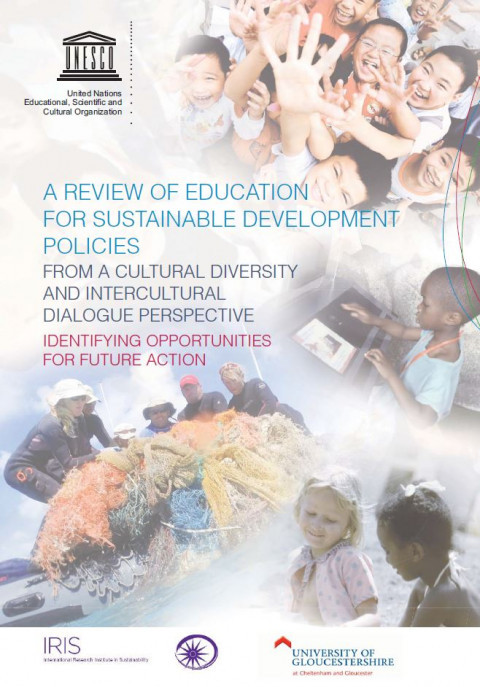 A Review of education for sustainable development policies from a cultural diversity and intercultural dialogue perspective: identifying opportunities for future action 出版年份: 2009 作者: Daniella Tilbury | I. Mulà 机构作者: UNESCO This review highlights the striking absence of culture in ESD, a gap also acknowledged by participants at the UNESCO World Conference on Education for Sustainable Development held in Bonn, Germany, from 31 March to 2 April 2009. The final declaration emphasizes that ESD is about 'creative and critical approaches, long-term thinking, innovation and empowerment for dealing with uncertainty', and for solving complex problems, highlighting in particular the interdependence of environment, economy, society, and cultural diversity from local to global levels. The review and its methodology provide an instructive example of ways to articulate the linkages between cultural diversity, intercultural dialogue and ESD, required for a sustainable future.