
相关资源
探索丰富的全球公民教育资源,深化理解,促进研究、倡导、教学与学习。
共找到93条结果
 Essentials of Dialogue: Guidance and Activities for Teaching and Practising Dialogue with Young People 出版年份: 2017 机构作者: Generation Global Essentials of Dialogue is a teaching resource filled with activities for use in learning communities to build the core skills of dialogue and is foundational for any curriculum or programme centred around global citizenship and intercultural communication.Each chapter includes both theory and practical activities to help explore, develop, and practise dialogue. The resource is free to use all over the world.
 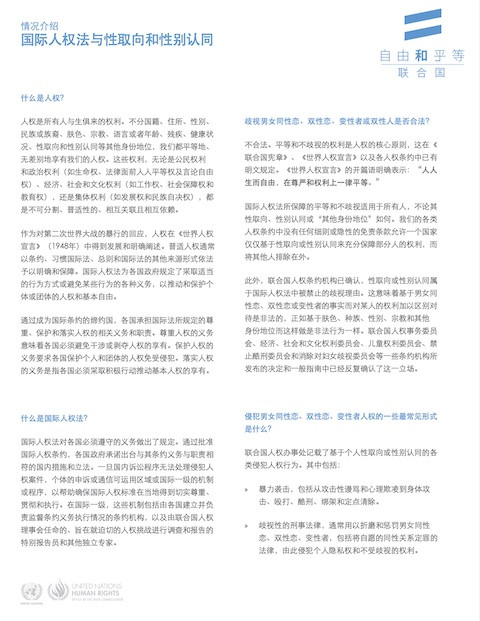 国际人权法与性取向和性别认同 出版年份: 2017 机构作者: UN. Office of the United Nations High Commissioner for Human Rights (UN. OHCHR) | United Nations Free & Equal 什么是人权?什么是国际人权法?歧视男女同性恋、双性恋、变性者或双性人是否合法?侵犯男女同性恋、双性恋、变性者人权的一些最常见形式是什么?联合国大会及人权事务委员会对该主题有何表述?各国在尊重男女同性恋、双性恋和变性者方面有哪些法律义务?
  The Digital Skills Toolkit 2018 出版年份: 2018 作者: Chris Coward 机构作者: International Telecommunication Union (ITU) This toolkit provides stakeholders with guidance on developing a digital skills strategy. It is intended for policymakers, along with partners in the private sector, non-governmental organizations, and academia. Its overarching aim is to facilitate the development of a comprehensive digital skills strategy at country level. It is also possible to use this guide to focus on selected priorities that require a fresh approach.
 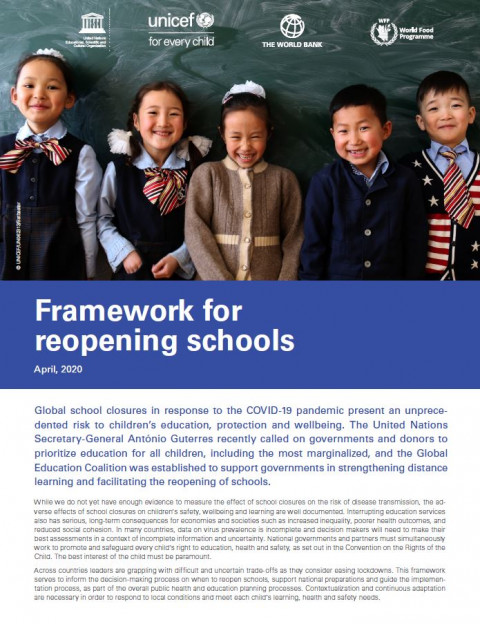 Framework for Reopening Schools; April, 2020 出版年份: 2020 机构作者: UNESCO | United Nations Children's Fund (UNICEF) | World Bank | World Food Programme By late April, nationwide school closures were still disrupting the learning of more than 73 per cent of students, or more than 1.2 billion children and youth. When deciding whether to reopen schools, authorities should look at the benefits and risks across education, public health and socio-economic factors, in the local context, using the best available evidence. The best interest of every child should be paramount.The guidelines aim to inform the decision-making process regarding school reopening, support national preparations and guide the implementation process, as part of overall public health and education planning processes. It is designed to be a flexible tool that can be adapted to each context and updated as the situation changes. The guidelines outline six key priorities to assess the readiness of those schools and inform planning.
  Global Citizenship Concepts in the Curricula of Four Countries 出版年份: 2017 作者: Natalie Browes 机构作者: UNESCO International Bureau of Education (IBE) | APCEIU This report details the presence of Global Citizenship Education (GCED) concepts in the education systems of four countries: Cambodia, Colombia, Mongolia and Uganda. It highlights the main findings of eight reports: four expert reports, which predominately analyse curriculum content, and four situational analysis reports, which take a broader view and detail some of the country-specific challenges and opportunities with regard to GCED. Findings reveal the presence of GCED concepts across the curricula of the four countries. In addition to cognitive content related to GCED, competency-based content is also found present within the curricula of these countries. However, the majority of this content can only be indirectly linked to GCED, and it is better interpreted as part of the more traditional civics or citizenship education approach. As such, it generally lacks a global perspective and does not engage with all key themes of GCED. Furthermore, this content is often concentrated at the lower and upper secondary levels, instead of being equally distributed across all grade levels. This is particularly true in the case of behaviour-based competencies. Findings also reveal challenges beyond the curriculum. These include lack of teacher training and lack of support to implement GCED, which are concerns expressed by stakeholders in all four countries. A lack of GCED content in textbooks and lack of supplementary materials were also found to be issues. The report concludes with recommendations regarding the effective implementation of GCED within curricula. Among others, the report suggests the transversal integration of GCED - across the curriculum at all grade levels, while at the same time, actors from all levels of the education system, ranging from central government to teachers, should be engaged to ensure the use of complementary learning materials, pedagogies and assessment techniques.
 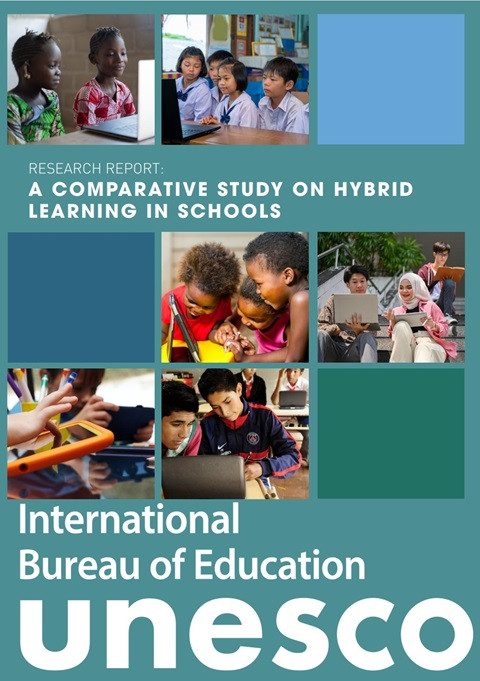 Research Report: A Comparative Study on Hybrid Learning in Schools 出版年份: 2024 机构作者: UNESCO International Bureau of Education (IBE) During the COVID-19 lockdown, policymakers and educators faced an unprecedented challenge disrupting all levels of education. The initial optimism about replacing physical classes with virtual lessons diminished as complex interconnected issues emerged. To address the need for continuous and sustainable learning, school systems implemented variations of hybrid learning during the pandemic, seeking to integrate physical and virtual classes. These approaches prompted this comparative study led by UNESCO-IBE. The initial phase of this study involved collecting and analysing data on hybrid strategies from six countries. The research aimed to examine factors influencing hybrid learning implementation during the lockdown, with a subsequent focus on developing and validating a practical Hybrid Learning Framework for Schools. The cross-case analysis was designed not to rank or compare, but to understand and connect different scenarios and contexts. Phase I focuses on current hybrid learning practices and influencing factors, while Phases II and III will concentrate on using the information gathered to create and validate a Hybrid Learning Framework for Schools. Aligned with UNESCO-IBE’s overarching vision of a comprehensive, personalized, and democratized curriculum accessible to all, hybrid learning facilitates inclusive education across diverse regions, overcoming geographical and temporal limitations. The approach aims to unlock the unique potential of every learner, fostering a more flexible educational environment.
 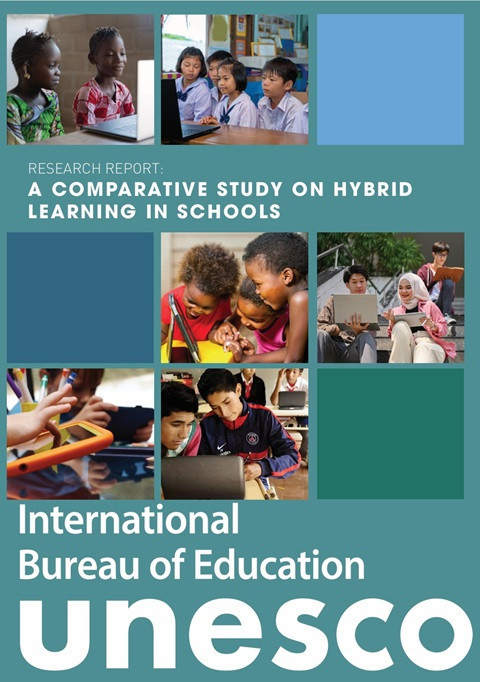 Research Report: A Comparative Study on Hybrid Learning in Schools 出版年份: 2024 机构作者: UNESCO International Bureau of Education (IBE) During the COVID-19 lockdown, policymakers and educators faced an unprecedented challenge disrupting all levels of education. The initial optimism about replacing physical classes with virtual lessons diminished as complex interconnected issues emerged. To address the need for continuous and sustainable learning, school systems implemented variations of hybrid learning during the pandemic, seeking to integrate physical and virtual classes. These approaches prompted this comparative study led by UNESCO-IBE. The initial phase of this study involved collecting and analysing data on hybrid strategies from six countries. The research aimed to examine factors influencing hybrid learning implementation during the lockdown, with a subsequent focus on developing and validating a practical Hybrid Learning Framework for Schools. The cross-case analysis was designed not to rank or compare, but to understand and connect different scenarios and contexts. Phase I focuses on current hybrid learning practices and influencing factors, while Phases II and III will concentrate on using the information gathered to create and validate a Hybrid Learning Framework for Schools. Hybrid learning is not just a response to pandemics but also serves as a viable solution for other scenarios where full school attendance is difficult. Aligned with UNESCO-IBE’s overarching vision of a comprehensive, personalized, and democratized curriculum accessible to all, hybrid learning facilitates inclusive education across diverse regions, overcoming geographical and temporal limitations. The approach aims to unlock the unique potential of every learner, fostering a more flexible educational environment.Published in February 2024 by the UNESCO International Bureau of Education (IBE) with support from the European Union.
 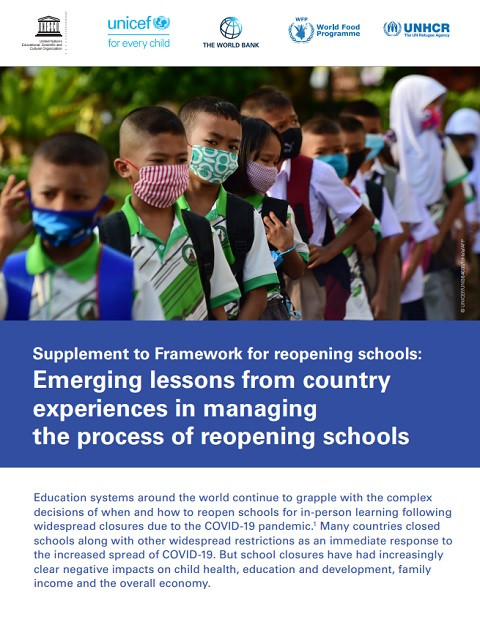 Supplement to Framework for Reopening Schools: Emerging Lessons From Country Experiences in Managing the Process of Reopening Schools 出版年份: 2020 机构作者: UNESCO | United Nations Children's Fund (UNICEF) | World Bank | World Food Programme | UN. Office of the United Nations High Commissioner for Refugees (UNHCR) Education systems around the world continue to grapple with the complex decisions of when and how to reopen schools for in-person learning following widespread closures due to the COVID 19 pandemic. This supplement to the Framework for reopening schools, originally published jointly by UNICEF, UNESCO, the World Bank, the World Food Programme, and the UN Refugee Agency (UNHCR) in April 2020, summarizes emerging lessons learnt over the past months.The supplement follows the four main dimensions of the Framework (safe operations, focus on learning, wellbeing & protection, and reaching the most marginalized) and highlighting a number of country examples.
  Global Gender Gap Report 2021: Insight Report, March 2021 出版年份: 2021 机构作者: World Economic Forum The report is a measure of gender gap on four parameters: economic participation and opportunity, educational attainment, health and survival, and political empowerment. The index has benchmarked 156 nations across the globe in 2021. The data show that it will take 135.6 years to bridge the gender gap worldwide and the pandemic has impacted women more severely than men. The gap is the widest on the political empowerment dimension with economic participation and opportunity being next in line. However, the gap on educational attainment and health and survival has been practically bridged.
  Preparing teachers for inclusive education in Latin America (Prospect: quarterly review of comparative education) 出版年份: 2011 作者: Denise Vaillant 机构作者: UNESCO International Bureau of Education (IBE) This article analyzes the current challenges facing inclusive education in Latin America and explores some possible solutions. The author suggests that teachers play a key role in providing education that is inclusive for all. In Latin America, today, however, inclusive education often does not respond to the needs of children and young people, and teachers often finish their professional training without acquiring the skills they need to work with children and young people living in difficult circumstances. Teachers also need incentives to work in remote or difficult geographical areas, and they benefit from national efforts to improve their status, including awards for innovative work. Much remains to be done, but the training of teachers for a more inclusive education system is gradually being incorporated as part of the educational policy agenda in Latin America.