
相关资源
探索丰富的全球公民教育资源,深化理解,促进研究、倡导、教学与学习。
共找到2,199条结果
 An Examination of the Ideas of Contemporary World Citizenship Education 出版年份: 2003 作者: Zhao Hui In order to grasp the ideas of contemporary world citizenship education, first of all, fundamental value orientation of citizenship education must be grasped in the tensions between nationalism and democracy; Secondly, new trend of nationalism and its influences on citizenship education under the background of globalization must be understood; and thirdly the new trends of the ideas of citizenship education must be put forward and understood in the disputes between liberalism(or neoliberalism) and republicanism(or communitarianism).
  Fostering Digital Citizenship through Safe and Responsible Use of ICT: A Review of Current Status in Asia and the Pacific as of December 2014 出版年份: 2015 机构作者: UNESCO Bangkok The publication examines various interventions to address issues concerning cybersafety, rights, and wellness. It provides a synthesis of various policy responses, programmes, and initiatives implemented by governments, international organizations, civil society, and the private sector.The report ends with a preliminary set of recommendations with regards to policy, research, education, and partnerships. It is hoped that the report can provide an insight into the current status of digital citizenship in the region and consequently highlight the importance of maintaining a conscious balance of opportunities and risks when dealing with ICT.
  A Policy Review: Building Digital Citizenship in Asia-Pacific through Safe, Effective and Responsible Use of ICT 出版年份: 2016 机构作者: UNESCO Bangkok This report is a major output of the project. The policy review described in this report took stock of national policies in 22 Member States in the Asia-Pacific region and assessed the capacity of their education sectors to foster digital citizenship among children aged 0-18.It is encouraging to note from the study that surveyed Member States’ policies to promote ICT opportunities mature alongside policies that address potential risks, at varying levels of policy maturity. However, while the surveyed Member States recognize the importance of equipping children with ICT skills and providing basic infrastructure, the findings indicate that there is much to be done for young learners (e.g. early childhood education and lower primary education) in introducing the concept of safe, effective and responsible use of ICT to their national curriculum as well as to their teacher professional development programmes.
  Global Citizenship in the English Language Classroom 出版年份: 2008 作者: Susan Hillyard | Elena Tarasheva | Clarissa Jordão | Francisco Fogaça | Esperanza Revelo Jiménez | Sabiha Khuram | Telma Gimenez | Vanessa Andeotti 机构作者: British Council This booklet contains a collection of papers on global citizenship in language education around the world. It provides theoretical frameworks and practical applications in different contexts.Following on from Audrey Osler and Hugh Starkey’s 'Citizenship and Language Learning: international perspectives', published in 2005, this collection aims at offering ideas and practical suggestions on how teachers around the world have tackled the teaching of English within a citizenship education perspective. There are seven chapters, from authors working in different parts of the world, such as Argentina, Bulgaria, Brazil, Colombia, and Pakistan.There are five report style chapters that deal with courses, teaching materials, research and curriculum innovation. The two remaining contributions can be seen as proposals for implementation of a global citizenship perspective in English language classrooms.The diverse interpretations teachers of English around the world have been giving to the task of promoting global citizenship in their classrooms are reflected in this collection with understandings that range from a more prescriptive approach to a transformational one. They bring the potential for new approaches to be tried out in different contexts. The aim is to inspire teachers to experiment and evaluate the results.
 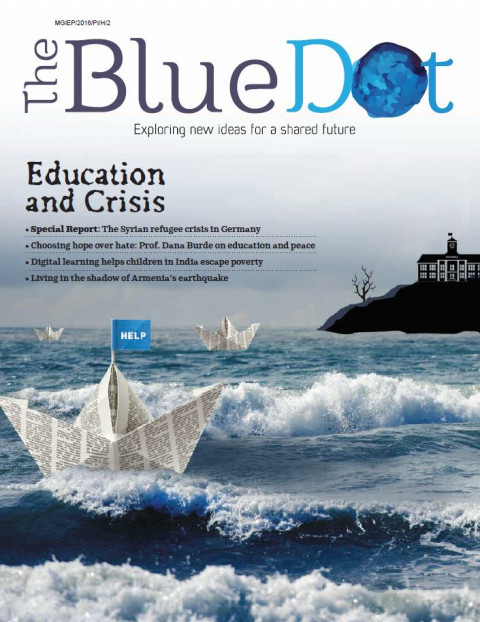 Education and Crisis (The Blue Dot Issue 3, 2016) 出版年份: 2016 机构作者: Mahatma Gandhi Institute of Education for Peace and Sustainable Development (MGIEP) In this third issue of The Blue Dot, we have chosen to focus on the often forgotten aspect of education in the context of crises. While relief efforts tend to focus on emergency responses such as providing food and shelter, more often than not rebuilding schools and ensuring that students continue to attend their classes are not considered priorities. At UNESCO MGIEP, we believe that when education is relegated to the side-lines, there is little hope for a country and its citizens to recover.In this issue, we have brought together expert contributors from academia and the field—from countries such as Afghanistan, Nepal and South Sudan—and have dedicated a large section to the ongoing civil conflict in Syria, which will soon enter its fifth year. With almost half of Syria’s population living as refugees or as internally displaced persons, an entire generation of young people risks losing out on stability and a better future. Our Syria Section explores how these young people, with a particular focus on those who have sought refuge in Germany, are faring and what their hopes are for the future.In other parts of the magazine, we focus on technology and on how modern information and communications technologies (ICTs) can help students access a better education. From impoverished communities in Calcutta using Skype to connect with teachers around the world, to new interactive platforms built for young people to discuss global issues, we hope the stories and experiences we have collected for our readers will give a new and fresh perspective on what it means for education when a crisis hits. We also hope that you enjoy our photo contest, which drew more than 100 entries from young people around the world on what “education and crisis” means to them.
 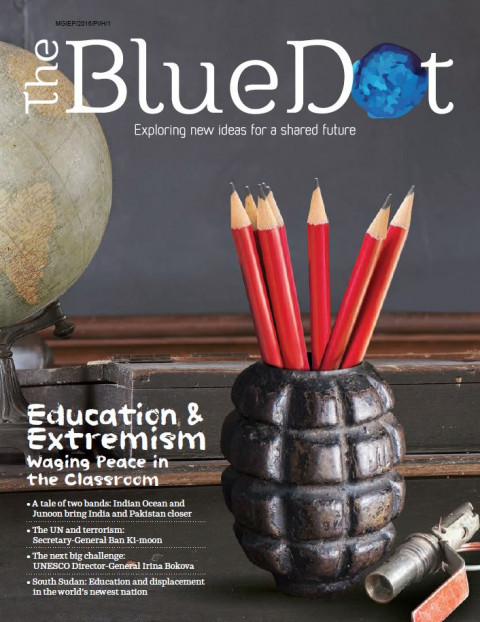 Education & Extremism: Waging Peace in the Classroom (The Blue Dot Issue 4, 2016) 出版年份: 2016 机构作者: Mahatma Gandhi Institute of Education for Peace and Sustainable Development (MGIEP) In this fourth issue of The Blue Dot, we have decided to focus on education as a tool for both preventing violent extremism and—sometimes—even propagating extremist ideologies. This issue reflects UNESCO MGIEP’s commitment to advancing the fundamental role of education as a means to changing mindsets and, ultimately, bringing about more peaceful societies.From an interview with award-winning social entrepreneur Prof. Sugata Mitra on the role of technology in revolutionizing education, to a foreword by Secretary-General Ban Ki-moon on the UN’s response to violent extremism, our contributors come from a host of different countries and backgrounds. What brings them together, however, is a call for changing current education systems. This is espoused even more clearly in a piece by Prof. K.P. Mohanan, who uses inquiry-driven approaches to prompt youth to question blind faith in any form of ideology or indoctrination.In this issue we also discuss UNESCO MGIEP’s activities in raising awareness of the strong link between education and radicalization and violent extremism, including our flagship Talking Across Generations (TAG) event which brought together policymakers and young people in an open discussion in Delhi this February. The outcome was a statement calling for greater inclusiveness and more space for young people to shape the policies that ultimately affect them.Just like our events, The Blue Dot is a platform for individuals from different backgrounds and walks of life who might have divergent ideologies, beliefs, and values, all of which may have prevented them from coming together to debate some of the most pressing issues of our time—including the global concern surrounding the rise in violent extremism. When individuals feel free to discuss, share ideas and question their beliefs, they can begin to think creatively and critically about the world and their surrounding environment. The challenge is to avoid lecturing or preaching to young people, but to provide youth with a safe space to discuss contentious issues in an open, inclusive and transparent manner.An open dialogue on violent extremism is a step towards providing young people with opportunities to ask questions and to reflect on their own beliefs, assumptions, and values, including animosities, prejudices, hatred and intolerance. At UNESCO MGIEP we believe that individuals who feel connected to others across political, religious or cultural divides also share a sense of responsibility for the world in which they live.
 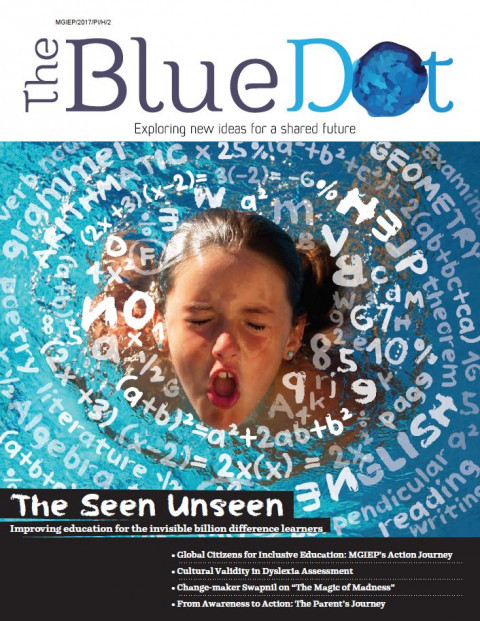 The Seen Unseen: Improving Education for the Invisible Billion Difference Learners (The Blue Dot Issue 5, 2017) 出版年份: 2017 机构作者: Mahatma Gandhi Institute of Education for Peace and Sustainable Development (MGIEP) MGIEP believes that addressing the needs of children with difference learning offers a unique opportunity to build the competency of understanding, respect and appreciation between the children and the rest of their peers in school.It provides the Institute favorable conditions to put in practice how inclusive education is a necessary condition for building peaceful and sustainable societies. Many of the Information Technology pedagogical tools developed by the Institute lend themselves to children with difference learning.Transforming the education system in such a manner will allow mainstream schools to provide a learning platform that breaks down barriers across learning types and provide the equitable access to education that is a fundamental Sustainable Development Goal.We are, in this issue of The Blue Dot, privileged to read from some of the world’s best experts on the subject describing the challenges at hand and suggesting ways and means of addressing the lacuna present in curricula and policy. As always, we dedicate a special section to reflecting the voices of young people in our discussion. I am especially honoured and delighted to present a foreword from a young entrepreneur who has not allowed his neurobiological dyslexic condition to prevent him from pursuing his dreams to help others.
  Moral Disengagement and Building Resilience to Violent Extremism: An Education Intervention 出版年份: 2014 作者: Anne Aly | Elisabeth Taylor | Saul Karnovsky 机构作者: Taylor & Francis This article reports on the development of an education intervention, the Beyond Bali Education Resource funded by the Australian Governments’ Building Community Resilience Grants of the Federal Attorney General's Department, that applies a conceptual framework grounded in moral disengagement theory. The theory of moral disengagement has been applied to the study of radicalization to violent extremism to explain how individuals can cognitively reconstruct the moral value of violence and carry out inhumane acts. Moral Disengagement and Building Resilience to Violent Extremism: An Education Intervention 出版年份: 2014 作者: Anne Aly | Elisabeth Taylor | Saul Karnovsky 机构作者: Taylor & Francis Dans cet article, il est question du développement d'une approche éducative, the « Beyond Bali Education Resource » financée par « l’Australian Governments’ Building Community Resilience Grants of the Federal Attorney General's Department ». Cette approche utilise un cadre conceptuel fondé sur la théorie du désengagement moral. La théorie du désengagement moral a été appliquée à l'étude de la radicalisation à l'extrémisme violent en vue d’expliquer comment les individus peuvent, du point de vue cognitif, reconsidérer la violence comme une valeur morale et commettre des actes inhumains.
 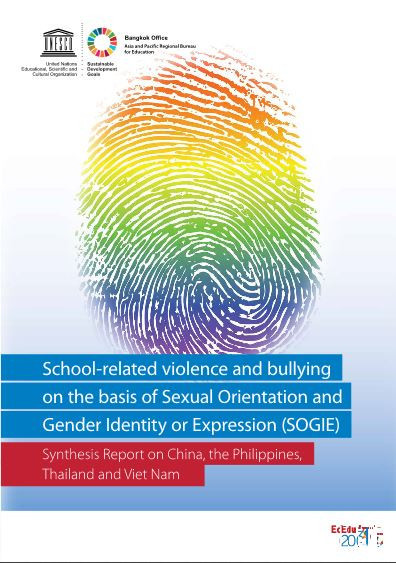 School-related violence and bullying on the basis of Sexual Orientation and Gender Identity or Expression (SOGIE) - Synthesis Report on China, the Philippines, Thailand and VietNam 出版年份: 2018 机构作者: UNESCO Bangkok School related violence and bullying is a problem in all countries. UNESCO is committed to ensuring that all children and young people have access to safe, inclusive, health-promoting learning environments as part of its strategy on education for health and well-being. This synthesis report on school related violence and bullying on the basis of Sexual Orientation and Gender Identity or Expression (SOGIE), covering China, the Philippines, Thailand and Viet Nam, was developed to broaden awareness and understanding about this issue, while also identifying best practices and policies. It also aims to mobilize support for advocacy among educators, research institutions, policy makers and activists at the national and regional levels.