
相关资源
探索丰富的全球公民教育资源,深化理解,促进研究、倡导、教学与学习。
共找到1,451条结果
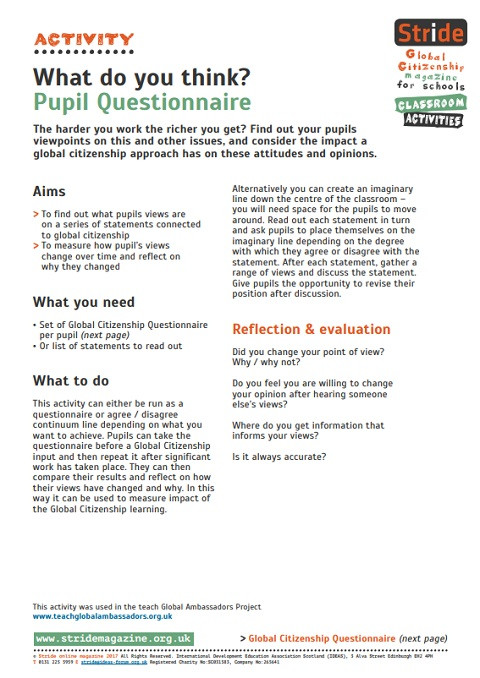 What Do You Think?: Pupil Questionnaire; Activity 出版年份: 2017 机构作者: Stride | International Development Education Association Scotland (IDEAS) This material aims to find out what pupils views are on a series of statements connected to global citizenship and to measure how pupil’s views change over time and reflect on why they changed.
  Tackling Controversial Issues in the Citizenship Classroom: A Resource for Citizenship Education 出版年份: 2012 作者: Lesley Emerson | Mary Gannon | Conor Harrison | Valerie Lewis | Anne-Marie Poynor 机构作者: City of Dublin Vocational Education Committee (CDVEC). Curriculum Development Unit | European Union (EU) The purpose of this resource is to provide teachers with the opportunity to reflect on a number of issues associated with teaching controversial issues in the classroom. It offers a practical approach which allows students to explore controversial issues which arise in citizenship and other areas of the curriculum in a way which is safe for both teacher and students.
  Intercultural Multilingual Education in Latin America: Mexico, Guatemala, Colombia, Brazil, Ecuador, Peru, Bolivia and Paraguay, and Norway 出版年份: 2011 机构作者: Internacional de la Educación para Latinoamerica This document deals with Intercultural Bilingual Education (IBE), its current status and the concepts and processes driving it today – and in a certain way the conflicts encompassing it. It contains information on Mexico, Guatemala, Colombia, Brazil, Ecuador, Peru, Bolivia and Paraguay, and includes some data and comments on Norway. Certainly all Latin America is involved in the topic, one way or another, but for now this is the geographical scope of the paper. It seeks to give an overview of the whole and profile a few specific aspects by country.
  Equality & Diversity: Building a Culture of Equality in Our Society; A Citizenship Education Resource for Transition Year and Key Stage 4 出版年份: 2012 作者: Mary Gannon | Aoife Ruane-Kelly 机构作者: City of Dublin Vocational Education Committee (CDVEC). Curriculum Development Unit | Centre for Cross Border Studies This resource is intended to support young people in critically exploring the concepts of equality and diversity and in acting to build a culture of equality within their own environment and within society. Looking specifically at equality and diversity within the school, community and society, the resource provides an opportunity for students to increase their knowledge and understanding of equality, develop the skills to critically analyse inequality, and become empowered to actively promote equality within their school and/or community.The resource is intended primarily for use in Citizenship Education in Transition Year (Ireland) and Key Stage 4 (Northern Ireland). As a resource on equality and diversity, it is clearly based on human rights, which underpin the citizenship curricula in both jurisdictions. It meets the aims of the KS 4 curriculum for Local and Global Citizenship by helping students:Respond to the specific challenges and opportunities which diversity and inclusion present in Northern Ireland and the wider worldIdentify and exercise their rights and social responsibilities in relation to local, national and global issuesDevelop their understanding of the role of society and government in safeguarding individual and collective rights in order to promote equality and to ensure that everyone is treated fairlyDevelop their understanding of how to participate in a range of democratic processesDevelop awareness of key democratic institutions and their role in promoting inclusion, justice and democracy.
  Adult Learning and Gender: EAEA Background Paper 出版年份: 2020 作者: Agatha Devlin 机构作者: European Association for the Education of Adults (EAEA) Gender sensitivity in adult learning and education (ALE) is about more than trying to improve targeted outreach programmes for men and women who seem to be slipping through the gaps. By providing gender sensitive education opportunities, people are not only more likely to engage but also more likely to get the most out of their experiences. This background paper explores the problems that gender sensitive adult education could attempt to solve, good practices and examples to help make current structures more gender sensitive, and the wider benefits of gender sensitivity in ALE.This background paper takes various subtopics or examples of gender sensitivity in adult education and analyses them as individual areas, making its content easier to navigate according to the reader’s interests or concerns.
 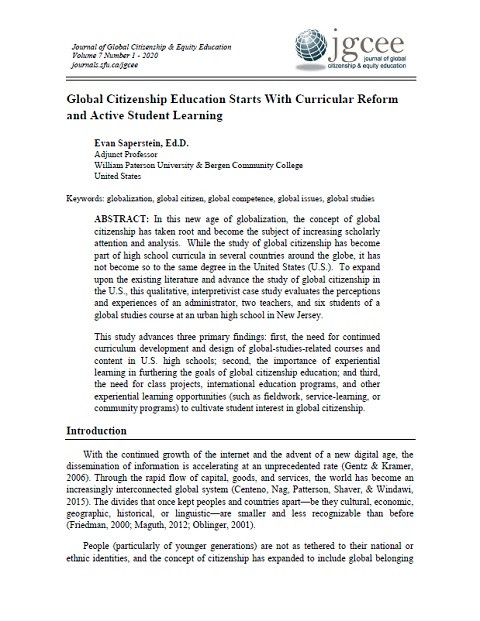 Global Citizenship Education Starts With Curricular Reform and Active Student Learning (Journal of Global Citizenship & Equity Education; Vol. 7, No. 1) 出版年份: 2020 作者: Evan Saperstein 机构作者: Centennial College In this new age of globalization, the concept of global citizenship has taken root and become the subject of increasing scholarly attention and analysis. While the study of global citizenship has become part of high school curricula in several countries across the globe, it has not to the same degree in the United States. To expand upon the existing literature and advance the study of global citizenship in the United States, this qualitative, interpretivist case study evaluates the perceptions and experiences of an administrator, two teachers, and six students of a global studies course at an urban high school in New Jersey. The study included interviews of the participants, as well as analysis of the course curriculum, syllabus, and student assignments.This study advances three primary findings. First, the need for continued curriculum development and design of global studies related courses and content in U.S. high schools. Second, the importance of experiential learning, among other forms of pedagogy and instructional practices, in furthering the goals of global citizenship education. Third, the need for class projects, international education programs, and other experiential learning opportunities (such as fieldwork, service-learning, or community programs) to cultivate student interest in global citizenship. Based on these findings and the prevailing literature, this study is proposing that U.S. high schools offer an elective course on global citizenship with ten units: 1) Introduction to Global Citizenship; 2) Sustainable Development; 3) Poverty and World Hunger; 4) Global Health Issues; 5) Child Mortality; 6) Peace and Conflict; 7) Human Rights and Gender Equality; 8) Universal Education; 9) Liberal Democratic Governance and Rights; 10) Global Citizenship Action Plan.
 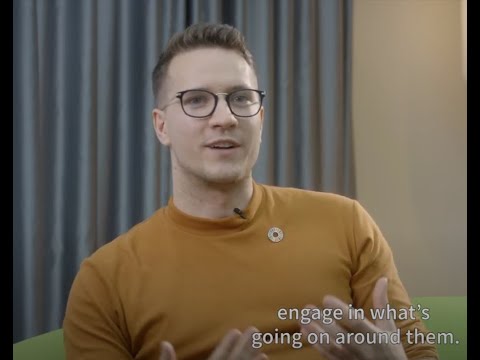 Why Is Target 4.7 So Important to the Sdgs? With Paul Bradley, SCVO 出版年份: 2020 作者: Paul Bradley 机构作者: Bridge 47 In this Bridge 47 Network Story, Paul Bradley of The Scottish Council for Voluntary Organizations eloquently talks about why Target 4.7 and Global Citizenship Education is crucial to Achieving the United Nations's SDGs (Sustainable Development Goals).
 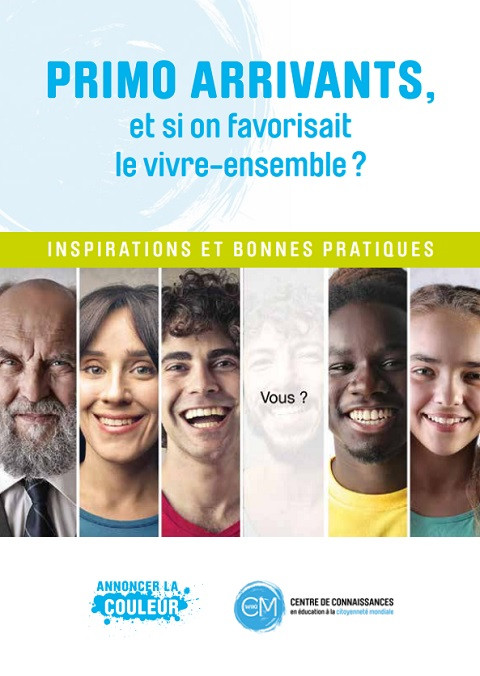 Primo arrivants, et si on favorisait le vivre-ensemble: Inspirations et bonnes pratiques 出版年份: 2018 机构作者: Annoncer la Couleur (ALC) | Centre de Connaissances en Éducation à la Citoyenneté Mondiale (WikiCM) Depuis plusieurs années, Annoncer la Couleur soutient des projets qui ont pour objectif de favoriser le vivre-ensemble dans les écoles avec des primo-arrivants. Ces projets, créés dans des contextes multiples et variés, nous ont questionné sur le rôle que joue l’éducation à la citoyenneté mondiale dans l’intégration des élèves. À travers cette publication, nous souhaitons vous présenter le fruit de la réflexion menée lors de la journée d’échanges et d’inspiration qui s’est déroulée le vendredi 12 octobre 2018 à Namur autour de la thématique « Primo-arrivants à l’école : et si on favorisait le vivreensemble ? » Lors de celle-ci, nous avons rassemblé des spécialistes et des enseignant∙e∙s porteur∙euse∙s de projets pour réfléchir et questionner la place des projets d’éducation à la citoyenneté mondiale face à ce défi toujours plus grand d’ouverture et d’acceptation des différences. L’ensemble des interventions, témoignages et échanges sont venus éclairer et enrichir nos pratiques de projets dans ce contexte d’intégration des primo-arrivants. Cette journée nous a confirmé que l’éducation à la citoyenneté mondiale peut être un levier pour favoriser le vivre-ensemble dans les écoles avec des élèves primo-arrivants (en DASPA ou non). Au sein de cet ouvrage, vous trouverez les articles tirés des interventions de Martine AbdellahPretceille « Éducation interculturelle et éducation la citoyenneté » et de Danièle Crutzen et Ahmed Talbi « Discours directs et indirects ». Ensuite, vous découvrirez huit projets d’éducation à la citoyenneté mondiale qui visent à favoriser l’intégration des primo-arrivants à l’école. Pour conclure, nous vous proposons un article synthétisant les « bonnes pratiques » que nous avons relevées pour la mise en projet.
  Action on Global Goals: Community Toolkit 出版年份: 2019 作者: Julia Haimlinger 机构作者: Global Action Plan (GAP) Ireland This toolkit aims to bring Development Education (DevEd) and Education for Sustainable Development (ESD), already established in the formal education sector, to the non-formal adult and community sector. Our toolkit is based on the idea to not have knowledge for knowledge sake, but through critical thinking and reflection we can aim to work towards taking action for positive change. For the goals to be reached, everyone needs to do their part: governments, the private sector, civil society and you! These are universal goals for all countries to be achieved. This resource pack will give you some fun and creative ideas on how to get informed about the Sustainable Development Goals, to create active global citizens and do your bit for the planet.
 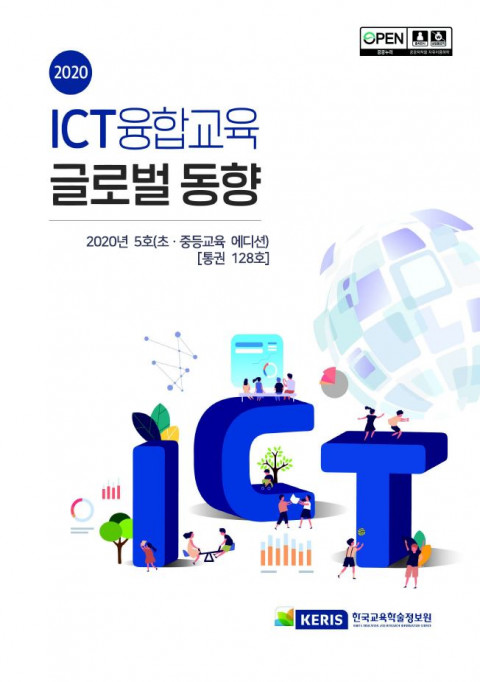 ICT융합교육 글로벌 동향: 초·중등교육 글로벌 동향 (2020년 5호 통권 128호) 出版年份: 2020 作者: 김민 | 이민주 | 윤환선 机构作者: 한국교육학술정보원 이 자료는 코로나 19로 인한 학교 폐쇄와 재개에 대한 글로벌동향과 사례를 미주, 유럽, 아시아 등 각 지역별로 나누어 정리하고 학교 재개에 대하여 국제기구가 제시하는 프레임 워크에 대해서 설명하고 있다. 또한 코로나 19에 대응하는 교육대책으로 ICT를 활용한 온라인 교육과 원격 수업에 대한 방안과 현황을 제시한다.