
相关资源
探索丰富的全球公民教育资源,深化理解,促进研究、倡导、教学与学习。
共找到2,162条结果
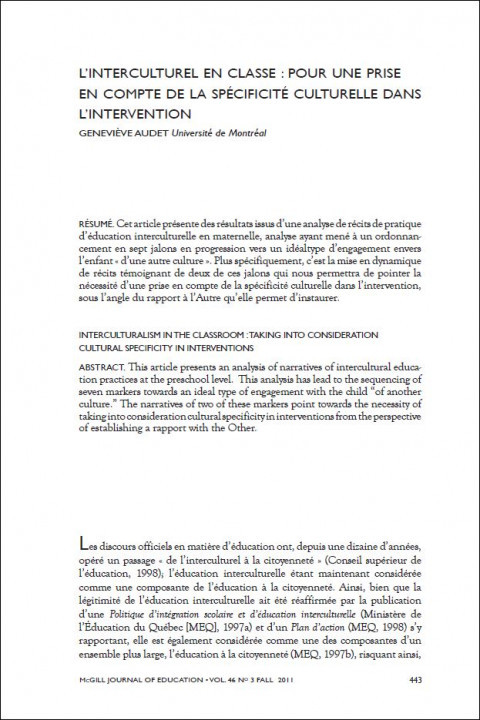 L’interculturel en classe: pour une prise en compte de la spécificité culturelle dans l’intervention 出版年份: 2011 作者: Geneviève Audet 机构作者: McGill University. Faculty of Education Cet article présente des résultats issus d’une analyse de récits de pratique d’éducation interculturelle en maternelle, analyse ayant mené à un ordonnancement en sept jalons en progression vers un idéaltype d’engagement envers l’enfant « d’une autre culture ». Plus spécifiquement, c’est la mise en dynamique de récits témoignant de deux de ces jalons qui nous permettra de pointer la nécessité d’une prise en compte de la spécificité culturelle dans l’intervention, sous l’angle du rapport à l’Autre qu’elle permet d’instaurer.
 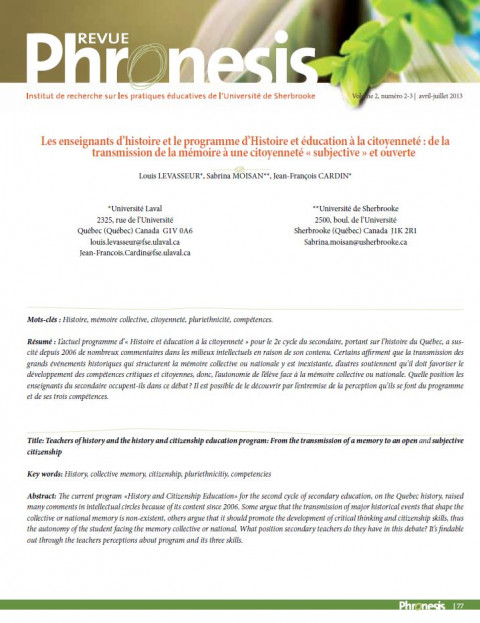 Teachers of History and the History and Citizenship Education Program: From the Transmission of a Memory to an Open and Subjective Citizenship 出版年份: 2013 作者: Louis LeVasseur | Sabrina Moisan | Jean-François Cardin 机构作者: Phronesis The current program «History and Citizenship Education» for the second cycle of secondary education, on the Quebec history, raised many comments in intellectual circles because of its content since 2006. Some argue that the transmission of major historical events that shape the collective or national memory is non-existent, others argue that it should promote the development of critical thinking and citizenship skills, thus the autonomy of the student facing the memory collective or national. What position secondary teachers do they have in this debate? It’s findable out through the teachers perceptions about program and its three skills. Les enseignants d’histoire et le programme d’Histoire et éducation à la citoyenneté: de la transmission de la mémoire à une citoyenneté « subjective » et ouverte 出版年份: 2013 作者: Louis LeVasseur | Sabrina Moisan | Jean-François Cardin 机构作者: Phronesis L’actuel programme d’« Histoire et éducation à la citoyenneté » pour le 2e cycle du secondaire, portant sur l’histoire du Québec, a suscité depuis 2006 de nombreux commentaires dans les milieux intellectuels en raison de son contenu. Certains affirment que la transmission des grands événements historiques qui structurent la mémoire collective ou nationale y est inexistante, d’autres soutiennent qu’il doit favoriser le développement des compétences critiques et citoyennes, donc, l’autonomie de l’élève face à la mémoire collective ou nationale. Quelle position les enseignants du secondaire occupent-ils dans ce débat ? Il est possible de le découvrir par l’entremise de la perception qu’ils se font du programme et de ses trois compétences.
 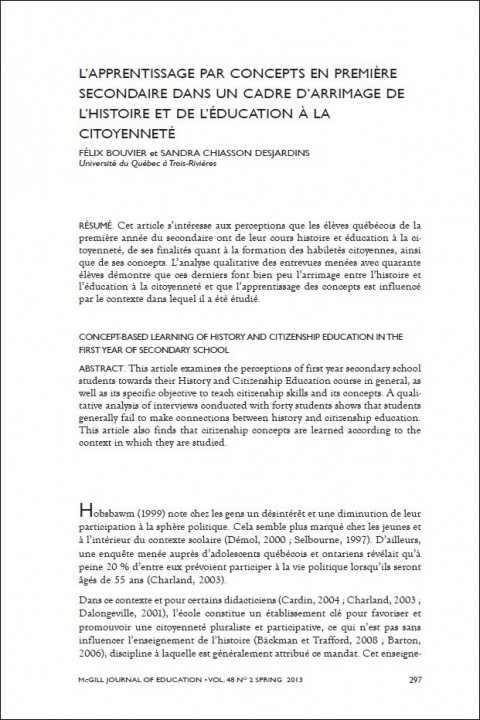 Concept-Based Learning of History and Citizenship Education in the First Year of Secondary School 出版年份: 2013 作者: Félix Bouvier | Sandra Chiasson Desjardins 机构作者: McGill University. Faculty of Education This article examines the perceptions of first year secondary school students towards their History and Citizenship Education course in general, as well as its specific objective to teach citizenship skills and its concepts. A qualitative analysis of interviews conducted with forty students shows that students generally fail to make connections between history and citizenship education. This article also finds that citizenship concepts are learned according to the context in which they are studied. L’apprentissage par concepts en première secondaire dans un cadre d’arrimage de l’histoire et de l’éducation à la citoyenneté 出版年份: 2013 作者: Félix Bouvier | Sandra Chiasson Desjardins 机构作者: McGill University. Faculty of Education Cet article s’intéresse aux perceptions que les élèves québécois de la première année du secondaire ont de leur cours histoire et éducation à la citoyenneté, de ses finalités quant à la formation des habiletés citoyennes, ainsi que de ses concepts. L’analyse qualitative des entrevues menées avec quarante élèves démontre que ces derniers font bien peu l’arrimage entre l’histoire et l’éducation à la citoyenneté et que l’apprentissage des concepts est influencé par le contexte dans lequel il a été étudié.
 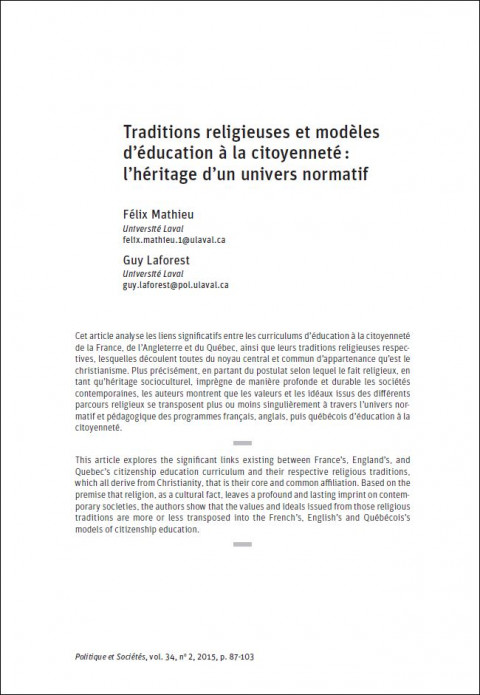 Religious Traditions and Models of Citizenship Education: The Heritage of a Normative Universe 出版年份: 2015 作者: Félix Mathieu | Guy Laforest 机构作者: Politique et Sociétés (Canada) This article explores the significant links existing between France’s, England’s, and Quebec’s citizenship education curriculum and their respective religious traditions, which all derive from Christianity, that is their core and common affiliation. Based on the premise that religion, as a cultural fact, leaves a profound and lasting imprint on contemporary societies, the authors show that the values and ideals issued from those religious traditions are more or less transposed into the French’s, English’s and Québécois’s models of citizenship education. Traditions religieuses et modèles d’éducation à la citoyenneté: l’héritage d’un univers normatif 出版年份: 2015 作者: Félix Mathieu | Guy Laforest 机构作者: Politique et Sociétés (Canada) Cet article analyse les liens significatifs entre les curriculums d’éducation à la citoyenneté de la France, de l’Angleterre et du Québec, ainsi que leurs traditions religieuses respectives, lesquelles découlent toutes du noyau central et commun d’appartenance qu’est le christianisme. Plus précisément, en partant du postulat selon lequel le fait religieux, en tant qu’héritage socioculturel, imprègne de manière profonde et durable les sociétés contemporaines, les auteurs montrent que les valeurs et les idéaux issus des différents parcours religieux se transposent plus ou moins singulièrement à travers l’univers normatif et pédagogique des programmes français, anglais, puis québécois d’éducation à la citoyenneté.
 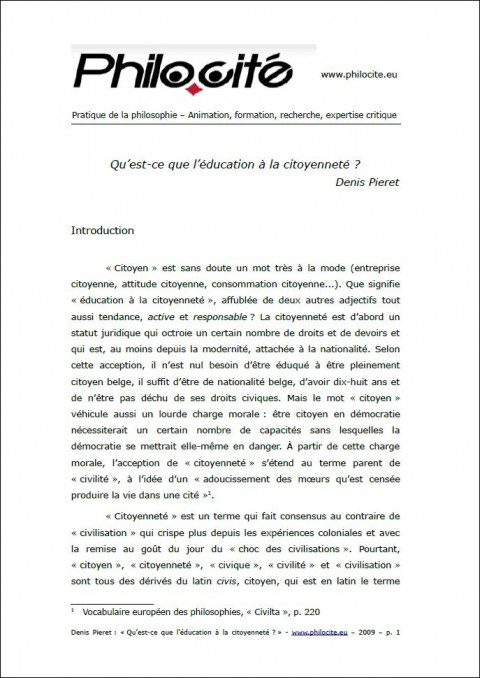 Qu'est-ce que l’éducation à la citoyenneté ? 出版年份: 2009 作者: Denis Pieret 机构作者: Philocité « Citoyen » est sans doute un mot très à la mode (entreprise citoyenne, attitude citoyenne, consommation citoyenne...). Que signifie « éducation à la citoyenneté », affublée de deux autres adjectifs tout aussi tendance, active et responsable ? La citoyenneté est d’abord un statut juridique qui octroie un certain nombre de droits et de devoirs et qui est, au moins depuis la modernité, attachée à la nationalité. Selon cette acception, il n’est nul besoin d’être éduqué à être pleinement citoyen belge, il suffit d’être de nationalité belge, d’avoir dix-huit ans et de n’être pas déchu de ses droits civiques. Mais le mot « citoyen » véhicule aussi un lourde charge morale : être citoyen en démocratie nécessiterait un certain nombre de capacités sans lesquelles la démocratie se mettrait elle-même en danger. À partir de cette charge morale, l’acception de « citoyenneté » s’étend au terme parent de « civilité », à l’idée d’un « adoucissement des mœurs qu’est censée produire la vie dans une cité ».
 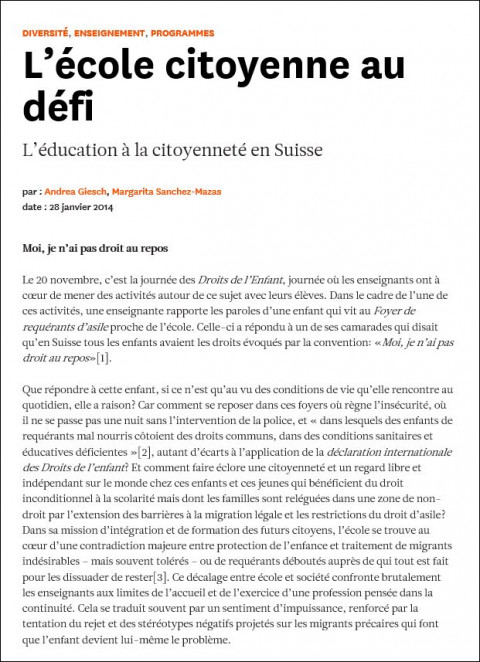 L’école citoyenne au défi: L’éducation à la citoyenneté en Suisse 出版年份: 2014 作者: Andrea Giesch | Margarita Sanchez-Mazas Le dispositif de formation que nous proposons aux futurs enseignants met l’accent sur les situations problématiques plutôt que sur les problèmes que poseraient les écarts dus à l’origine et à la spécificité culturelle des élèves, afin d’éviter les pièges de l’essentialisation et de restituer la complexité des trajectoires et des circonstances vécues. La construction d’une compétence interculturelle peut fortement tirer parti d’une approche psychosociale qui articule étroitement l’analyse de facteurs macrosociaux et celle des dynamiques qui se développent dans le cadre de la classe du fait de l’irruption d’enjeux identitaires amenés par les élèves.
 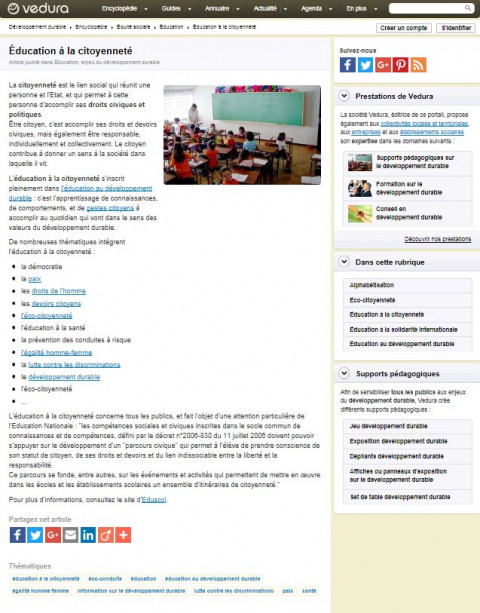 Éducation à la citoyenneté 机构作者: Vedura La citoyenneté est le lien social qui réunit une personne et l'Etat, et qui permet à cette personne d'accomplir ses droits civiques et politiques. Être citoyen, c'est accomplir ses droits et devoirs civiques, mais également être responsable, individuellement et collectivement. Le citoyen contribue à donner un sens à la société dans laquelle il vit. L'éducation à la citoyenneté s'inscrit pleinement dans l'éducation au développement durable : c'est l'apprentissage de connaissances, de comportements, et de gestes citoyens à accomplir au quotidien qui vont dans le sens des valeurs du développement durable. De nombreuses thématiques intègrent l'éducation à la citoyenneté : la démocratie la paix les droits de l'homme les devoirs citoyens l'éco-citoyenneté l'éducation à la santé la prévention des conduites à risque l'égalité homme-femme la lutte contre les discriminations le développement durable l'éco-citoyenneté ... L'éducation à la citoyenneté concerne tous les publics, et fait l'objet d'une attention particulière de l'Education Nationale : "les compétences sociales et civiques inscrites dans le socle commun de connaissances et de compétences, défini par le décret n°2006-830 du 11 juillet 2006 doivent pouvoir s’appuyer sur le développement d’un "parcours civique" qui permet à l’élève de prendre conscience de son statut de citoyen, de ses droits et devoirs et du lien indissociable entre la liberté et la responsabilité. Ce parcours se fonde, entre autres, sur les événements et activités qui permettent de mettre en œuvre dans les écoles et les établissements scolaires un ensemble d'itinéraires de citoyenneté."