
相关资源
探索丰富的全球公民教育资源,深化理解,促进研究、倡导、教学与学习。
共找到2条结果
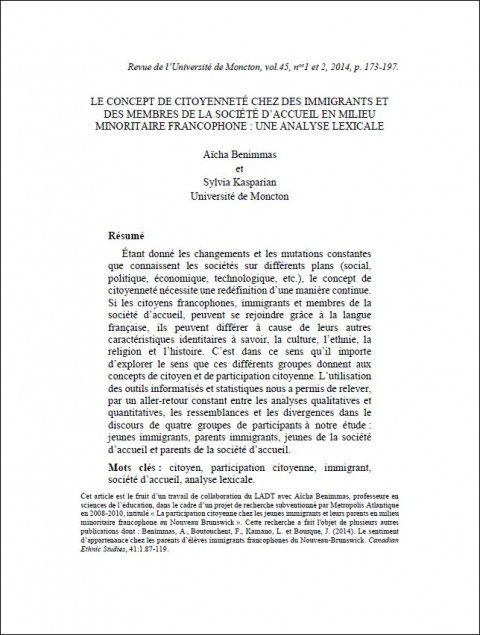 The Concept of Citizenship for Immigrants and Members of the Host Society within the Minority Francophone Context: A Lexical Analyse 出版年份: 2014 作者: Aïcha Benimmas | Sylvia Kasparian 机构作者: Revue de l’Université de Moncton Given the changes and constant mutations which occur in societies at the social, political, economic, technological, and educational levels, the concept of citizenship must be continually redefined. While French-speaking citizens, immigrants and members of the host society can find common ground thanks to the French language, they can also find differences because of other characteristics linked to their identity, such as culture, ethnic background, religion, and history. This is why we must analyze the meaning that these groups give to the concepts of citizenship and citizen participation, interpreting the differences and similarities that surface in their discourse regarding these two concepts. The use of computerized tools and statistics has enabled us to find through a constant comparison between qualitative and quantitative analyses-the perceptions, similarities, and divergences in the discourse of four groups of participants involved in our study: immigrant youth, immigrant parents, host society youth, and host society parents. Le concept de citoyenneté chez des immigrants et des membres de la société d’accueil en milieu minoritaire francophone : une analyse lexicale 出版年份: 2014 作者: Aïcha Benimmas | Sylvia Kasparian 机构作者: Revue de l’Université de Moncton Étant donné les changements et les mutations constantes que connaissent les sociétés sur différents plans (social, politique, économique, technologique, etc.), le concept de citoyenneté nécessite une redéfinition d’une manière continue. Si les citoyens francophones, immigrants et membres de la société d’accueil, peuvent se rejoindre grâce à la langue française, ils peuvent différer à cause de leurs autres caractéristiques identitaires à savoir, la culture, l’ethnie, la religion et l’histoire. C’est dans ce sens qu’il importe d’explorer le sens que ces différents groupes donnent aux concepts de citoyen et de participation citoyenne. L’utilisation des outils informatisés et statistiques nous a permis de relever, par un aller-retour constant entre les analyses qualitatives et quantitatives, les ressemblances et les divergences dans le discours de quatre groupes de participants à notre étude : jeunes immigrants, parents immigrants, jeunes de la société d’accueil et parents de la société d’accueil.