
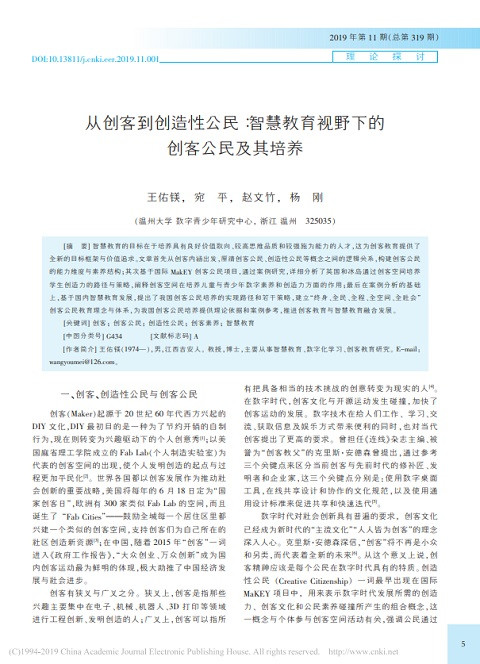
From Maker to Creative Citizens: Maker Citizens and Its Cultivation from the Perspective of Smart Education
- المؤلف المؤسسي
- Digital Education Studies
- الترتيب
- p. 5-27
- لغة المورد
- الصينية
- سنة النشر
- 2019
- أنواع الموارد
- الأوراق البحثية/ مقالات المجالات
- مستوى التعليم
- التعلم مدى الحياة
- المناطق
- آسيا والمحيط الهادئ
- مكان النشر
- Wenzhou
The goal of smart education is to cultivate talents with good value orientation, high thinking quality and strong decisive ability, which provides a brand new target framework and value pursuit for maker education. Firstly, this paper starts from the connotation of makers, clarifies the logical relationship between the concepts of maker citizens and creative citizens, and builds the capability dimension and literacy structure of maker citizens. Secondly, based on the International MakEY creator citizen project, this paper analyzes the paths and strategies of the UK and Iceland to cultivate students’ creativity through maker space in detail, and illustrates the role of maker space in cultivating the digital literacy and creativity of children and adolescents. Finally, this paper, on the basis of case analysis and the development of smart education in China, proposes the realization path and some strategies to cultivate maker citizens in China, and establishes the concept and system of citizenship education for “Lifelong, All People, Whole Process, All Space, and Whole Society”, which provides theoretical basis and case references for the cultivation of Chinese makers’ citizens, and promotes the integral development of maker education and smart education.
موارد ذات صلة
-
 Study on the Historical Impact of the 1974 Recommendation concerning Education for International Understanding, Cooperation and Peace and Education relating to Human Rights and Fundamental Freedoms
 -
 IIEP-UNESCO 12th Medium-Term Strategy: 2026–2029
 -
 More than Welcome: Intercultural Integration of Migrants in and Through Higher Education
 -
 Advancing Intergenerational Learning: Identifying Challenges and Opportunities for Older Adults; Integrated Case Study Report