
الموارد
استكشف مجموعة واسعة من الموارد القيمة حول تعليم المواطنة العالمية لتعميق فهمك وتعزيز البحث والمناصرة والتعليم والتعلم.
تم العثور على 1,402 نتيجة
 Address by Mr Koïchiro Matsuura, Director-General of UNESCO on the occasion of the First Meeting of the UN Inter-Agency Committee (IAC) on the United Nations Decade on Education for Sustainable Development (2005-2014); UNESCO, 12 June 2006 سنة النشر: 2006 المؤلف المؤسسي: UNESCO. Director-General, 1999-2009 (Matsuura, K.) This address was delivered by Mr. Koïchiro Matsuura, Director-General of UNESCO on the occasion of the first meeting of the UN Inter-Agency Committee (IAC) on the United Nations Decade on Education for Sustainable Development (2005-2014). Discours de M. Koïchiro Matsuura, Directeur général de l'UNESCO à l'occasion de la première réunion du Comité interinstitutions des Nations Unies (CCI) sur la Décennie des Nations Unies سنة النشر: 2006 المؤلف المؤسسي: UNESCO. Director-General, 1999-2009 (Matsuura, K.) Ce discours a été prononcé par M. Koïchiro Matsuura, Directeur général de l'UNESCO à l'occasion de la première réunion du Comité interinstitutions des Nations Unies sur la Décennie des Nations Unies sur l'éducation pour le développement durable (2005-2014).
 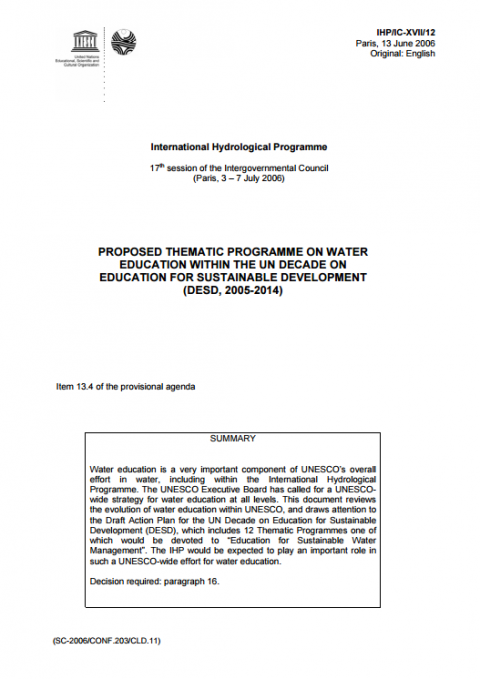 Proposed thematic programme on water education within the UN Decade on Education for Sustainable Development (DESD, 2005-2014) سنة النشر: 2006 المؤلف المؤسسي: International Hydrological Programme (IHP) Water education is a very important component of UNESCO’s overall effort in water, including within the International Hydrological Programme. The UNESCO Executive Board has called for a UNESCO-wide strategy for water education at all levels. This document reviews the evolution of water education within UNESCO, and draws attention to the Draft Action Plan for the UN Decade on Education for Sustainable Development (DESD), which includes 12 Thematic Programmes one of which would be devoted to “Education for Sustainable Water Management”. The IHP would be expected to play an important role in such a UNESCO-wide effort for water education.
  Learning with Intangible Heritage for a Sustainable Future: Guidelines for Educators in the Asia-Pacific Region سنة النشر: 2015 المؤلف المؤسسي: UNESCO Bangkok The guide provides teacher educators and teachers with an understanding of the concept of intangible cultural heritage (ICH) and explains why ICH should be integrated into the curriculum in tandem with the principles and perspectives of Education for Sustainable Development (ESD). This guide explains how the strategic incorporation of ICH elements and ESD principles into the curriculum can enable learners to gain the knowledge and skills that are necessary for ensuring sustainable development in the future. Нематериальное наследие в системе обучения в интересах устойчивого будущего سنة النشر: 2015 المؤلف المؤسسي: UNESCO Bangkok Руководство предоставляет работникам образования и преподавателям понимание концепции нематериального культурного наследия и объясняет внедрения нематериального культурного наследия в учебные планы вместе с принципами и теорией Образования в интересах устойчивого развития (ОУР). Руководство объясняет, как стратегическое включение элементов нематериального культурного наследия и принципов ОУР в учебные планы может помочь учащимся получить знания и навыки, необходимые для обеспечения устойчивого развития в будущем.ЮНЕСКО разработала настоящее руководство на основании результатов пилотных проектов, проведенных в четырех странах в Азиатско-Тихоокеанском регионе, где участники разработали своиместные руководства и материалы для включения элементов нематериального культурного наследия и принципов ОУР в образовательный процесс. Примеры нематериального культурного наследия, приведенные в данном руководстве, не являются более важными, чем другие, и не обязательно должны быть приоритетными. Они скорее представлены в качестве иллюстративных примеров.
 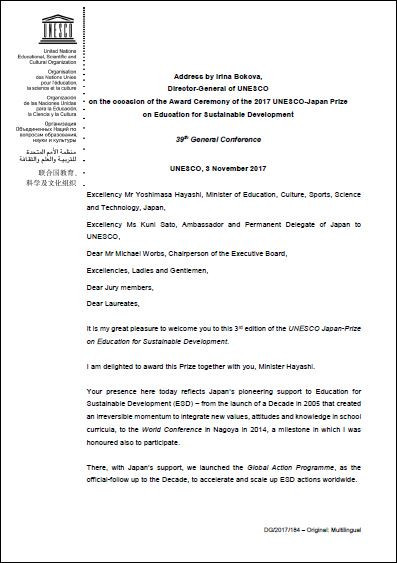 Address by Irina Bokova, Director-General of UNESCO, on the occasion of the Award Ceremony of the 2017 UNESCO-Japan Prize on Education for Sustainable Development, 39th General Conference; UNESCO, 3 November 2017 سنة النشر: 2017 المؤلف المؤسسي: UNESCO. Director-General, 2009-2017 (Bokova, I.G.) This address was delivered by Irina Bokova, Director-General of UNESCO, on the occasion of the Award Ceremony of the 2017 UNESCO-Japan Prize on Education for Sustainable Development at UNESCO Headquarters in Paris, on 3 November.
  Climate Risk Informed Decision Analysis (CRIDA): Collaborative Water Resources Planning for an Uncertain Future سنة النشر: 2024 المؤلف المؤسسي: UNESCO Intergovernmental Hydrological Programme (IHP) | International Center for Integrated Water Resources Management (ICIWaRM) | Alliance for Global Water Adaptation (AGWA) | Deltares The importance of integrating climate change considerations into water resources planning is recognized on a global scale. Various frameworks, such as the Sendai Framework for Disaster Risk Reduction, the United Nations Sustainable Development Goals, and the Paris Agreement, emphasize the need for proper planning, policy-making, and adaptation strategies. The Climate Risk Informed Decision Analysis (CRIDA) methodology was launched in 2018 as a response to these international agendas, bridging the gap between climate change uncertainty and water resource planning. Address by Irina Bokova, Director-General of UNESCO on the occasion of the Seminar on Climate Change and Education at the UN University: Responding to Climate Change Starts with Education; Tokyo, 26 November 2010 سنة النشر: 2010 المؤلف المؤسسي: UNESCO. Director-General, 1999-2009 (Matsuura, K.) This document is an address of Irina Bokova, Director-General of UNESCO on the occasion of the Seminar on Climate Change and Education at the UN University “Responding to Climate Change Starts with Education” in Tokyo, 26 November 2010. She highlighted the importance of climate change education for the sustainable future and underlined the importance of several programme such as Sandwatch and YouthXchange which have been lead by the UNESCO. Discours de Mme Irina Bokova, Directrice générale de l'UNESCO à l'occasion du Séminaire sur les changements climatiques et l'éducation à l'Université des Nations Unies: Réagir aux changements climatiques commence par l'éducation سنة النشر: 2010 المؤلف المؤسسي: UNESCO. Director-General, 1999-2009 (Matsuura, K.) Ce document est une adresse de Irina Bokova, Directrice générale de l'UNESCO à l'occasion du Séminaire sur les changements climatiques et l'éducation à l'Université des Nations Unies "Réagir aux changements climatiques commence par l'éducation" à Tokyo, le 26 Novembre 2010. Elle a souligné l'importance de la l'éducation au changement climatique pour l'avenir durable et a souligné l'importance de plusieurs programmes tels que Sandwatch et YouthXchange qui ont été prêcher par l'UNESCO. Climate change starter's guidebook: an issues guide for education planners and practitioners سنة النشر: 2011 المؤلف: Alejandro Deeb | Amber French | Julia Heiss | Jason Jabbour | Dominique LaRochelle | Arkadiy Levintanus | Anna Kontorov | Rummukainen Markku | Gerardo Sanchez Martinez | Rosalyn McKeown | Nicolay Paus | Antoine Pecoud | Guillaume Pénisson | Daniel Puig | Vanessa Retana | Serban Scrieciu | Morgan Strecker | Vimonmas Vachatimanont | Benjamin Witte | Noriko Yamada. المؤلف المؤسسي: United Nations Environment Programme (UNEP) The Climate Change Starter’s Guide provides an introduction and overview for education planners and practitioners on the wide range of issues relating to climate change and climate change education, including causes, impacts, mitigation and adaptation strategies, as well as some broad political and economic principles. The aim of this guide is to serve as a starting point for mainstreaming climate change education into school curricula. It has been created to enable education planners and practitioners to understand the issues at hand, to review and analyse their relevance to particular national and local contexts, and to facilitate the development of education policies, curricula, programmes and lesson plans. The guide covers four major thematic areas: 1. the science of climate change, which explains the causes and observed changes; 2. the social and human aspects of climate change including gender, health, migration, poverty and ethics; 3. policy responses to climate change including measures for mitigation and adaptation; and 4. education approaches including education for sustainable development, disaster reduction and sustainable lifestyles. A selection of key resources in the form of publication titles or websites for further reading is provided after each of the thematic sections. The United Nations Educational, Scientific and Cultural Organization (UNESCO) provides its expertise and know-how in areas such as education, culture, and the social sciences. In particular, UNESCO emphasises the role of education in support of climate change adaptation and mitigation in providing skills and capacities but also through shaping the values, attitudes and behaviours needed to put the world on a more sustainable path. The United Nations Environment Programme (UNEP) works with countries to strengthen their ability to adapt to climate change, move towards low-carbon growth, reduce emissions from deforestation and forest degradation, improve understanding of climate science, and raise public awareness of the changing climate. UNEP is supporting countries to seize the opportunities of moving towards low-carbon growth, while improving human health and well-being, generating green jobs and moving towards a green economy. With this publication, the two organizations have embarked on a collaboration on climate change education that we are committed to building upon and expanding in the period ahead.