
الموارد
استكشف مجموعة واسعة من الموارد القيمة حول تعليم المواطنة العالمية لتعميق فهمك وتعزيز البحث والمناصرة والتعليم والتعلم.
تم العثور على 1,726 نتيجة
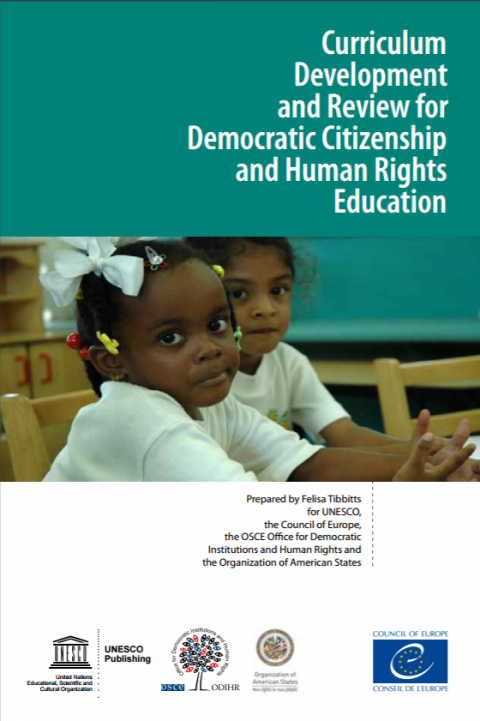 Élaboration et révision des programmes d'enseignement pour l'éducation à la citoyenneté démocratique et aux droits de l'homme سنة النشر: 2016 المؤلف المؤسسي: UNESCO | Conseil de l'Europe | Organization of American States (OAS) | OSCE. Office for Democratic Institutions and Human Rights (ODIHR) Education for democratic citizenship and human rights education are vital for peaceful, sustainable and inclusive societies based on respect for the human rights of every person. Effective teaching and learning processes require well-trained teachers, positive learning environments and high-quality learning materials. This is underpinned by education policy, including curriculum development and review, which is the main focus of this book. The strengthening of education policies in the fields of education for democratic citizenship and human rights lies at the very heart of the efforts of the Council of Europe, the United Nations Educational, Scientific and Cultural Organization, the Office for Democratic Institutions and Human Rights of the Organization for Security and Co-operation in Europe, and the Organization of American States. These organisations have jointly produced this publication in order to support states’ commitment to fostering citizenship and human rights education and improving access to quality education for all. Разработка и пересмотр учебных программ по воспитанию демократической гражданственности и образованию в области прав человека سنة النشر: 2016 المؤلف المؤسسي: UNESCO | Council of Europe | Organization of American States (OAS) | OSCE. Office for Democratic Institutions and Human Rights (ODIHR) Education for democratic citizenship and human rights education are vital for peaceful, sustainable and inclusive societies based on respect for the human rights of every person. Effective teaching and learning processes require well-trained teachers, positive learning environments and high-quality learning materials. This is underpinned by education policy, including curriculum development and review, which is the main focus of this book. The strengthening of education policies in the fields of education for democratic citizenship and human rights lies at the very heart of the efforts of the Council of Europe, the United Nations Educational, Scientific and Cultural Organization, the Office for Democratic Institutions and Human Rights of the Organization for Security and Co-operation in Europe, and the Organization of American States. These organisations have jointly produced this publication in order to support states’ commitment to fostering citizenship and human rights education and improving access to quality education for all.
 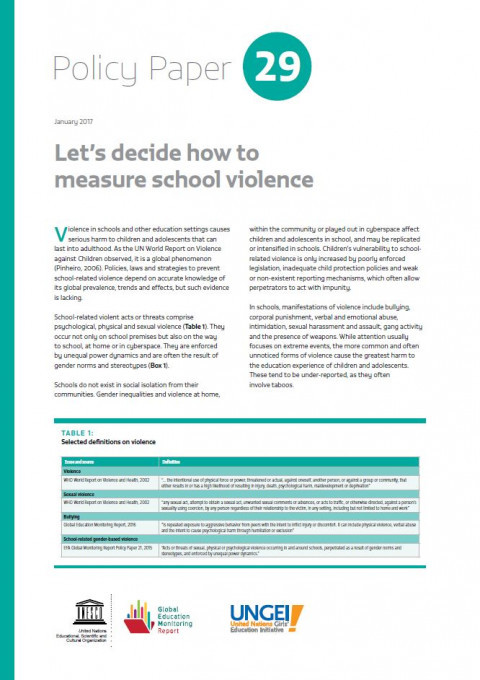 Let's Decide How to Measure School Violence (Policy Paper 29) سنة النشر: 2017 المؤلف المؤسسي: UNESCO Violence in schools and other education settings causes serious harm to children and adolescents that can last into adulthood. As the UN World Report on Violence against Children observed, it is a global phenomenon (Pinheiro, 2006). Policies, laws and strategies to prevent school-related violence depend on accurate knowledge of its global prevalence, trends and effects, but such evidence is lacking.In schools, manifestations of violence include bullying, corporal punishment, verbal and emotional abuse, intimidation, sexual harassment and assault, gang activity and the presence of weapons. While attention usually focuses on extreme events, the more common and often unnoticed forms of violence cause the greatest harm to the education experience of children and adolescents. These tend to be under-reported, as they often involve taboos.To collect data on aspects of violence in schools, large-scale, multi-country school-based surveys are increasingly used; some countries also have well-established monitoring mechanisms. Overall, however, consistent evidence on the global prevalence and trends of school-related violence is lacking. To ensure reliable data is gathered, action is needed to bridge differences between the various monitoring methods. This paper, launched to coincide with the International Symposium on School Violence and Bullying: From Evidence to Action, in Seoul, Republic of Korea (January 17–19, 2017), aims to inform the current debate and propose options for the future.
  Предложение в отношении Глобальной программы действий по образованию в интересах устойчивого развития в качестве последующей деятельности по итогам Десятилетия образования в интересах устойчивого развития (ДОУР) Организации Объединенных Наций в период после 2014 г. سنة النشر: 2013 المؤلف المؤسسي: UNESCO Настоящий документ содержит предложение в отношении Гло-бальной программы действий по образованию в интересах устойчивого развития (ОУР), а также комментарии и замечания Исполнительного со-вета.
 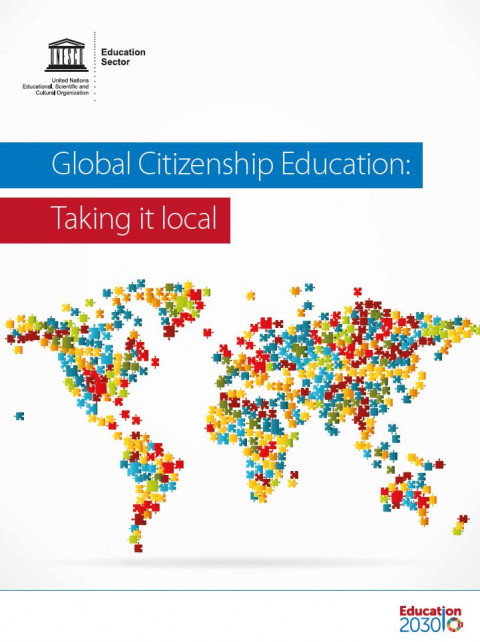 Global Citizenship Education: Taking It Local سنة النشر: 2018 المؤلف المؤسسي: UNESCO UNESCO is leading global efforts on Global Citizenship Education (GCED), which is at the core of Target 4.7 of Sustainable Development Goal 4 on Education. To address the perception that the concept of GCED is concerned mainly with global matters and maybe dissociated from local needs and realities, UNESCO has identified local/national/traditional precepts and concepts that are similar to the UNESCO understanding of global citizenship.As culturally relevant expressions of GCED and to contribute to building peace through the implementation of GCED, the concepts identified here can serve as entry-points to teach and learn about GCED in more locally relevant ways. Education à la citoyenneté mondiale: pour une approche locale سنة النشر: 2018 المؤلف المؤسسي: Organisation des Nations Unies pour l'éducation, la science et la culture (UNESCO) L’UNESCO mène les efforts mondiaux portant sur l’éducation à la citoyenneté mondiale, qui est au coeur de la cible 4.7 de l’Objectif 4 de développement durable sur l’éducation. Afin de clarifier la perception selon laquelle le concept de l’éducation à la citoyenneté mondiale concerne principalement des questions mondiales et qu’il est peut-être dissocié des réalités et des besoins locaux, l’UNESCO a identifié des préceptes et des concepts locaux/nationaux/traditionnels qui sont comparables à la compréhension qu’a l’UNESCO de la citoyenneté mondiale. En tant qu’expressions culturellement pertinentes de l’éducation à la citoyenneté mondiale, et dans le but de contribuer à l’édification de la paix grâce à la mise en oeuvre de l’éducation à la citoyenneté mondiale, les concepts identifiés dans ce document peuvent servir de points d’entrée pour enseigner l’éducation à la citoyenneté mondiale et pour l’apprendre, de manière plus pertinente au niveau local.
 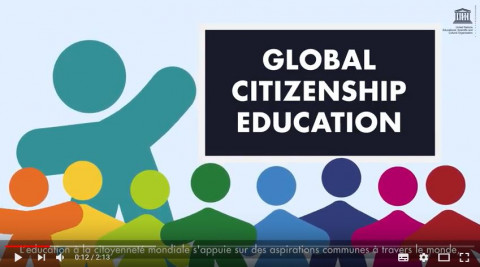 [Video] Global Citizenship Education: Taking it Local! سنة النشر: 2018 المؤلف المؤسسي: UNESCO | APCEIU Societies across the world have long lived according to principles that emphasize solidarity, dialogue and respect for diversity. It is from this rich well of practices that UNESCO’s Global Citizenship Education (GCED) programme draws inspiration -- to instill in learners the skills, values, attitudes and behaviors to ‘live together’ and help shape more peaceful, sustainable societies and world. GCED is not a new concept, but an aspiration long-held across the world.
  Report of the 2019 Arab Forum for Sustainable Development "Empowering people and ensuring inclusion and equality in the Arab region" سنة النشر: 2019 المؤلف: United Nations (UN) المؤلف المؤسسي: United Nations (UN) The Economic and Social Commission for Western Asia (ESCWA), in partnership with the League of Arab States and the United Nations system working in the Arab region, organized the 2019 Arab Forum on Sustainable Development under the theme 'Empowering People and Ensuring Inclusion and Equality in the Arab Region', in Beirut, from 9 to 11 April 2019. تقرير المنتدى العربيللتنمية المستدامة لعام 2019تمكين الناس وضمان الشمول والمساواة في المنطقة العربية" بيت الأمم المتحدة،بيروت، سنة النشر: 2019 المؤلف المؤسسي: United Nations (UN) نظمت اللجنة الاقتصادية والاجتماعية لغربي آسيا (الإسكوا)، وبالشراكة مع جامعة الدول العربية ومنظومة الأمم المتحدة العاملة في المنطقة العربية، المنتدى العربي للتنمية المستدامة لعام 2019 تحت عنوان "تمكين الناس وضمان الشمول والمساواة في المنطقة العربية"، في بيروت، في الفترة من 9 إلى 11 نيسان/أبريل 2019 برئاسة جمهورية العراق.
 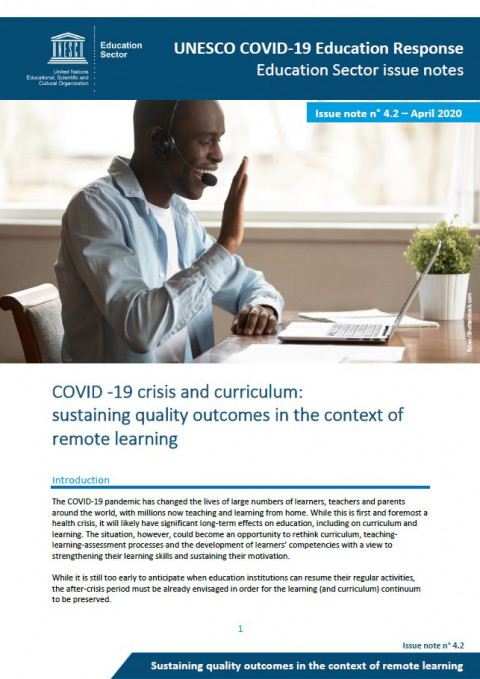 COVID-19 Crisis and Curriculum: Sustaining Quality Outcomes in the Context of Remote Learning (Issue Note no. 4.2 – April 2020) سنة النشر: 2020 المؤلف المؤسسي: UNESCO The COVID-19 pandemic has changed the lives of large numbers of learners, teachers and parents around the world, with millions now teaching and learning from home. While this is first and foremost a health crisis, it will likely have significant long-term effects on education, including on curriculum and learning. The situation, however, could become an opportunity to rethink curriculum, teaching-learning-assessment processes and the development of learners’ competencies with a view to strengthening their learning skills and sustaining their motivation.This crisis will likely provide an opportunity for schools to strengthen their ties with families, and for teachers to communicate and cooperate better with parents in the interest of learners. In the same vein, the crisis means teachers and parents may become more involved in decisions regarding curriculum appropriateness. This can support the development of a learner-centred, participative and inclusive learning paradigm that takes into account the interests of learners, as well as their environments and aspirations.