
الموارد
استكشف مجموعة واسعة من الموارد القيمة حول تعليم المواطنة العالمية لتعميق فهمك وتعزيز البحث والمناصرة والتعليم والتعلم.
تم العثور على 2,668 نتيجة
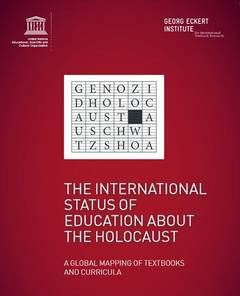 The International status of education about the Holocaust : A global mapping of textbooks and curricula سنة النشر: 2015 المؤلف المؤسسي: UNESCO This publication by UNESCO and the Georg Eckert Institute documents ways in which the Holocaust is presented in secondary school level history and social studies curricula worldwide, and conceptualized and narrated in textbooks from twenty-six countries, with all continents represented. Historical understandings of the Holocaust are defined in terms of the spatial and temporal scales with which the event is portrayed, the protagonists involved, interpretative patterns (according to definitions, comprehensiveness, causes, relativization or banalization), narrative techniques and viewpoints, didactic methods, and national idiosyncrasies. The study is based on 272 currently valid curricula from 135 countries, and on 89 textbooks published in 26 countries since 2000. The aim of the study is primarily to document information in such a way that it reflects local understandings of the Holocaust, principally by recording concepts and narratives of the Holocaust found in educational media currently in use in schools. The findings show both convergence and divergence in the representations analysed. The Holocaust is subject to shared patterns of representation, which include selectivity, personalization, appropriation, screening and omission. It is also subject to narrative idiosyncrasies. One of the main trends worldwide is domestication, a process whereby countries place emphasis on the local significance of the event or appropriate them in the interests of local populations. Drawing on such national and international patterns of representation, the publication concludes by formulating recommendations for future curricula and textbook narratives about the Holocaust. These recommendations relate to such issues as the use of terms, the comprehensiveness of historical facts, the definition of causes, the combination of universal and local approaches, and the development of historical literacy. (By the publisher) Le statut international de l'éducation sur l'Holocauste: Une cartographie mondiale des manuels et des programmes سنة النشر: 2015 المؤلف المؤسسي: Organisation des Nations Unies pour l'éducation, la science et la culture (UNESCO) Cette publication par l'UNESCO et l'Institut Georg Eckert documente façons dont l'Holocauste est présenté dans l'histoire du niveau de l'école et de programmes d'études sociales secondaire dans le monde, et conceptualiser et narré dans les manuels de vingt-six pays, avec tous les continents représentés. compréhensions historiques de l'Holocauste sont définis en fonction des échelles spatiales et temporelles avec laquelle l'événement est dépeint, les acteurs impliqués, les modèles d'interprétation (selon les définitions, l'intégralité, causes, relativisation ou banalisation), les techniques narratives et des points de vue, des méthodes didactiques, et les particularités nationales. L'étude est basée sur 272 programmes en cours de validité à partir de 135 pays, et 89 manuels publiés dans 26 pays depuis 2000. L'objectif de l'étude est d'abord de documenter l'information de façon à ce qu'il reflète la vision locale de l'Holocauste, principalement par l'enregistrement les concepts et les récits de la Shoah trouvés dans les médias éducatifs actuellement en usage dans les écoles. Les résultats montrent à la fois la convergence et de divergence dans les représentations analysées. L'Holocauste est soumis à des modèles communs de représentation, qui comprennent la sélectivité, la personnalisation, l'appropriation, le dépistage et l'omission. Il est également soumis à des particularités narratives. L'une des principales tendances dans le monde est la domestication, un processus par lequel les pays mettent l'aCECnt sur l'importance locale de l'événement ou les approprient dans l'intérêt des populations locales. Dessin sur ces modèles nationaux et internationaux de représentation, de la publication conclut en formulant des recommandations pour les futurs programmes et manuels scolaires récits sur l'Holocauste. Ces recommandations portent sur des questions telles que l'utilisation des termes, l'exhaustivité des faits historiques, la définition des causes, la combinaison des approches universelles et locales, ainsi que le développement de l'alphabétisation historique. (Par l'éditeur)
  Collection des meilleures pratiques en éducation pour une citoyenneté mondiale en Afrique centrale سنة النشر: 2015 المؤلف المؤسسي: UNESCO This collection of best practices in human rights education in Central Africa and Ethiopia was prepared in order to respond to UNESCO’s demand to promote such initiatives and to ensure a multiplier effect considering human rights education in the region. The objective is to support the concept of UNESCO’s ‘Global Citizenship Education’ in the field of human rights education in identifying its best practices. In order to identify the best practices, UNESCO’s activities in the field of human rights education in the region were mapped out. This mapping out has shown big differences in implementing the initiatives focused on achieving global citizenship education through human rights education, particularly in primary and secondary education, as indicated in the first phase of the World Programme for human rights education. Nevertheless, various initiatives collected are either conducted/supported by UNESCO or not, in terms of three themes: citizenship education, intercultural dialogue, and the peace and security which are considered to be relevant to Africa in general and particularly to Central Africa, in order to address the main theme of global citizenship education. The selected best practices deal with the tertiary level and are in line with the second phase of the World Programme for human rights education, covering the period between 2009 and 2014 and focusing on higher and vocational education. The practices include 1) citizenship education which supports the principles set out in the Universal Declaration of Human Rights and which is reiterated in the two phases of the World Programme for human rights education, 2) the intercultural dialogue which supports education for understanding and evaluating unity in diversity, and which fits well with the objectives of the UN Decade of Education for Sustainable Development proclaimed by the UN General Assembly and managed by UNESCO, and 3) education for peace and security.It is obvious that many linkages exist among the three subjects mentioned above. Therefore, the examples presented in this collection can affect one or several problems. Each example is presented with the following sequence: identification, background, implementation, and results.
 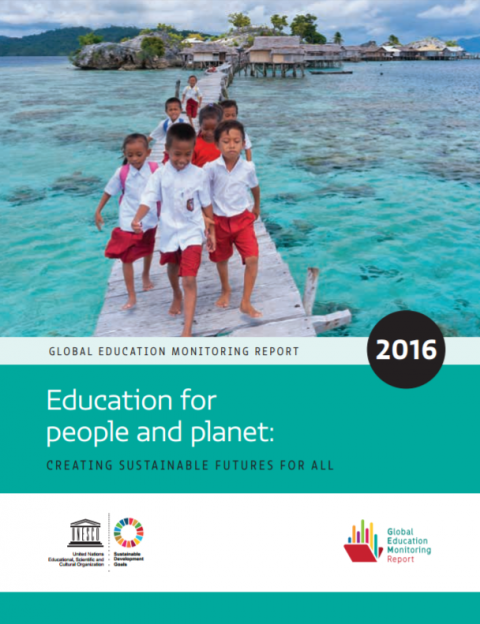 Education for People and Planet: Creating Sustainable Futures for All, Global Education Monitoring Report, 2016 سنة النشر: 2016 المؤلف المؤسسي: UNESCO | Global Education Monitoring Report Team Education for People and Planet: Creating Sustainable Futures for All explores the complex relationship between education and the new 2030 Agenda for Sustainable Development, covering six fundamental pillars – Planet, Prosperity, People, Peace, Place and Partnerships. This report shows that education will not deliver its full potential unless participation rates increase dramatically and sustainable development guides education system reform. It also warns of the destructive impact that climate change, conflict, unsustainable consumption and the increasing gap between rich and poor have on education. A huge transformation is needed if we are to create sustainable futures for all.
 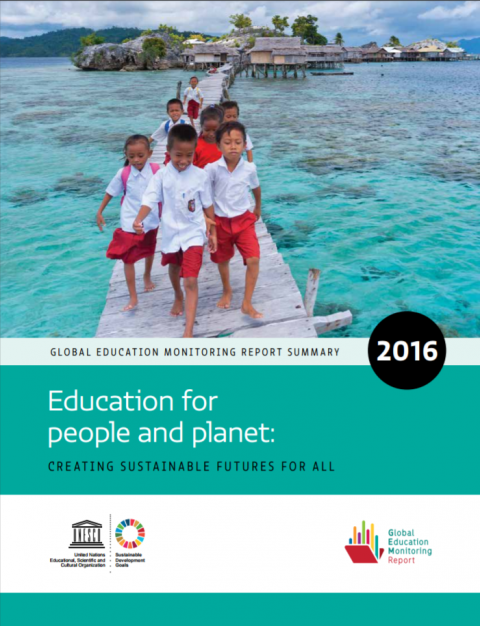 [Summary] Education for People and Planet: Creating sustainable Futures for All, Global Education Monitoring Report, 2016; Summary سنة النشر: 2016 المؤلف المؤسسي: UNESCO Education for People and Planet: Creating Sustainable Futures for All explores the complex relationship between education and the new 2030 Agenda for Sustainable Development, covering six fundamental pillars – Planet, Prosperity, People, Peace, Place and Partnerships. This report shows that education will not deliver its full potential unless participation rates increase dramatically and sustainable development guides education system reform. It also warns of the destructive impact that climate change, conflict, unsustainable consumption and the increasing gap between rich and poor have on education. A huge transformation is needed if we are to create sustainable futures for all.
  Teaching respect for all: implementation guide سنة النشر: 2014 المؤلف المؤسسي: UNESCO Teaching Respect for All is a joint UNESCO-United States of America-Brazil project launched in January 2012 to counteract discrimination both in and through education. Acknowledging that discrimination is on the rise worldwide, Teaching Respect for All promotes an educational response to counter discrimination and violence through strengthening the foundations of mutual tolerance and cultivating respect for all people, regardless of colour, gender, class, sexual orientation, national, ethnic, or religious orientation/identity. Teaching Respect for All has chosen to focus efforts on the formal and informal classroom, targeting learners of 8-16 years old, and aims to build curiosity, openness, critical thinking and understanding among youth learners, thus equipping them with the awareness, knowledge, and skills to cultivate respect and stop discrimination on all levels. The project is founded on the universal values and core principles of human rights, while acknowledging each country has its own history and mechanism for addressing the issue of discrimination in education. Enseigner le respect pour tous: guide de mise en oeuvre سنة النشر: 2014 المؤلف المؤسسي: Organisation des Nations Unies pour l'éducation, la science et la culture (UNESCO) Respect Pédagogique pour Tous est un UNESCO-États-Unis conjointe de projet Amérique-Brésil a lancé en Janvier 2012 pour lutter contre la discrimination à la fois dans et par l'éducation. Reconnaissant que la discrimination est à la hausse dans le monde entier, Respect Pédagogique pour Tous favorise une réponse éducative pour lutter contre la discrimination et la violence en renforçant les fondements de la tolérance mutuelle et de cultiver le respect pour toutes les personnes, indépendamment de la couleur, le sexe, la classe, l'orientation sexuelle, nationale, ethnique ou religieuse orientation / identité. Respect Pédagogique pour Tous a choisi de concentrer les efforts sur la salle de classe formelle et informelle, en ciblant les apprenants de 8-16 ans, et vise à développer la curiosité, l'ouverture, la pensée critique et la compréhension entre les apprenants de la jeunesse, en les dotant ainsi avec la prise de conscience, la connaissance, et les compétences nécessaires pour cultiver le respect et arrêter la discrimination à tous les niveaux. Le projet est fondé sur les valeurs universelles et les principes fondamentaux des droits de l'homme, tout en reconnaissant que chaque pays a sa propre histoire et un mécanisme pour régler le problème de la discrimination dans l'éducation. ‘모두를 존중하는 방법’ 실행 가이드 سنة النشر: 2014 المؤلف المؤسسي: 유네스코 ‘모두를 존중하는 방법(Teaching Respect for All)’은 교육을 통해 차별을 근절하기 위하여 2012년 1월에 시작된 유네스코 미국-브라질 합작 프로젝트이다. 차별이 전 세계적으로 부상하고 있음을 인식하는 요즘, ‘모두를 존중하는 방법’은 인종, 성별, 계급, 성적 성향, 국가, 민족 또는 종교적 정체성에 관계없이 상호 관용의 기초 토대를 강화하고 모든 사람들을 존중하는 문화를 배양함으로써 차별과 폭력에 대응하는 교육적 반응을 고취시킨다. ‘모두를 존중하는 방법’은 8~16세 학습자를 대상으로 정식 및 약식 수업을 하도록 포커스를 맞춰, 이들에게 호기심, 개방성, 비판적 사고와 이해심, 의식과 지식을 키워주며 모든 수준에서의 차별을 중단하고 존경심을 키울 수 있는 방법을 가르쳐주는 것이다. 본 프로젝트는 각국이 교육 차별 문제를 해결할 수 있는 자체적 역사와 메커니즘을 소유하고 있음을 인정하며, 인권의 보편적 가치와 그 핵심 원칙에 기초를 두고 있다.
  Human rights education: learning counts! سنة النشر: 2006 المؤلف المؤسسي: UNESCO This poster was originally published in 2006 and reissued for UNESCO Works for Human Rights: a Poster Exhibition on the Street, held at UNESCO, Paris, 2 December 2008 to 27 February 2009. Éducation sur droits de l'homme: les chiffres d'apprentissage! سنة النشر: 2006 المؤلف المؤسسي: Organisation des Nations Unies pour l'éducation, la science et la culture (UNESCO) Cette affiche a été initialement publié en 2006 et réédité pour l'UNESCO Works pour les droits de l'homme: une exposition d'affiches sur la rue, tenue à l'UNESCO, Paris, le 2 Décembre 2008 au 27 Février de 2009.