
الموارد
استكشف مجموعة واسعة من الموارد القيمة حول تعليم المواطنة العالمية لتعميق فهمك وتعزيز البحث والمناصرة والتعليم والتعلم.
تم العثور على 1,447 نتيجة
 Réunion de consultation régionale sur l'ODD 4: Education 2030, Etats d'Europe et d'Amérique du Nord, Paris, 24-25 octobre 2016 سنة النشر: 2016 المؤلف المؤسسي: Organisation des Nations Unies pour l'éducation, la science et la culture (UNESCO)
  Consolidated Report on the Implementation of the 1974 Recommendation Concerning Education for International Understanding, Cooperation and Peace and Education Relating to Human Rights and Fundamental Freedoms سنة النشر: 2013 المؤلف المؤسسي: UNESCO Background: In accordance with 34 C/Resolution 87, 177 EX/Decision 35 (I) and 184 EX/Decision 20, the Executive Board has monitored the implementation of the 1974 Recommendation concerning Education for International Understanding, Cooperation and Peace and Education relating to Human Rights and Fundamental Freedoms. Pursuant to 192 EX/Decision 20 (III), the Director-General hereby submits the consolidated report on the implementation by Member States of the Recommendation.Purpose: This document reports on the results of the Fifth Consultation on the Implementation of the Recommendation concerning Education for International Understanding, Cooperation and Peace and Education relating to Human Rights and Fundamental Freedoms (covering the period 2009-2012). The analysis was prepared on the basis of 55 national reports from Member States received by the Secretariat.
 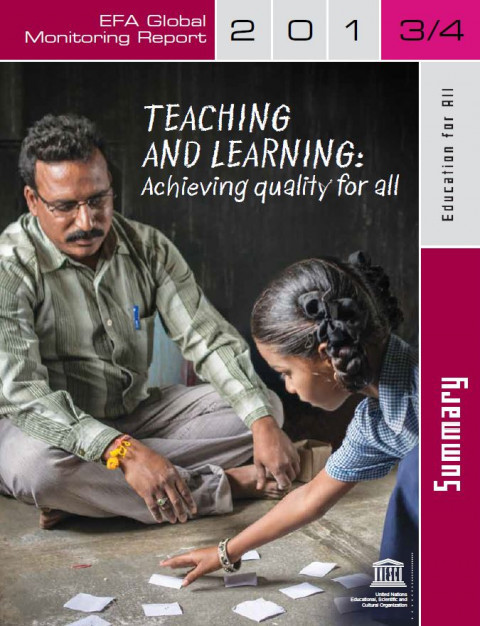 Teaching and Learning: Achieving Quality for All (EFA Global Monitoring Report, 2013-2014; Summary) سنة النشر: 2014 المؤلف المؤسسي: UNESCO This Report is an independent publication commissioned by UNESCO on behalf of the international community. It is the product of a collaborative effort involving members of the Report Team and many other people, agencies, institutions and governments. This 11th EFA Global Monitoring Report provides a timely update on progress that countries are making towards the global education goals that were agreed in 2000. It also makes a powerful case for placing education at the heart of the global development agenda after 2015.An education system is only as good as its teachers. Unlocking their potential is essential to enhancing the quality of learning. Evidence shows that education quality improves when teachers are supported – it deteriorates if they are not, contributing to the shocking levels of youth illiteracy captured in this Report. This Report identifies four strategies to provide the best teachers to reach all children with a good quality education. The Report shows also that teachers can only shine in the right context, with well-designed curricula and assessment strategies to improve teaching and learning. This Report’s evidence clearly shows that education provides sustainability to progress against all development goals. Educate mothers, and you empower women and save children’s lives. Educate communities, and you transform societies and grow economies. This is the message of this EFA Global Monitoring Report. Преподавание и обучение: Обеспечение качества для всех سنة النشر: 2014 المؤلف المؤسسي: Организация Объединенных Наций по вопросам образования, науки и культуры (UNESCO) Настоящий доклад представляет собой независимую публикацию, подготовленную по заказу ЮНЕСКО для международного сообщества. Он является результатом совместной работы, в которой участвовали члены Группы по подготовке Всемирного доклада по мониторингу "Образование для всех" (ОДВ), а также многие другие специалисты, учреждения, институты и правительства.Настоящий 11-й Всемирный доклад по мониторингу ОДВ представляет обновленную информацию о прогрессе стран на пути к достижению глобальных целей в области образования, согласованных в 2000 г. В докладе также приводятся серьезные доводы в пользу обеспечения приоритетного внимания вопросам образования в рамках глобальной повестки дня в области развития на период после 2015 г.Система образования напрямую зависит от учителей. Раскрытие их потенциала играет ключевую роль для повышения качества обучения. Факты говорят о том, что качество образования повышается при оказании поддержки учителям и понижается при ее отсутствии, что влияет на шокирующий уровень неграмотности молодежи, отраженный в настоящем докладе.В данном докладе представлены четыре стратегии по обеспечению школ лучшими учителями в целях предоставления всем детям качественного образования. В докладе также отмечается, что учителя могут действительно добиваться успеха только в благоприятных условиях при использовании хорошо разработанных стратегий в области учебных программ и процедур оценки, направленных на повышение уровня преподавания и обучения. В настоящем докладе представлены четкие доказательства того, что образование обеспечивает устойчивые условия для достижения всех целей в области развития. Просвещение матерей позволяет не только расширить права и возможности женщин, но и сохранить жизни детей. Просвещение общин способствует преобразованию обществ и развитию экономики. В этом и заключается главная идея настоящего Всемирного доклада по мониторингу ОДВ.
 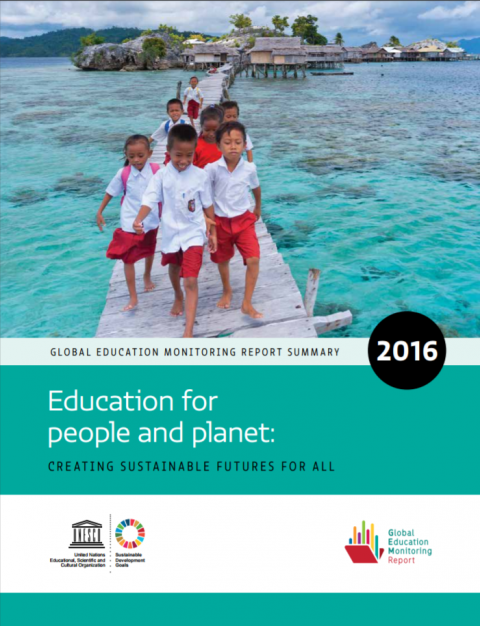 教育造福 人类与地球:为全民创造可持续的未来, 2016 全球教育监测报告; 摘要 سنة النشر: 2016 المؤلف المؤسسي: 联合国教科文组织 (UNESCO) The GEM Report provides an authoritative account of how education is the most vital input for every dimension of sustainable development. Better education leads to greater prosperity, improved agriculture, better health outcomes, less violence, more gender equality, higher social capital and an improved natural environment. Education is key to helping people around the world understand why sustainable development is such a vital concept for our common future. Education gives us the key tools – economic, social, technological, even ethical – to take on the SDGs and to achieve them. These facts are spelled out in exquisite and unusual detail throughout the report. Yet the report also emphasizes the remarkable gaps between where the world stands today on education and where it has promised to arrive as of 2030. التعليم من أجل الناس والكوكب: بناء مستقبل مستدام للجميع سنة النشر: 2016 المؤلف المؤسسي: منظمة الأمم المتحدة للتربية والعلم والثقافة (UNESCO) The GEM Report provides an authoritative account of how education is the most vital input for every dimension of sustainable development. Better education leads to greater prosperity, improved agriculture, better health outcomes, less violence, more gender equality, higher social capital and an improved natural environment. Education is key to helping people around the world understand why sustainable development is such a vital concept for our common future. Education gives us the key tools – economic, social, technological, even ethical – to take on the SDGs and to achieve them. These facts are spelled out in exquisite and unusual detail throughout the report. Yet the report also emphasizes the remarkable gaps between where the world stands today on education and where it has promised to arrive as of 2030.
 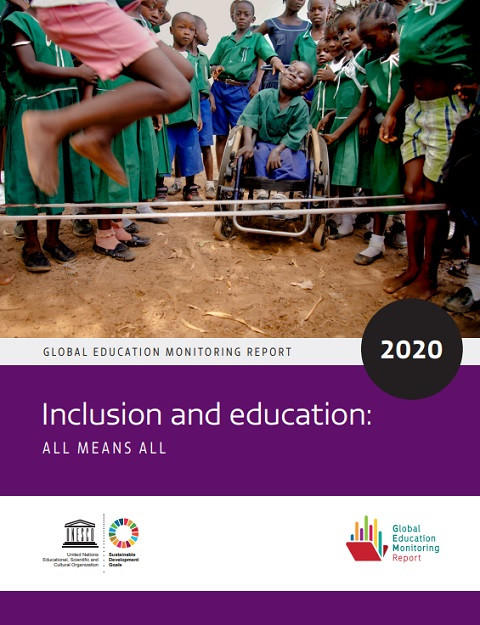 Global Education Monitoring Report 2020: Inclusion and Education; All Means All سنة النشر: 2020 المؤلف المؤسسي: Global Education Monitoring Report Team | UNESCO The 2020 Global Education Monitoring Report looks at social, economic and cultural mechanisms that discriminate against disadvantaged children, youth and adults, keeping them out of education or marginalized in it. Spurred by their commitment to fulfil the right to inclusive education, countries are expanding their vision of inclusion in education to put diversity at the core of their systems. Yet implementation of well-meaning laws and policies often falters. Released at the start of the decade of action to 2030, and in the middle of the Covid-19 crisis, which has exacerbated underlying inequalities, the Report argues that resistance to addressing every learner’s needs is a real threat to achieving global education targets. Inclusion and education: All means all identifies the practices in governance and finance; curricula, textbooks and assessments; teacher education; school infrastructure; and relations with students, parents and communities that can unlock the process to inclusion. It provides policy recommendations to make learner diversity a strength to be celebrated, a force for social cohesion. Two new websites complement the fourth edition of the Global Education Monitoring Report. PEER describes how countries approach inclusion, serving as a resource for policy dialogue. SCOPE offers an opportunity to interact with the data and explore selected SDG 4 indicators. Rapport mondial de suivi sur l’éducation 2020: Inclusion et éducation ; Tous, sans exception سنة النشر: 2020 المؤلف المؤسسي: Global Education Monitoring Report Team | Organisation des Nations Unies pour l'éducation, la science et la culture (UNESCO) L’édition 2020 du Rapport mondial de suivi sur l’éducation examine les mécanismes sociaux, économiques et culturels qui discriminent les enfants, les jeunes et les adultes défavorisés, les tenant à l’écart de l’éducation ou les marginalisant en son sein. Encouragés par leur engagement à réaliser le droit à l’éducation inclusive, les pays élargissent leur vision de l’inclusion dans l’éducation afin de placer la diversité au cœur de leurs systèmes. Pourtant, la mise en œuvre de lois et de politiques bien intentionnées échoue souvent. Publié au début de la décennie d’action à l’horizon 2030, et en pleine crise de COVID-19 qui a exacerbé les inégalités existantes, rapport affirme que la résistance à la prise en compte des besoins de chaque apprenant constitue une menace réelle pour la réalisation des objectifs mondiaux d’éducation. Inclusion et éducation : Tous, sans exception recense les pratiques en matière de gouvernance et de financement, de programmes, de manuels et d’évaluations, de formation des enseignants, d’infrastructures scolaires et de relations avec les élèves, les parents et les communautés, qui peuvent enclencher le processus menant à l’inclusion. Il fournit des recommandations stratégiques pour faire de la diversité des apprenants une force à célébrer, une force de cohésion sociale. Deux nouveaux sites web complètent cette quatrième édition du Rapport mondial de suivi sur l’éducation. PEER décrit la manière dont les pays abordent l’inclusion, et sert de ressource pour le dialogue sur les politiques. SCOPE offre la possibilité d’interagir avec les données et d’explorer un choix d’indicateurs de l’ODD 4.
  Educación para el desarrollo sostenible: Asociados en la acción; Informe de los asociados clave del Programa de Acción Mundial de Educación para el Desarrollo Sostenible (2015-2019) سنة النشر: 2019 المؤلف المؤسسي: Organización de las Naciones Unidas para la Educación, la Ciencia y la Cultura (UNESCO) La UNESCO puso en marcha el Programa de Acción Mundial de Educación para el Desarrollo Sostenible (EDS) como seguimiento del Decenio de las Naciones Unidas de la EDS, con el fin de acelerar el progreso del desarrollo sostenible e intensificar las iniciativas de EDS en todas las esferas de la educación y el aprendizaje. Este Programa se desarrolló entre 2015 y 2019. La UNESCO trabajó con una red de 97 asociados clave del Programa de Acción Mundial, procedentes de gobiernos, la sociedad civil, el sector privado y el mundo académico que trabajan en cinco ámbitos de acción prioritarios: la promoción de políticas, la transformación de los entornos de aprendizaje, el desarrollo de la capacidad de los educadores, el empoderamiento de los jóvenes y la aceleración de las soluciones sostenibles a escala local. Los asociados clave del Programa se comprometieron a cumplir objetivos específicos para 2019.Se desarrollaron diez indicadores, dos por cada ámbito de acción prioritario.Los asociados clave del Programa informaron de sus progresos en relación con esos indicadores en tres encuestas que les envió la UNESCO a lo largo del Programa. También se invitó a los asociados clave a que valoraran los beneficios que había tenido para su labor la participación en el Programa de Acción Mundial y a que proporcionaran datos cualitativos sobre los progresos realizados en la aplicación del mismo. Se elaboraron tres informes sobre los progresos realizados:• El primer informe, que abarca los progresos realizados entre 2015 y 2016, fue publicado por la UNESCO en 2017.• El segundo informe, que abarca de 2015 a 2018, se publicó en 2019.• Este tercer y último informe abarca todo el periodo del Programa de Acción Mundial, desde 2015 hasta 2019.En el presente informe se presenta el análisis de las respuestas cuantitativas de los asociados clave del Programa a cada uno de los diez indicadores. Sobre la base de las respuestas cualitativas, se ofrece también un breve comentario sobre los progresos realizados en relación con cada indicador. Este breve informe concluye con algunas enseñanzas extraídas del Programa de Acción Mundial que pueden servir de base para la aplicación del nuevo marco mundial para el periodo 2020-2030: “Educación para el desarrollo sostenible: hacia la consecución de los ODS (EDS para 2030)”. Образование в интересах устойчивого развития: Партнеры в действии; Доклад ключевых партнеров по Глобальной программе действий (ГПД) (2015-2019 гг.) سنة النشر: 2019 المؤلف المؤسسي: Организация Объединенных Наций по вопросам образования, науки и культуры (UNESCO) По итогам Десятилетия образования в интересах устойчивого развития (ОУР) Организации Объединенных Наций ЮНЕСКО предприняла осуществление Глобальной программы действий (ГПД) по ОУР в целях содействия устойчивому развитию и расширению масштабов действий в сфере ОУР во всех областях образования и обучения. Время осуществления программы – с 2015 г. по 2019 г. ЮНЕСКО развернула сотрудничество с сетью из 97 ключевых партнеров по ГПД, представляющих правительство, гражданское общество, частный сектор и академические круги. Деятельность осуществлялась в пяти приоритетных областях: разработка политики, преобразование учебной среды, создание потенциала преподавателей, расширение прав и возможностей молодежи и содействие принятию устойчивых решений на местном уровне. Ключевые партнеры по ГПД взяли на себя обязательство выполнить к 2019 г. ряд конкретных задач. Было разработано десять целевых показателей – по два для каждой приоритетной области деятельности. Ключевые партнеры по ГПД представили информацию о прогрессе в достижении этих показателей, ответив на три опроса, которые ЮНЕСКО направила им в ходе осуществления программы. Ключевым партнерам было также предложено оценить преимущества, полученные ими самими благодаря участию в ГПД, и представить данные качественного характера о ходе работы. Достигнутым успехам были посвящены три доклада: первый доклад, охватывающий период 2015-2016 гг., был выпущен ЮНЕСКО в 2017 г.; второй доклад, охватывающий период 2015-2018 гг., был опубликован в 2019 г.; настоящий доклад, третий и заключительный, охватывает весь период осуществления ГПД с 2015 г. по 2019 г. В этом докладе содержится анализ количественных данных, представленных ключевыми партнерами по ГПД по каждому из десяти показателей. На основе качественных ответов, представленных ключевыми партнерами по ГПД, в докладе также дается краткий комментарий о ходе работы над каждым показателем.В заключительной части доклада содержатся некоторые выводы, касающиеся осуществления ГПД, которые могут послужить информационной основой для реализации новых рамочных принципов деятельности в области ОУР на период 2020-2030 гг. под названием «Образование в интересах устойчивого развития: на пути к достижению ЦУР (ОУР на период до 2030 г.)».