
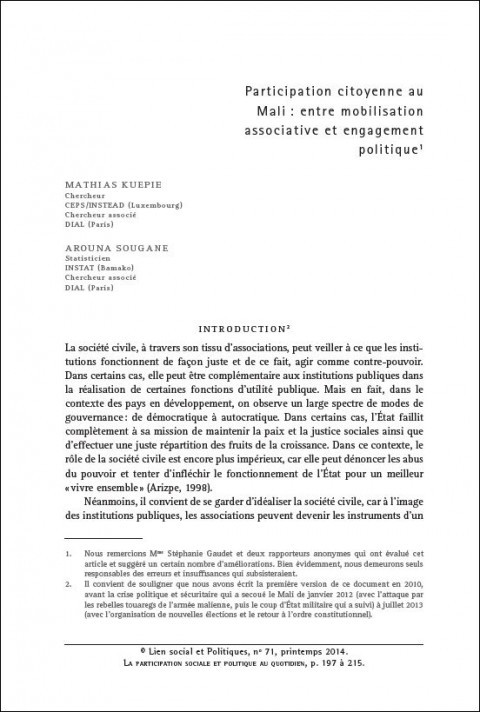
Citizen Participation in Mali: Between Associative Mobilization and Political Engagement
- Author
- Mathias KuepieArouna Sougane
- Corporate Author
- Lien social et Politiques
- ISBN
- ISSN 1703-9665 (numérique)
- Collation
- p. 197–215
- Resource Language
- French
- Year of publication
- 2014
- Resource Type
- International normative instruments / policy and advocacy documentsResearch papers / journal articles
- Level of education
- Non-formal education
- Region
- Africa
- Place of publication
- Québec
In this study we examine citizen engagement in Mali. We begin by discussing the concept of civil society associated with such engagement. We then draw on two sources of data (the 2006 light integrated household survey [ELIM] and the national election administrative reports) to analyse involvement in political and community life. The results show that even if most Malians have already taken part in political activities, only a small minority has actually ever voted, which is a crucial form of political participation. Another finding that raises questions is that the advantaged social groups are those that participate more in political activities, whereas the less advantaged are more likely to become involved in community life through associations. Lastly, participation in associations seems to encourage political participation, most probably because community involvement can awaken political consciousness, but also no doubt because involvement in associations can help increase one’s political influence.
Related Resources
-
 IIEP-UNESCO 12th Medium-Term Strategy: 2026–2029
 -
 Advancing Intergenerational Learning: Identifying Challenges and Opportunities for Older Adults; Integrated Case Study Report
 -
 Digital Empowerment for Lifelong Learning and Transformative Andragogy (DELTA) for Adult Educators: Introduction to the DELTA Framework and Resources
 -
 Bridging the Grey Digital Divide: Enhancing ICT Learning for Older Adults; Research Report