
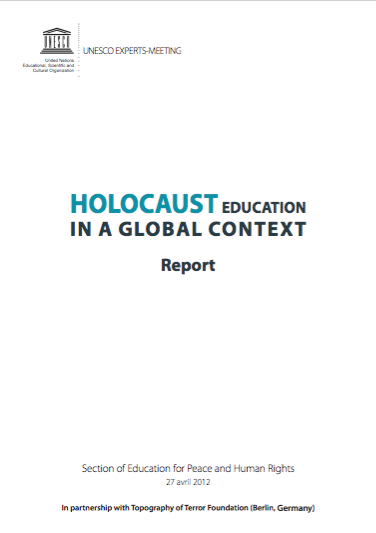
Holocaust Education in a Global Context: Report
- Corporate Author
- UNESCO
- Collation
- 14 p.
- Resource Language
- English
- Year of publication
- 2013
- Region
- Global
Teaching and learning about the Holocaust, which until this point had largely been a matter of regional interest, for Europeans, as well as North Americans and Israelis, became officially an issue of universal concern. Other countries are now invited to teach about the Holocaust even if they do not have a direct link to the event. This raises many issues concerning the pedagogical implications of this global perspective on Holocaust education. Why and how is the Holocaust taught in countries that have no connections with the genocide and the history of the Jewish people? How does this history connect and resonate with the preoccupations of these countries? Generally speaking, what could be the purposes and the benefits of teaching about the Holocaust globally?
In order to address these issues, UNESCO organized an experts-meeting on 27 April 2012, in partnership with the Topography of Terror Foundation (Berlin, Germany). The purpose was specifically to clarify the following questions:
- What are the current trends of Holocaust education worldwide?
- How can the Holocaust be studied in a comparative fashion in the classroom?
- In which ways does Holocaust education contribute to the prevention of genocide? Furthermore, how is it taught in a human rights education perspective?
- Can the Holocaust provide a suitable framework to address other traumatic events of the past?
Related Resources
-
 Addressing Violent Pasts through Education: A Policy Guide
 -
 UNESCO Framework for Culture and Arts Education: Implementation Guidance
 -
 Mainstreaming the General History of Africa into Education Systems: The Curriculum Pathway
 -
 The Representation of Jews, Judaism and Antisemitism in School Textbooks and Curricula in Europe