
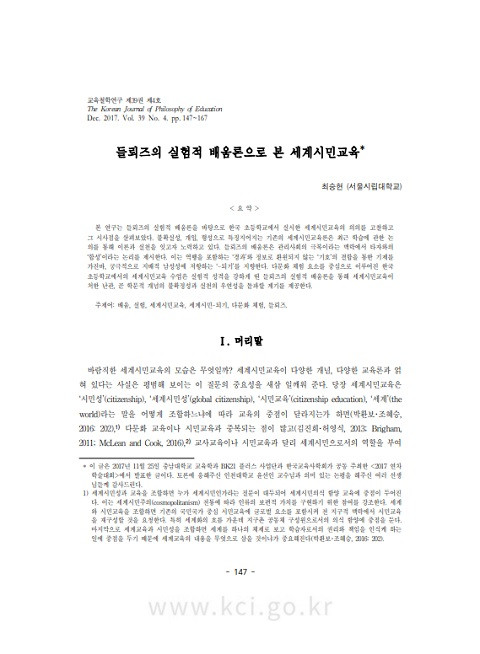
Deleuze’s Experimental Apprenticeship and Global Citizenship Education
- Author
- Seunghyun Choi
- Corporate Author
- Korean Philosophy of Education Society
- ISBN
- ISSN 1598-1568
- Collation
- p. 147-167
- Resource Language
- Korean
- Year of publication
- 2017
- Resource Type
- Research papers / journal articles
- Level of education
- Primary education
- Region
- Asia and the Pacific
- Place of publication
- Gwangju
The purpose of this study is to examine the implications of Deleuze’s apprenticeship for Global Citizenship Education. Nowadays, many researchers are interested in the meaning of learning as a bridge between ideal and practice. Deleuze’s apprenticeship suggests the logic of the ‘composition’ with others in the context of overcoming ‘the societies of control’. The structure of this argument consists in ‘process’ including involution and in ‘signs’ that are not reduced to information. It aims at ‘becoming’. The global citizenship lesson focusing on the element of multi-cultural experience of Korean elementary school students has a well-balanced relationship with Deleuze’s apprenticeship as experimentation. Lastly, we are able to understand the meaningful implications for the aporia in Global Citizenship Education, that is the uncertainty of academic conceptualization and the contingency of practice.
Related Resources
-
 Addressing Violent Pasts Through Education: A Policy Guide
 -
 Where Learners Meet History: Reaffirming the Role of History Education in the 21st Century
 -
 Voices Against Violence: Middle Years
 -
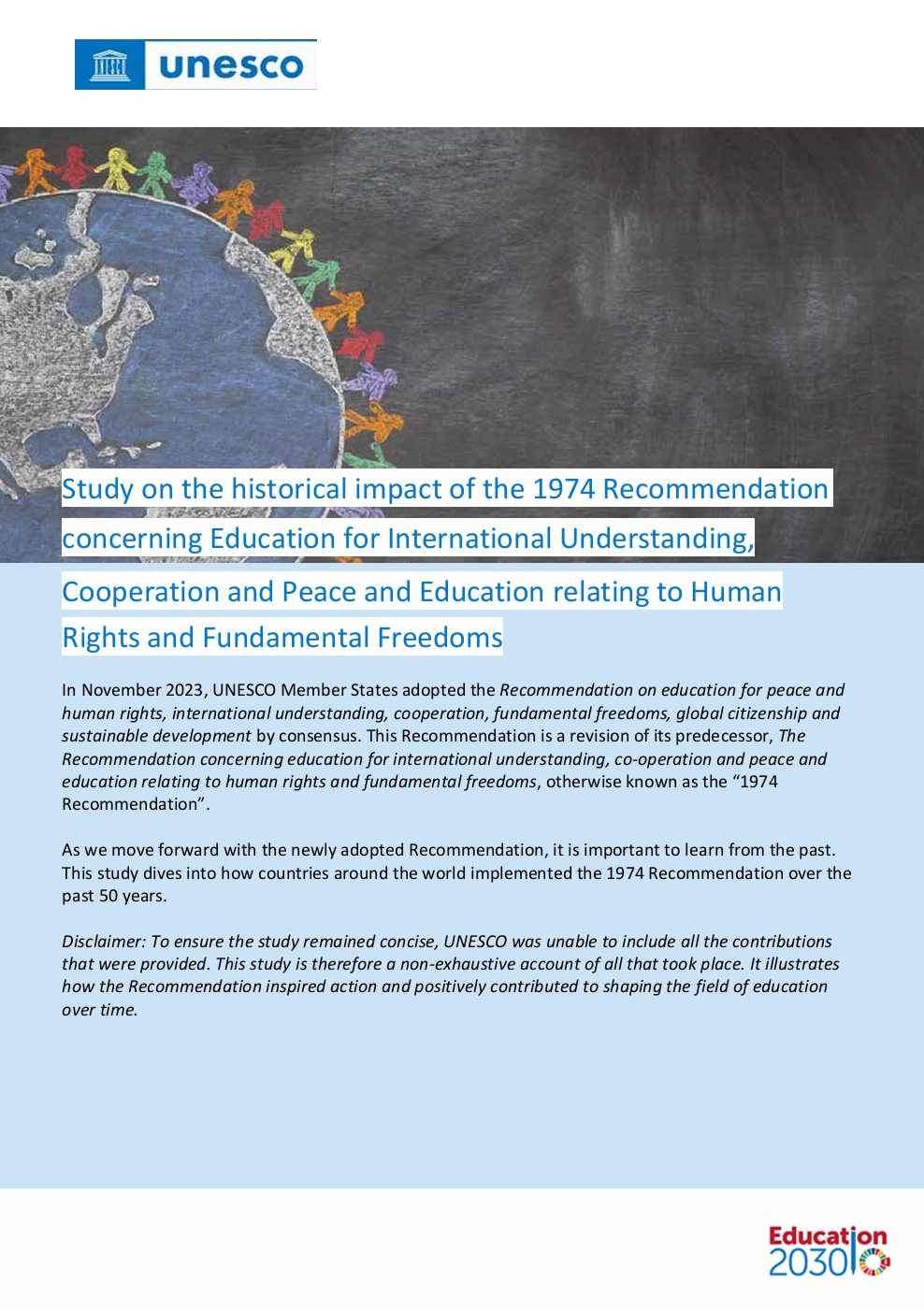 Study on the Historical Impact of the 1974 Recommendation concerning Education for International Understanding, Cooperation and Peace and Education relating to Human Rights and Fundamental Freedoms