
Resources
Explore a wide range of valuable resources on GCED to deepen your understanding and enhance your research, advocacy, teaching, and learning.
3 Results found
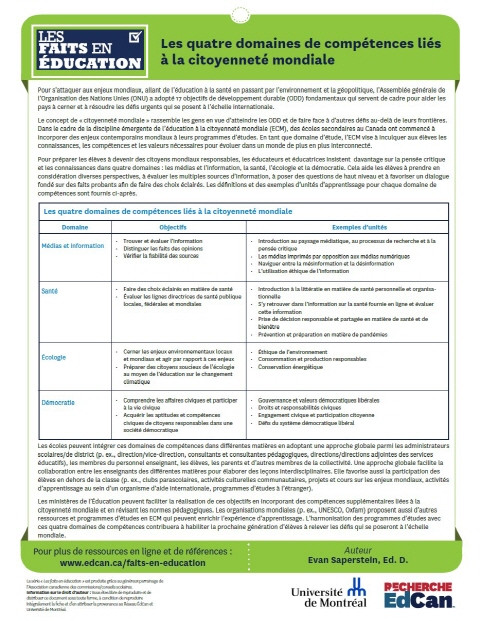 The Four Areas of Competence Linked to Global Citizenship Year of publication: 2023 Author: Evan Saperstein Corporate author: Université de Montréal | Association Canadienne d'Education Ce document présente les quatre domaines de compétences liées à la citoyenneté, et comment les intégrer à l'éducation des élèves. Pour préparer les élèves à devenir des citoyens mondiaux responsables, les éducateurs et éducatrices insistent davantage sur la pensée critique et les connaissances dans quatre domaines : les médias et l’information, la santé, l’écologie et la démocratie. This document presents the four areas of competency linked to citizenship, and how to integrate them into pupils' education. To prepare students to become responsible global citizens, educators are placing greater emphasis on critical thinking and knowledge in four areas: media and information, health, ecology and democracy. Les quatre domaines de compétences liés à la citoyenneté mondiale Year of publication: 2023 Author: Evan Saperstein Corporate author: Université de Montréal | Association Canadienne d'Education Ce document présente les quatre domaines de compétences liées à la citoyenneté, et comment les intégrer à l'éducation des élèves. Pour préparer les élèves à devenir des citoyens mondiaux responsables, les éducateurs et éducatrices insistent davantage sur la pensée critique et les connaissances dans quatre domaines : les médias et l’information, la santé, l’écologie et la démocratie. This document presents the four areas of competency linked to citizenship, and how to integrate them into pupils' education. To prepare students to become responsible global citizens, educators are placing greater emphasis on critical thinking and knowledge in four areas: media and information, health, ecology and democracy.
 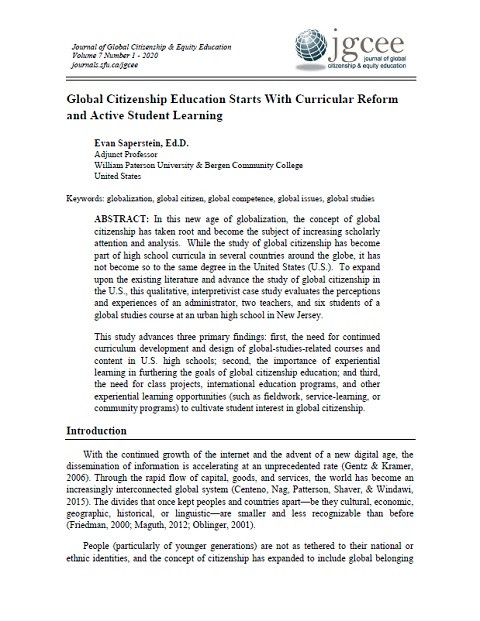 Global Citizenship Education Starts With Curricular Reform and Active Student Learning (Journal of Global Citizenship & Equity Education; Vol. 7, No. 1) Year of publication: 2020 Author: Evan Saperstein Corporate author: Centennial College In this new age of globalization, the concept of global citizenship has taken root and become the subject of increasing scholarly attention and analysis. While the study of global citizenship has become part of high school curricula in several countries across the globe, it has not to the same degree in the United States. To expand upon the existing literature and advance the study of global citizenship in the United States, this qualitative, interpretivist case study evaluates the perceptions and experiences of an administrator, two teachers, and six students of a global studies course at an urban high school in New Jersey. The study included interviews of the participants, as well as analysis of the course curriculum, syllabus, and student assignments.This study advances three primary findings. First, the need for continued curriculum development and design of global studies related courses and content in U.S. high schools. Second, the importance of experiential learning, among other forms of pedagogy and instructional practices, in furthering the goals of global citizenship education. Third, the need for class projects, international education programs, and other experiential learning opportunities (such as fieldwork, service-learning, or community programs) to cultivate student interest in global citizenship. Based on these findings and the prevailing literature, this study is proposing that U.S. high schools offer an elective course on global citizenship with ten units: 1) Introduction to Global Citizenship; 2) Sustainable Development; 3) Poverty and World Hunger; 4) Global Health Issues; 5) Child Mortality; 6) Peace and Conflict; 7) Human Rights and Gender Equality; 8) Universal Education; 9) Liberal Democratic Governance and Rights; 10) Global Citizenship Action Plan.