
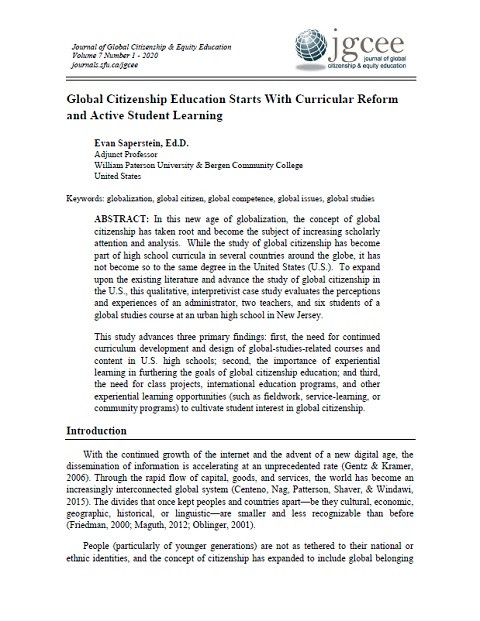
Global Citizenship Education Starts With Curricular Reform and Active Student Learning (Journal of Global Citizenship & Equity Education; Vol. 7, No. 1)
- Author
- Evan Saperstein
- Corporate Author
- Centennial College
- ISBN
- ISSN 1927-2669
- Collation
- p. 1-32
- Resource Language
- English
- Year of publication
- 2020
- Resource Type
- Research papers / journal articles
- Level of education
- Secondary education
- Region
- Europe and North America
- Place of publication
- Toronto
In this new age of globalization, the concept of global citizenship has taken root and become the subject of increasing scholarly attention and analysis. While the study of global citizenship has become part of high school curricula in several countries across the globe, it has not to the same degree in the United States. To expand upon the existing literature and advance the study of global citizenship in the United States, this qualitative, interpretivist case study evaluates the perceptions and experiences of an administrator, two teachers, and six students of a global studies course at an urban high school in New Jersey. The study included interviews of the participants, as well as analysis of the course curriculum, syllabus, and student assignments.
This study advances three primary findings. First, the need for continued curriculum development and design of global studies related courses and content in U.S. high schools. Second, the importance of experiential learning, among other forms of pedagogy and instructional practices, in furthering the goals of global citizenship education. Third, the need for class projects, international education programs, and other experiential learning opportunities (such as fieldwork, service-learning, or community programs) to cultivate student interest in global citizenship. Based on these findings and the prevailing literature, this study is proposing that U.S. high schools offer an elective course on global citizenship with ten units: 1) Introduction to Global Citizenship; 2) Sustainable Development; 3) Poverty and World Hunger; 4) Global Health Issues; 5) Child Mortality; 6) Peace and Conflict; 7) Human Rights and Gender Equality; 8) Universal Education; 9) Liberal Democratic Governance and Rights; 10) Global Citizenship Action Plan.
Related Resources
-
 Study on the Historical Impact of the 1974 Recommendation concerning Education for International Understanding, Cooperation and Peace and Education relating to Human Rights and Fundamental Freedoms
 -
 IIEP-UNESCO 12th Medium-Term Strategy: 2026–2029
 -
 More than Welcome: Intercultural Integration of Migrants in and Through Higher Education
 -
 Advancing Intergenerational Learning: Identifying Challenges and Opportunities for Older Adults; Integrated Case Study Report