
Resources
Explore a wide range of valuable resources on GCED to deepen your understanding and enhance your research, advocacy, teaching, and learning.
190 Results found
 A Study on the Monitoring Framework of GCED in South Korea Year of publication: 2020 Author: Hwanbo Park | Daehoon Jho | Kyunghee Park | Jeongmin Eom Corporate author: APCEIU The purpose of this study is to establish a feasible monitoring system for the implementation of Global Citizenship Education (GCED) in South Korea that can both align itself with the global indicator (SDG 4.7.1) and reflect the domestic context and feasibility. The study further builds upon previous studies carried out by the Asia-Pacific Centre of Education for International Understanding (APCEIU). Particularly, it aims to refine and validate the GCED indicator system for domestic monitoring as proposed in the previous studies, which are also in line with SDG 4.7.1, the global indicator to monitor the mainstreaming of GCED/ESD.To this end, the study involved a Delphi survey and expert consultation to build the refined list and classification of GCED related thematic areas and keywords contextualized in Korea, and aligned these with global indicators so that it could establish a set of sub-indicators for the South Korean context. Then, it pilot-tested the sub-indicators by codifying and statistically analyzing key policy documents and the curricula of Teacher Education Institutes (TEIs) to validate the sub-indicators and to examine the extent to which GCED is mainstreamed in the given domains of the Korean context. Case analyses with focused interviews for some TEI curricula were also added to enrich the study. Lastly, the study draws key implications and proposes some recommendations for the establishment of a feasible and sustainable GCED monitoring system in South Korea. Considering the importance of national input in initiating the SDG agenda, the research concluded with a proposal on how to manage the global citizenship indicators in South Korea.
  Global Citizenship Education and Youth Advocacy for a More Peaceful and Sustainable World: A Resource Manual Year of publication: 2020 Author: Dylan Wray | Lisa Van Wyk | Rigoberto D. Banta Jr. | Roy Hellenberg | Anna Susarenco | Diego Manrique | Guranda Bursulaia | Noora Elkenawi | Shawgi Ahmed | Tshering Zangmo | Valeriia Moroz Corporate author: APCEIU Since 2016 the Global Citizenship Education (GCED) Youth Network and UNESCO Asia-Pacific Centre of Education for International Understanding(APCEIU) have been working together to support young people to take action to make their communities and the world a better place.This manual, which is the outcome of a joint initiative by the GCED Youth Network and APCEIU, is intended to provide a useful resource for those who teach GCED, for youth organisations that are engaged in advocacy on themes that relate to global citizenship, and those who are supporting youth advocacy.The manual is organized in three main sections: Section 1 focuses on GCED and the teaching of history as a strategy for building a peaceful world.Section 2 provides step by step practical guidelines and ideas for youth advocacy organisations to help them plan advocacy initiatives.Section 3 includes background information and practical ideas for youth advocacy on a series of themes that are relevant to GCED, including empowerment of vulnerable communities, media literacy and peace building. It also considers the role of GCED, and young people, in global crises, using the example of the COVID-19 pandemic, and provides suggestions to help youth advocacy and other organisations to prepare for and respond to such crises
  GCED Learning and Assessment: An Analysis of Four Case Studies in Asia Year of publication: 2020 Corporate author: APCEIU | UNESCO Bangkok “GCED Learning and Assessment: An Analysis of Four Case Studies in Asia” is a result report of research jointly led by UNESCO Asia-Pacific Regional Bureau for Education, the Asia-Pacific Centre of Education for International Understanding (APCEIU) and the Asia-Pacific Regional GCED Network. The report encompasses four case studies of GCED Learning in the region and its assessment. Four leading researchers in the field of GCED, Satya Bushan from the National Council of Educational Research and Training (NCERT), India; Sayaka Matsukura of Ageo Oishi Junior High School, Japan; Dawon Kim from Gwangju National University of Education, Republic of Korea; and Le Anh Vinh from the Vietnam National Institute of Educational Science (VNIES), Viet Nam, contributed to this research. Through presenting and sharing the cases of India, Japan, Republic of Korea and Viet Nam, the publication is expected to shed light on the assessment on how GCED is implemented in the region and further inspire and encourage the GCED practitioners on the ground to take another step forward to reflect GCED in their respective educational systems. <List of Contents>ForewordAcknowledgementsAcronymsExecutive summaryChapter 1: IntroductionChapter 2: Schoollevel approaches at integrating GCEDChapter 3: Assessment of GCED learning Chapter 4: Reflections on GCED learning assessment Chapter 5: Conclusions and recommendations References
  Understanding GCED in Asia-Pacific: A How-to Guide for ‘Taking It Local’ Year of publication: 2020 Corporate author: APCEIU | UNESCO Bangkok The Asia-Pacific Centre of Education for International Understanding (APCEIU), in partnership with UNESCO Bangkok, has published “Understanding GCED in Asia-Pacific: A How-To Guide for ‘Taking It Local’”, a guidebook for GCED-themed workshop organizations in the region. The publication is developed by UNESCO Asia-Pacific Regional Bureau for Education under the framework of the Asia-Pacific Regional GCED Network that is coordinated by UNESCO Bangkok and APCEIU. Taking stock of the key data from the 2019 publication titled “GCED: Taking it Local in Asia-Pacific”, the guidebook presents full-detailed guidelines on preparing and conducting a ‘Taking it Local’ workshop on GCED with particular focuses on the three core notions of GCED – respect for diversity, solidarity and a shared sense of humanity. The purpose of the publication is to promote GCED in local contexts and support active GCED practitioners on the ground to design and carry out GCED workshops that are translated and designed fully within the local context of the Asia-Pacific region. <Contents>Chapter 1: Introduction1.1 What is GCED?1.2 Purpose of the Guidebook1.3 Pedagogical ApproachChapter 2: Preparing a ‘Taking it Local’ Workshop on GCED2.1 Workshop Objectives2.2 Target Audiences2.3 Workshop Preparation2.4 Tips for a Successful Workshop2.5 Sample Agenda for the WorkshopChapter 3: Conducting a ‘Taking it Local’ Workshop on GCED3.1 Welcome, Overview, and Agreements3.2 Introduction Exercise: Story Circles3.3 GCED in AsiaPacific Exercise3.4 Optional Activities for the Workshop 3.5 Application Exercise 3.6 Closing 3.7 Final Reflection and Workshop Evaluation 3.8 Sharing Reflections 3.9 FollowUp of the WorkshopReferences
  International Understanding and Cooperation in Education in the Post-Corona World Year of publication: 2020 Author: Dongjoon Jo | Edward Vickers | Dina Kiwan | Fei Yan | Kyujoo Seol | Kyoko Nakayama Corporate author: APCEIU Research Report of International Understanding and Cooperation in Education in the Post-Corona World APCEIU has published a report, including research studies from 6 experts in order to figure out the role of education in promoting international understanding and cooperation in the education sector in the post-pandemic world. Through this research project, APCEIU mainly sought to answer the following questions; ▲What will be the implications of COVID-19 for international exchange and cooperation especially in education?▲What should we as educators, researchers, and practitioners do to counter the rise of populist nationalism?▲What should be the focus and direction of international cooperation in education during and after the pandemic in order to promote international understanding and GCED? This research project is expected to provide insightful views on the desirable direction for international understanding and cooperation in the education sector. Table of Contents 1. The development of UNESCO’s exchange programmes and their possible rearrangements in the post-pandemic years (Dong-Joon Jo, Professor at Department of Political Science and International Relations, Seoul National University, Korea) 2. ‘Rethinking Schooling’ once again: Post-corona challenges for education for peace and sustainability in Asia (Edward Vickers, Professor of Comparative Education at Kyushu University, Japan) 3. Race, gender, disability, and their intersections under the impact of COVID-19 (Dina Kiwan, Professor in Comparative Education, University of Birmingham, United Kingdom) 4. Competition or cooperation: Configuring ‘International’ in Chinese school textbooks (Fei Yan, Post-Doctoral Research Fellow, South China University, China) 5. The implications of democratic citizenship education and global citizenship education in South Korea for the post-corona era (Kyujoo Seol, Professor of Social Studies Education, Kyeongin National University of Education, Korea) 6. What can we learn from the pandemic of COVID-19?: An attempt to develop teaching materials for international understanding and cooperation based on Japanese educational issues (Kyoko Nakayama, Professor of Social Studies Education and Multicultural Education, Teikyo University, Japan)
 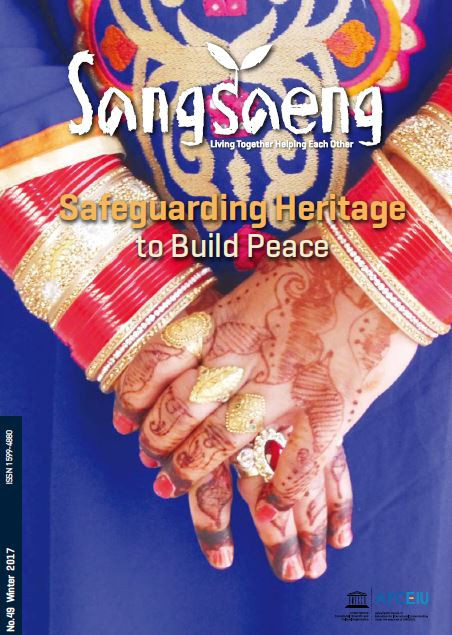 Safeguarding Heritage to Build Peace (SangSaeng no. 49 Winter 2017) Year of publication: 2017 Corporate author: APCEIU The 49h issue of SangSaeng, “Safeguarding Heritage to Build Peace,” has been published. All ancient civilizations have contributed in some way to the development of modern society. Therefore, all are equally deserving of study. This edition of SangSaeng aims to examine heritage in its different contexts and to help identify our responsibilities as a global community to understand and tolerate other people’s heritages. 3 Director’s Message4 Special Column4 Taking Stewardship of Our Planet8 Focus: Heritage8 Heritage for Peace and Prosperity12 Heritage Education: Opportunity to Enhance Cultural Literacy17 Photo Essay: World Heritage Sites of 2017 21 Special ReportUNAI Impacts Scholarship, Research for Greater Good24 Best Practices24 Frontier Education on the Frontier for Life29 Encouraging the Heart of the Matter33 InterviewGCED Challenge Issued36 Youth NetworkYouth Building Peace 40 LetterJourney to the Heart of Peace42 Peace in My MemoryPeace in a World of Violence46 Understanding the Asia-Pacific RegionEgg, Tambourine and Commemoration49 APCEIU in Action
  Global Citizenship Concepts in the Curricula of Four Countries Year of publication: 2017 Author: Natalie Browes Corporate author: UNESCO International Bureau of Education (IBE) | APCEIU This report details the presence of Global Citizenship Education (GCED) concepts in the education systems of four countries: Cambodia, Colombia, Mongolia and Uganda. It highlights the main findings of eight reports: four expert reports, which predominately analyse curriculum content, and four situational analysis reports, which take a broader view and detail some of the country-specific challenges and opportunities with regard to GCED. Findings reveal the presence of GCED concepts across the curricula of the four countries. In addition to cognitive content related to GCED, competency-based content is also found present within the curricula of these countries. However, the majority of this content can only be indirectly linked to GCED, and it is better interpreted as part of the more traditional civics or citizenship education approach. As such, it generally lacks a global perspective and does not engage with all key themes of GCED. Furthermore, this content is often concentrated at the lower and upper secondary levels, instead of being equally distributed across all grade levels. This is particularly true in the case of behaviour-based competencies. Findings also reveal challenges beyond the curriculum. These include lack of teacher training and lack of support to implement GCED, which are concerns expressed by stakeholders in all four countries. A lack of GCED content in textbooks and lack of supplementary materials were also found to be issues. The report concludes with recommendations regarding the effective implementation of GCED within curricula. Among others, the report suggests the transversal integration of GCED - across the curriculum at all grade levels, while at the same time, actors from all levels of the education system, ranging from central government to teachers, should be engaged to ensure the use of complementary learning materials, pedagogies and assessment techniques.
 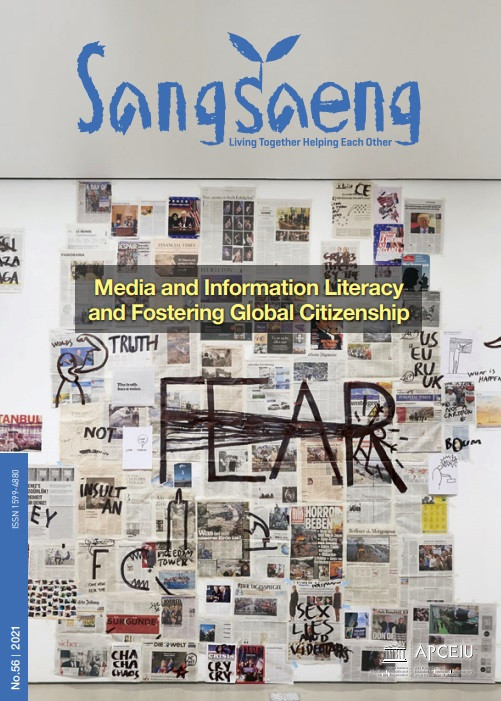 Media and Information Literacy and Fostering Global Citizenship (SangSaeng no.56, 2021) Year of publication: 2023 Corporate author: APCEIU In today’s digital age, we increasingly rely on media content and information mostly shared online to keep us informed and connected. Those issues of hate speech and stigma during the COVID-19 pandemic are closely related to the spread of fake news and disinformation. Thus, media and information literacy (MIL) has become more crucial than ever for global citizenship. In this context, the 56th edition of SangSaeng focuses on “Media and Information Literacy and Fostering Global Citizenship.” Contents 03 Editor’s Note 04 Special Column Media and Information Literacy to Ensure Rights, Freedoms / Milena Dragicevic Sesic 09 FOCUS: Media and Information Literacy and Fostering Global Citizenship09 Inclusive Media Education Promotes Media and Information Literacy / Sirkku Kotilainen13 Emotional Awareness in Age of Misinformation and Media and Information Literacy / Lisa van Wyk17 Empowering Youth to Shape Our Digital Future / Amie Kim20 A Narrative in Peace(s) / Bushra Ebadi 25 Best Practices25 Building a FaMiLLi* of MIL Educators in Namibia and Beyond / Uajorokisa Akwenye29 Youth Promoting Literacy for Life through HILA Alliance / Beatrice Bonami 33 Special Report33 Peace as an End and a Process – Dialogue with Dr. Betty Reardon on Peace Education / APCEIU38 Learn for Our Planet, Act for Sustainability – Highlights of World Conference on ESD / Alexander Leicht and Won Jung Byun 42 Story TimeGalap & Jomo / Sirhajwan Idek 44 GCED Youth NetworkYes, We Hear You, We See You / GCED Youth Network Core Group 48 LetterFostering Cultural and Language Diversity in Georgia / Marika Sikharulidze 50 APCEIU in Action
 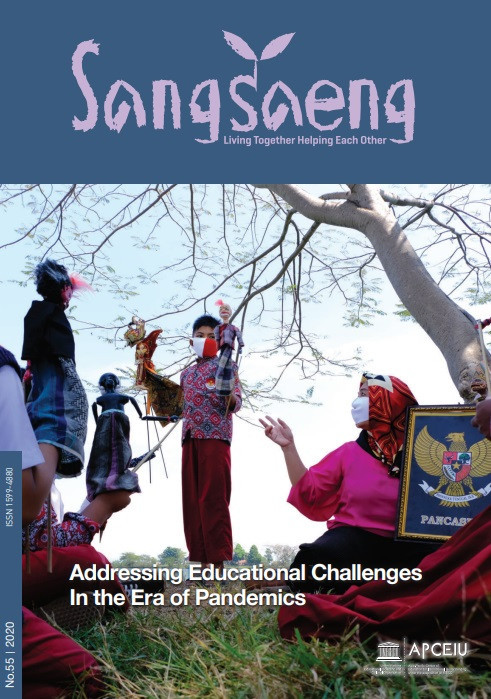 Addressing Educational Challenges In the Era of Pandemics (SangSaeng no.55, 2020) Year of publication: 2023 Corporate author: APCEIU With the prolonged COVID-19 pandemic, the global crisis has further aggravated various multifaceted challenges to humanity. We are forced to prepare for another paradigm shift or, in other words, a “New Normal.” With this in mind, the 55th edition of SangSaeng focuses on “Addressing Educational Challenges in the Era of Pandemics.” Contents03 Editor’s Note04 Special ColumnTowards Sustainability: Implications of Pandemic and How to Create the Future We All Want / Jae C. Choe 08 FOCUS: Addressing Educational Challenges in the Era of Pandemics08 Rethinking Education in the Shadow of the Pandemic / Edward Vickers12 Reimagining Education System to Reduce Social Inequalities / Paul R. Carr16 Reshaping Kenya for Beyond COVID / Jane Wanjiru Nyaga19 Rethinking Human Rights Education in the Pandemic / Abraham Magendzo K.22 Prioritizing GCED in Recovery of Pandemic: Challenges and Opportunities / Romina Kasman 26 Best Practices26 Loxo Yakaar: Hands of Hope / Karima Grant and Chakera McIntosh29 Care for Tomorrow Starts Today / Tina Trdin 32 Special ReportReport on the Round Table: “Next Normal” We Make / IGCED, APCEIU 36 Story TimeHow Do You Paint? / Recka Olasiman 38 Peace in My MemoryGive Me Peace on Earth / Libby Giles 41 Understanding the Asia-Pacific RegionWater Heritage in Southeast Asia / Karen Chin Ai Ying 45 GCED Youth NetworkMeaningful Spaces to Exchange and Learn Together / GCED Youth Network Core Group 48 LetterPromoting GCED in Sri Lanka / Deshamanya A.L.S. Abeywickrama 50 APCEIU in Action
 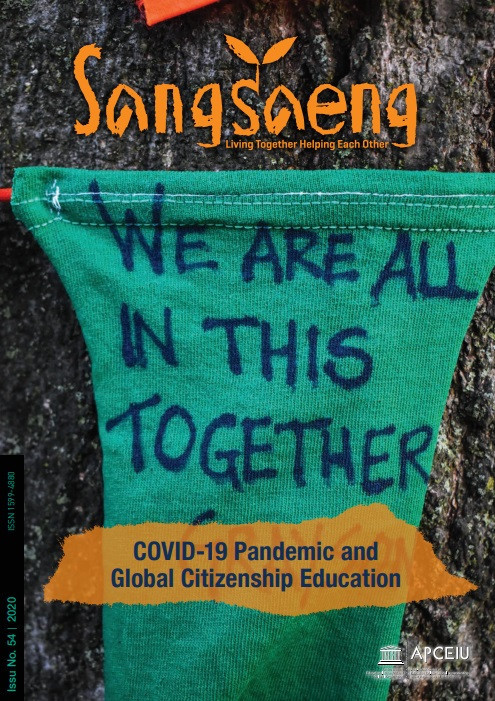 COVID-19 Pandemic and Global Citizenship Education (SangSaeng no.54, 2020) Year of publication: 2023 Corporate author: APCEIU Considering the significance of the global pandemic crisis, the 54th edition of SangSaeng focuses on the “COVID-19 Pandemic and Global Citizenship Education.” This issue invites readers to explore how the pandemic has affected the global community and reflect on how we should and can work together to address our common, multifaceted challenges while enhancing global citizenship and solidarity. Contents03 Editor’s Note04 Special Column What Changes Do We Want in the Post-Coronavirus World? / Hyun Mook Lim 08 FOCUS: COVID-19 Pandemic and Global Citizenship Education08 Reflecting on Global Citizenship Education in the Era of the Pandemic / Soon-Yong Pak12 Choosing Our Post-Pandemic World / Ilan Kelman16 Political Economy of COVID-19 and Global Cooperation / Chang-Yup Kim21 Peace in the Time of Global Pandemic / Yonas Adaye Adeto25 The Pandemic Stall of 2020 / Virginia A. Miralao30 Marine Conservation Efforts in Uncertain Times / Kerstin Forsberg35 Plague, Prejudice and Protest: The Role of Education in Pandemic World / Lynn Davies39 Media and Information Literacy Matters in Preparing for Post-Pandemic World / Divina Frau-Meigs 44 GCED Youth NetworkYouth Voices on the COVID-19 Pandemic and a New Work / Diego Manrique, Tshering Zangmo and Zanji Sinkala in collaboration with Hadi Althib 50 APCEIU in Action