
Resources
Explore a wide range of valuable resources on GCED to deepen your understanding and enhance your research, advocacy, teaching, and learning.
11 Results found
 The prospects of development education in African countries: building a critical mass of citizenry for civic engagement Year of publication: 2015 Author: Simon Eten Corporate author: Centre for Global Education (CGE) This article argues that development education is often framed in an African context within notions of national citizenship designed to engender support for public institutions and policies rather than develop critical thinking skills. This limited concept and application of development education often results in public apathy and disengagement from participation in community, national and global development initiatives. The author argues that recourse to the more radical, Freirean conception of development education practice in African states could potentially support more engaged public activism in issues underpinning poverty and injustice locally and globally. The author draws upon his knowledge and experience of the public sector in Ghana and general trends across Africa to propose potentially fertile areas of research that could support more effective DE practice that nurtures enhanced civic engagement. Les perspectives de l'éducation au développement dans les pays africains: la construction d'une masse critique de citoyens pour l'engagement civique Year of publication: 2015 Author: Simon Eten Corporate author: Centre for Global Education (CGE) Cet article soutient que l'éducation au développement est souvent encadrée dans un contexte africain dans les notions de citoyenneté nationale visant à susciter le soutien des institutions et des politiques publiques plutôt que de développer la pensée critique. Ce concept limité et l'application de l'éducation au développement se traduit souvent par l'apathie du public et le désengagement de la participation à la communauté, les initiatives nationales et mondiales de développement. L'auteur fait valoir que le recours à la plus radicale, la conception freirienne de la pratique de l'éducation au développement dans les pays africains pourrait soutenir l'activisme public plus engagé dans les questions qui sous-tendent la pauvreté et de l'injustice localement et globalement. L'auteur puise dans ses connaissances et de l'expérience du secteur public au Ghana et les tendances générales à travers l'Afrique pour proposer des zones potentiellement fertiles de la recherche qui pourrait soutenir la pratique DE plus efficace qui favorise l'engagement civique renforcée.
  International Youth White Paper on Global Citizenship Year of publication: 2017 Corporate author: Centre for Global Citizenship Education and Research (CGCER) | Centre for Global Education (CGE) The paper aims to mobilize, connect and amplify the voices and actions of youth from across the globe on GCED. The Centre provided feedback on the draft of the initial framework and activities for the project in November, 2016 and provided funds to help support the travel and participation of several students at UNESCO Education Week. Ten of these youth presented the International Global Citizenship White Paper, discussing both the content and the process.The paper identifies three pillars that these youth feel define global citizenship and make it accessible to everyone: deep listening to others, self-reflexivity and engaged actions within a global community. These double as important features of educating for pluralism. The paper focuses on three themes: 1) interconnection and complexity; 2) diversity and difference; 3) community, relationality and compassion.
  Education for Social Change: The Global Learning Programme in the North of Ireland (Policy and Practice: A Development Education Review; Vol. 23, Autumn) Year of publication: 2016 Author: Stephen McCloskey Corporate author: Centre for Global Education (CGE) The Global Learning Programme (GLP) is a four-year initiative funded by the UK government that aims ‘to support schools to teach about global poverty and international development, with a particular focus on upper primary and early secondary school’ (DfID, 2013). The overarching outcome for the project in Northern Ireland is ‘increased and improved delivery of development education in 50% of grant aided primary, secondary and special schools’. It seeks ‘to embed development education and global citizenship as regular practice across curriculum subjects and through whole school initiatives’. The GLP in the north of Ireland is managed by the Centre for Global Education and this article outlines the programme of support provided to schools including Continuing Professional Development (CPD), twilight training, senior leadership seminars and a designated website. The article will also describe the mixed methods approach used to evaluate the impact of the GLP on schools and, in particular, its effectiveness in implementing global learning in the classroom. The article will summarise research findings to date and what they reveal about how teachers have perceived the value of the support provided. The article will conclude by considering the positive impact of the GLP on the wider global education non-governmental sector in Northern Ireland.
  Opening Eyes and Minds: Inspiring, Educating and Engaging Third Level Students in Global Education (Policy and Practice: A Development Education Review; Vol. 19, Autumn) Year of publication: 2014 Author: Joanne Malone | Gráinne Carley | Meliosa Bracken Corporate author: Centre for Global Education (CGE) Suas has worked since its inception to engage Irish third level students in global citizenship education. This article focuses on the Suas Global Citizenship Programme, setting out the purpose and context of the programme, its innovative design and educational approach and its comprehensive monitoring and evaluation framework. The article presents an analysis of key findings from Suas’ evaluation process and a summary of our learning to date on the challenges of supporting third level students in reflecting, learning and acting on global justice issues.
  The Role of Economic Citizenship Education in Advancing Global Citizenship (Policy & Practice: A Development Education Review; Vol. 24, Spring) Year of publication: 2017 Author: Jared Penner | Janita Sanderse Corporate author: Centre for Global Education (CGE) This article focuses on how to provide children and youth with the appropriate skills and capabilities required to create a more equal and sustainable world for future generations. It presents the concept of Economic Citizenship Education and the importance of combining financial, social and livelihoods education for the empowerment of children and youth throughout the world. Throughout the article, this concept is linked to Global Citizenship, Education for Sustainable Development, Development Education and the Sustainable Development Goals to show its importance to contemporary discourse on education and youth development. The reader is provided with examples of Economic Citizenship Education put in practice through government authorities and civil society organisations.
  Thinkpiece: Are We Changing the World?; Reflections on Development Education, Activism and Social Change Year of publication: 2015 Author: Stephen McCloskey Corporate author: Centre for Global Education (CGE) This article has been published as part of a one year development education project delivered by the Centre for Global Education and funded by Trócaire. It aims to support reflection and debate on how development educators engage the public on international development issues. The article comes on the back of recent research, most notably Oxfam’s Finding Frames report, which suggests that the development sector is struggling to enhance and sustain citizenship engagement on the structural causes of poverty and inequality. The article probes some of the factors that may underpin this lack of engagement both within the development education sector specifically and the wider development sector more generally. It examines some of the challenges involved in engaging learners in actions on global issues. Some of these challenges relate to the sectors and environmental pressures in which development educators operate which can thwart in-depth engagement with learners.
 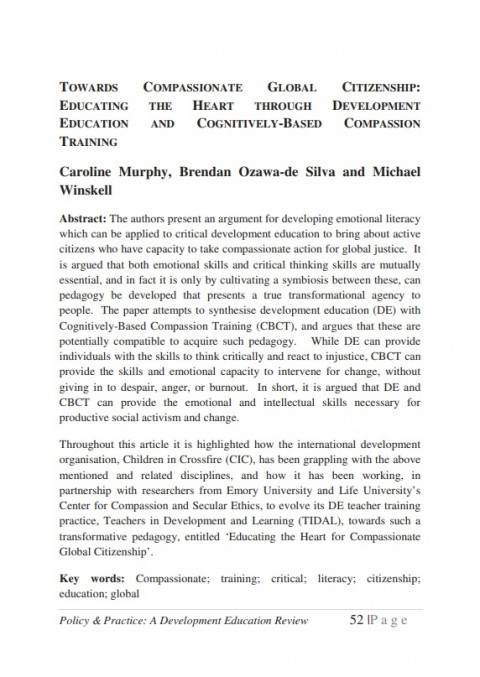 Towards Compassionate Global Citizenship: Educating the Heart through Development Education and Cognitively-Based Compassion Training (Vol. 19, Autumn, 2014) Year of publication: 2014 Author: Caroline Murphy | Brendan Ozawa-de Silva | Michael Winskel Corporate author: Centre for Global Education (CGE) The authors present an argument for developing emotional literacy which can be applied to critical development education to bring about active citizens who have capacity to take compassionate action for global justice. It is argued that both emotional skills and critical thinking skills are mutually essential, and in fact it is only by cultivating a symbiosis between these, can pedagogy be developed that presents a true transformational agency to people. The paper attempts to synthesise development education (DE) with Cognitively-Based Compassion Training (CBCT), and argues that these are potentially compatible to acquire such pedagogy. While DE can provide individuals with the skills to think critically and react to injustice, CBCT can provide the skills and emotional capacity to intervene for change, without giving in to despair, anger, or burnout. In short, it is argued that DE and CBCT can provide the emotional and intellectual skills necessary for productive social activism and change. Throughout this article it is highlighted how the international development organisation, Children in Crossfire (CIC), has been grappling with the above mentioned and related disciplines, and how it has been working, in partnership with researchers from Emory University and Life University’s Center for Compassion and Secular Ethics, to evolve its DE teacher training practice, Teachers in Development and Learning (TIDAL), towards such a transformative pedagogy, entitled ‘Educating the Heart for Compassionate Global Citizenship’.
  Let’s Talk SDGs: Supporting Critical Perspectives on the Sustainable Development Goals Year of publication: 2020 Author: Caroline Murphy Corporate author: Centre for Global Education (CGE) This resource is an invitation to development educators to critically interrogate the Sustainable Development Goals and discuss their capacity to deliver upon their intended outcomes. It invites users to ask if the SDGs can support effective global learning and represent a sound critique of the international system. The resource is a useful starting point for a critical discussion on the Goals' capacity for effective advocacy and education toward the eradication of poverty and inequality. Developing the global dimension in primary schools Year of publication: 2009 Author: Sian Higgins Corporate author: Centre for Global Education (CGE) ‘Developing the Global Dimensions in Peterborough Schools’ was a two year project co-funded by the Department for International Development (DfID) and The Leprosy Mission to engage six primary schools in development issues and support children to become effective global citizens. Using the writer's perspective of the project as Head of Programmes Coordination at The Leprosy Mission, it will be reflected on the importance of the Global Dimension in primary education and explore how these primary schools developed their curriculum, policies and ethos to ensure children are better prepared for the global world in which we live.