
Resources
Explore a wide range of valuable resources on GCED to deepen your understanding and enhance your research, advocacy, teaching, and learning.
28 Results found
 Fostering Intercultural Perspectives of Future Teachers Year of publication: 2012 Author: Marilyn Steinbach Corporate author: McGill University. Faculty of Education This article describes pedagogical activities in teacher education. The objective is to make intercultural education more pertinent for future teachers and to broaden their intercultural perspectives to enable them to work more effectively in pluriethnic environments. This study emphasizes the importance of experiences and personal contacts, and promotes changes in students’ perspectives, focusing on the sense of intercultural education, and contributing to the methodology of intercultural education in teacher education. Élargir les perspectives interculturelles des futurs enseignants Year of publication: 2012 Author: Marilyn Steinbach Corporate author: McGill University. Faculty of Education Cet article est une description des interventions lors de la formation des enseignants. L’objectif est de rendre l’éducation interculturelle plus pertinente pour les futurs enseignants et d’élargir leurs perspectives interculturelles afin de mieux agir dans un milieu pluriethnique. Cette étude souligne l’importance des expériences et des contacts personnels, et incite les étudiants à apporter des changements notoires à leur façon de faire, attribuant ainsi une signification particulière à l’éducation interculturelle. Cet article contribue à la didactique de l’éducation interculturelle dans la formation des enseignants.
  The Failure of Living-Together in Rwanda: What is the Responsibility of History Textbooks? Year of publication: 2013 Author: Éric Mutabazi Corporate author: McGill University. Faculty of Education Rwanda, landlocked in the Great Lakes region in Central Africa, has known war and massacres resulting in the 1994 genocide. Many critics and researchers have attempted to explain the reasons behind the inhuman and monstrous massacres that ravaged this country. While political, historical and economical factors are more often invoked to justify these horrible events, this article seeks to draw attention to the responsibility of history textbooks in the failure of living-together in pre-genocide Rwanda. Our analysis of textbook content reveals that certain values transmitted through the teaching of Rwanda’s history has generated injustice, inequality, victimisation, suffering, etc., at school and in society. We attempt to demonstrate how textbook content contributed to the failure of living-together in Rwanda and we propose alternative perspectives to guide the development of content that can contribute to peace, unity and living-together in post-genocide Rwanda. Échec du vivre-ensemble au Rwanda : quelle est la responsabilité des manuels scolaires d’histoire ? Year of publication: 2013 Author: Éric Mutabazi Corporate author: McGill University. Faculty of Education Le Rwanda, enclavé dans la région des Grands Lacs en Afrique centrale, a connu la guerre et les massacres aboutissant au génocide de 1994. Plusieurs penseurs et chercheurs ont tenté d’expliquer les raisons de ces massacres inhumains et monstrueux qui ont ravagé ce pays. Alors que les facteurs politiques, historiques et économiques sont plus souvent évoqués pour justifier ces horribles événements, cette contribution consiste à dégager la responsabilité des manuels scolaires d’histoire dans l’échec du vivre-ensemble au Rwanda avant le génocide. Notre analyse des contenus des manuels scolaires révèle que certaines valeurs transmises à travers l’enseignement de l’histoire du Rwanda ont généré toutes sortes d’injustices, d’inégalités, de victimisation, de souffrances, etc., à l’école et dans la société. Nous essaierons de montrer en quoi le contenu des manuels a contribué à l’échec du vivre-ensemble au Rwanda et nous proposerons des perspectives qui pourraient guider l’élaboration du nouveau contenu contribuant à la paix, à l’unité et au vivre-ensemble au Rwanda après le génocide.
  Indicators of the Concept of Secularism in the Context of Conversations Between Teachers on the Topic of Civic Education in High Schools Year of publication: 2015 Author: Sylvie Courtine Sinave | France Jutras Corporate author: McGill University. Faculty of Education As part of a collaborative research project on civic education, conversations between high school teachers and faculty were analyzed from the perspective of indicators of secularism, namely, freedom of conscience and religion as they relate to tolerance, equality of rights, fraternity, emancipation, separation between church and state, and law and order. The results show that, according to these educators, the role of the school is paramount to the learning of social behaviour and that some values related to secularism are actualized in the context of teaching history and civic education, such as the primacy of human rights, emancipation, and the importance of the public space. Éléments indicateurs de la laïcité dans le cadre de discussions d’enseignants sur l’éducation à la citoyenneté à l’école secondaire Year of publication: 2015 Author: Sylvie Courtine Sinave | France Jutras Corporate author: McGill University. Faculty of Education Dans le cadre d’une recherche collaborative sur l’éducation à la citoyenneté, les discussions d’enseignants du secondaire et d’universitaires sont analysées sous l’angle d’indicateurs de la laïcité, c’est-à-dire de la liberté de conscience et de culte liée à la tolérance, l’égalité des droits, la fraternité, l’émancipation, la séparation de l’Église et de l’État, le droit et l’ordre public juste. L’analyse des discussions permet de dégager que, selon ces intervenants, le rôle de l’école est primordial dans la gestion du social et que des valeurs reliées à la laïcité sont actualisées dans le cadre de l’enseignement de l’histoire et éducation à la citoyenneté au secondaire : la primauté du droit, l’émancipation, l’importance de l’espace public.
  Concepts and Actors’ Perceptions of Living Together in Basic Education Textbooks in Ivory Coast Year of publication: 2013 Author: Goïta Ouattara Kanndanan Insiata Corporate author: McGill University. Faculty of Education This article first highlights the concepts of living together in basic education textbooks in Ivory Coast. Second, it identifies the perceptions of these concepts by the actors (trainers and learners) as well as the media used for instruction. To address these two concerns, the methodology consisted of a content analysis of textbooks and current program guides, as well as an analysis of interviews with the actors. The results indicate that solidarity, peace, tolerance, discipline, and inter-ethnic alliance are concepts, among others, taught to instil a culture of peace in potential future socio-political actors. In addition, these concepts are positively perceived and appropriated by the actors.
 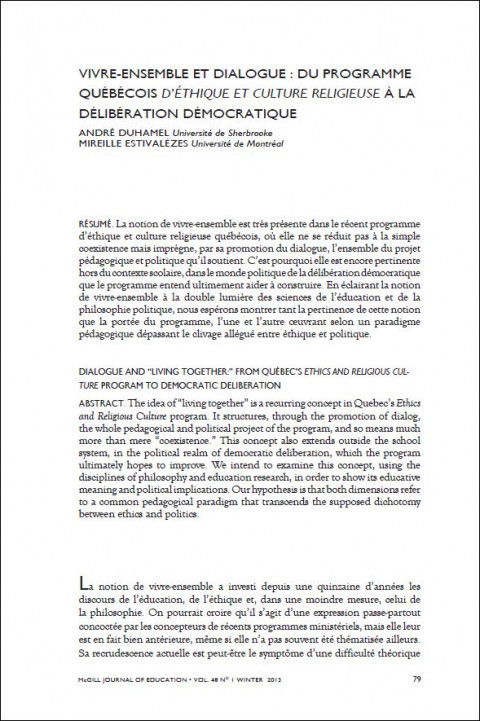 Vivre-ensemble et dialogue : du programme québécois d’éthique et culture religieuse à la délibération démocratique Year of publication: 2013 Author: André Duhamel | Mireille Estivalèzes Corporate author: McGill University. Faculty of Education La notion de vivre-ensemble est très présente dans le récent programme d’éthique et culture religieuse québécois, où elle ne se réduit pas à la simple coexistence mais imprègne, par sa promotion du dialogue, l’ensemble du projet pédagogique et politique qu’il soutient. C’est pourquoi elle est encore pertinente hors du contexte scolaire, dans le monde politique de la délibération démocratique que le programme entend ultimement aider à construire. En éclairant la notion de vivre-ensemble à la double lumière des sciences de l’éducation et de la philosophie politique, nous espérons montrer tant la pertinence de cette notion que la portée du programme, l’une et l’autre oeuvrant selon un paradigme pédagogique dépassant le clivage allégué entre éthique et politique. Les notions du vivre-ensemble dans les manuels scolaires de l’enseignement de base en Côte d’Ivoire et leurs perceptions par les acteurs Year of publication: 2013 Author: Goïta Ouattara Kanndanan Insiata Corporate author: McGill University. Faculty of Education Cet article se propose d’une part de mettre en relief les notions du vivre ensemble contenues dans les manuels scolaires de l’enseignement de base en Côte d’Ivoire. D’autre part, il identifie les supports utilisés pour leur enseignement et leurs perceptions par les formateurs et les apprenants. Pour répondre à ces préoccupations, la méthodologie a consisté en une analyse de contenu des manuels scolaires et guides-programmes en vigueur; puis à celle des entretiens réalisés avec les acteurs. Les résultats obtenus montrent que la solidarité, la paix, la tolérance, la discipline et l’alliance interethnique sont entre autres, des notions enseignées pour préparer l’esprit des futurs potentiels acteurs sociopolitiques à adopter un comportement de paix. D’ailleurs, ces notions sont perçues positivement par les acteurs et les bénéficiaires. Dialogue and Living Together: From Québec’s Ethics and Religious Culture Program to Democratic Deliberation Year of publication: 2013 Author: André Duhamel | Mireille Estivalèzes Corporate author: McGill University. Faculty of Education The idea of “living together” is a recurring concept in Quebec’s Ethics and Religious Culture program. It structures, through the promotion of dialog, the whole pedagogical and political project of the program, and so means much more than mere “coexistence.” This concept also extends outside the school system, in the political realm of democratic deliberation, which the program ultimately hopes to improve. We intend to examine this concept, using the disciplines of philosophy and education research, in order to show its educative meaning and political implications. Our hypothesis is that both dimensions refer to a common pedagogical paradigm that transcends the supposed dichotomy between ethics and politics.