
Resources
Explore a wide range of valuable resources on GCED to deepen your understanding and enhance your research, advocacy, teaching, and learning.
12 Results found
 Schools as Hubs for Social and Emotional Learning Year of publication: 2023 Corporate author: OECD Schools are perfect hubs for social and emotional learning, but are they ready for this task? To address this question, this Spotlight reports previously unpublished findings from the OECD’s Survey on Social and Emotional Skills (SSES) and discusses their implications for education policy and practice. Both an active promotion in schools and extensive learning opportunities for teachers on relevant topics provide a fertile ground for an effective social and emotional education. They boost teachers’ self-efficacy and use of active learning pedagogies, as well as quality relationships at school. The Spotlight also points to important differences for teachers of 10- vs. 15-year-old students that can explain higher skills at a younger age. Younger students benefit more often from key elements of an effective social and emotional education in school, i.e. the evaluation of their social and emotional skills and teachers teaming up with parents to reinforce skill promotion. Teachers of 10-year-olds are also more intensively trained and requested to promote social and emotional learning in their work.
  Education at a Glance 2021: OECD Indicator Year of publication: 2021 Corporate author: OECD Education at a Glance is the authoritative source for information on the state of education around the world. It provides data on the structure, finances and performance of education systems across OECD countries and a number of partner economies. More than 100 charts and tables in this publication – as well as links to much more available on the educational database – provide key information on the output of educational institutions; the impact of learning across countries; access, participation and progression in education; the financial resources invested in education; and teachers, the learning environment and the organisation of schools.The 2021 edition includes a focus on equity, investigating how progress through education and the associated learning and labour market outcomes are impacted by dimensions such as gender, socio‐economic status, country of birth and regional location. A specific chapter is dedicated to Target 4.5 of the Sustainable Development Goal 4 on equity in education, providing an assessment of where OECD and partner countries stand in providing equal access to quality education at all levels. Two new indicators on the mechanisms and formulas used to allocate public funding to schools and on teacher attrition rate complement this year’s edition.
  Education at a Glance 2019: OECD Indicators Year of publication: 2019 Corporate author: OECD Education at a Glance is the authoritative source for information on the state of education around the world. It provides data on the structure, finances and performance of education systems across OECD countries and a number of partner economies.The 2019 edition includes a focus on tertiary education with new indicators on tertiary completion rates, doctoral graduates and their labour market outcomes, and on tertiary admission systems, as well as a dedicated chapter on the Sustainable Development Goal 4.
  The Future of Education and Skills: Education 2030 Year of publication: 2018 Corporate author: OECD The aim of OECD’s Education 2030: The Future of Education and Skills project is to support countries to find answers to two far-reaching questions: “What knowledge, skills, attitudes and values will today’s students need to shape and thrive their world in 2030?” and “How can instructional systems develop these knowledge, skills, attitudes and values effectively?” This OECD Education 2030 position paper considers the challenges that young people will face; suggests the importance of the concept of learner agency; proposes an overarching learning framework with transformative competencies; reviews the nature of the knowledge, skills, attitudes and values that young people will need; and ends with possible curriculum design principles. It encapsulates the key messages of the project so far.
  Measuring Distance to the SDG Targets 2019 - An Assessment of Where OECD Countries Stand Year of publication: 2019 Corporate author: OECD The Sustainable Development Goals (SDGs) set a broad and ambitious programme for the world to achieve by 2030. With 17 Goals, underpinned by 169 Targets, the complex and integrated nature of the 2030 Agenda presents national governments with huge challenges for implementation. To assist countries, the OECD has developed a unique methodology allowing comparison of progress across SDG goals and targets. Based on the UN Global List of 244 indicators, this study evaluates the distance that OECD countries need to travel to meet SDG targets for which data is currently available. This 2019 edition of the study presents the latest results for OECD countries, both on average and individually, as well as new exploratory approaches to assessing progress over time and transboundary aspects of the SDGs. By providing a high-level overview of countries’ strengths and weaknesses in performance across the SDGs, this study aims to support member countries in navigating the SDGs and in setting their own priorities for action within the broad 2030 Agenda.
  Trends Shaping Education 2019 Year of publication: 2019 Corporate author: OECD This book, published every two to three years, is designed to give policy makers, researchers, educational leaders, administrators and teachers a robust, non-specialist source to inform strategic thinking and stimulate reflection on the challenges facing education, whether in schools, universities or programmes for older adults. Trends Shaping Education 2019 is designed to support long-term strategic thinking in education. It provides an overview of key economic, social, demographic and technological trends and raises pertinent questions about their impact on education. This book fills an important need: decision makers and practitioners in education often have only anecdotal or local information on the megatrends that play out in their context; too often they do not have solid facts in front of them, especially about trends.`
  Education at a Glance 2020: OECD Indicators Year of publication: 2020 Corporate author: OECD Education at a Glance is the authoritative source for information on the state of education around the world. It provides data on the structure, finances and performance of education systems across OECD countries and a number of partner economies. More than 100 charts and tables in this publication – as well as links to much more available on the educational database – provide key information on the output of educational institutions; the impact of learning across countries; access, participation and progression in education; the financial resources invested in education; and teachers, the learning environment and the organisation of schools.The 2020 edition includes a focus on vocational education and training, investigating participation in vocational education and training at various levels of education, the labour market and social outcomes of vocational graduates as well as the human and financial resources invested in vocational institutions. Two new indicators on how vocational education and training systems differ around the world and on upper secondary completion rate complement this topic. A specific chapter is dedicated to the Sustainable Development Goal 4, and investigates the quality and participation in secondary education.
 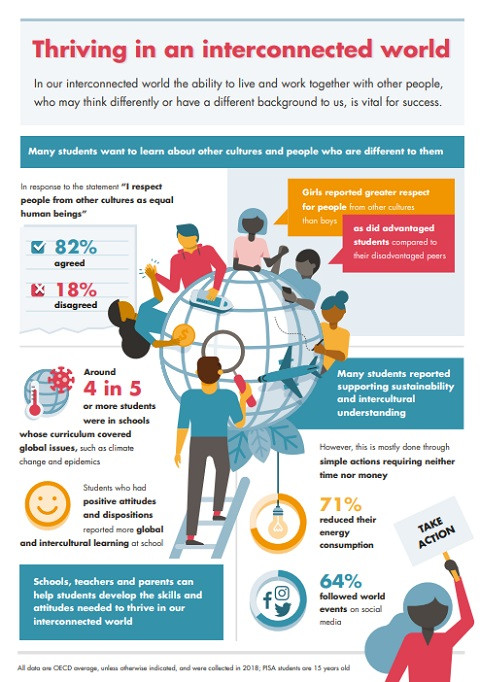 Thriving in an Interconnected World Year of publication: 2020 Corporate author: OECD This infographic shows how ready students are to thrive in an interconnected world. All data were collected from PISA 2018 survey.
 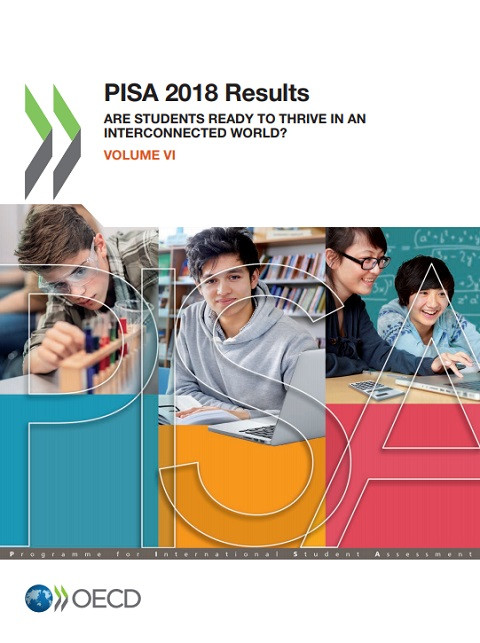 PISA 2018 Results (Volume VI): Are Students Ready to Thrive in an Interconnected World? Year of publication: 2020 Corporate author: OECD The OECD Programme for International Student Assessment (PISA) examines what students know in reading, mathematics and science, and what they can do with what they know. It provides the most comprehensive and rigorous international assessment of student learning outcomes to date. Results from PISA indicate the quality and equity of learning outcomes attained around the world, and allow educators and policy makers to learn from the policies and practices applied in other countries. This is one of six volumes that present the results of the PISA 2018 survey, the seventh round of the triennial assessment. Volume VI: Are Students Ready to Thrive in an Interconnected World? explores students’ ability to examine issues of local, global and cultural significance; understand and appreciate the perspectives and worldviews of others; engage in open, appropriate and effective interactions across cultures; and take action for collective well-being and sustainable development. The volume explores students’ outcomes on the cognitive test and corresponding questionnaire in addition to their experiences of global and intercultural learning at school and beyond.
  Reviews of National Policies for Education: Kazakhstan, Kyrgyz Republic and Tajikistan 2009; Students With Special Needs and Disabilities Year of publication: 2009 Corporate author: OECD This OECD publication provides an overview of current education policies for children with special educational needs and disabilities in Kazakhstan, the Kyrgyz Republic and Tajikistan. Provides an idea of the socio-historical context, education systems and the corresponding legislation, critically analyzes the adopted views on access to education for the most vulnerable group of children in these countries. Particular attention is paid to political measures, aimed at ensuring inclusive education, procedures identification and assessment, overall coordination of educational service delivery, integration into the general education system, as well as best practices and the role of NGOs and community donors.