
Resources
Explore a wide range of valuable resources on GCED to deepen your understanding and enhance your research, advocacy, teaching, and learning.
110 Results found
 Action Research to Improve Youth and Adult Literacy: Empowering Learners in a Multilingual World Year of publication: 2015 Corporate author: UNESCO Institute for Lifelong Learning (UIL) | UNESCO Abuja This guidebook is about the quest for quality, which is a lifelong pursuit linked to social justice. As we move in time and space new challenges emerge, but our vision is that no one should be left behind in the quest for self- and collective realization. We have to consider all possible means for enabling the active participation of all citizens in education. We must look at both challenges and opportunities, such as those that technology offers us for making linkages and improving access to information, knowledge and skills. We must seek out possibilities for retaining positive values and acquiring new ones which foster deeper appreciation for human, linguistic, cultural and ecological diversity.
  Communities in action: lifelong learning for sustainable Year of publication: 2015 Author: Fumiko Noguchi | Jose Roberto Guevara | Rika Yorozu Corporate author: UNESCO Institute for Lifelong Learning (UIL) This handbook identifies principles and policy mechanisms to advance community-based learning for sustainable development based on the commitments endorsed by the participants of the Kominkan-CLC International Conference on Education for Sustainable Development, which was in Okayama City, Japan, in October 2014. To inform policymakers and practitioners new to this field, the handbook clarifies the international vision and goals for sustainable development and Education for Sustainable Development, and identifies the potential contributions of community-based learning centres and organizations. It documents both policy and practice from different regions and concludes with a summary of principles and policy support mechanisms.
  [Summary] 4th Global Report on Adult Learning and Education: Leave No One Behind: Participation, Equity and Inclusion; Key Messages and Executive Summary Year of publication: 2020 Corporate author: UNESCO Institute for Lifelong Learning (UIL) The fourth Global Report on Adult Learning and Education (GRALE 4) argues that achieving SDG 4, and realizing its cross-cutting contribution to the other 16 goals, demands a much more integrated and comprehensive approach to education, with adult learning and education at its heart. GRALE 3, published in 2016, showed that adult learning and education produces significant benefits across a range of policy areas. Countries reported a positive impact on health and well-being, employment and the labour market, and social, civic and community life. GRALE 4, while reinforcing the message that the benefits of participation in ALE are substantial, shows that they remain unevenly distributed. [요약문] 제4차 유네스코 성인학습 및 교육에 관한 글로벌 보고서: 참여, 형평 및 포용을 통해 그 누구도 소외되지 않는 세상; 주요 결과 및 요약 Year of publication: 2020 Corporate author: UNESCO Institute for Lifelong Learning (UIL) 제4차 유네스코 성인학습 및 교육에 관한 글로벌 보고서(GRALE IV)는 SDG 4의 달성 및 이를 통한 나머지 16개 목표에 대한 범분야적 기여 실현에 있어 성인학습 및 교육을 중심으로 교육에 대해 훨씬 더 통합적이고 포괄적인 접근이 요구된다고 주장한다. 본 보고서의 주요내용은 대부분의 회원국이 능동적 시민성 함양을 위한 성인학습 및 교육(ALE for active citizenship)의 가능성을 인정하고 있음에도 불구하고 여전히 정책우선순위에서 밀려나 있다는 것이다. 이러한 정책 흐름을 바꾸지 않는 이상, SDG 4의 다양한 세부 목표를 이행할 수 없으며 교육분야 목표가 달성되지 못하면 다른 목표 역시 달성되지 못할 위험에 빠질 것이라고 강조한다. GRALE IV는 성인학습 및 교육 참여가 가져오는 다양한 이점을 강조함과 동시에 이러한 이점들이 고르지 않게 분배되어 있음을 보여준다.
  4th Global Report on Adult Learning and Education: Leave No One Behind: Participation, Equity and Inclusion Year of publication: 2019 Corporate author: UNESCO Institute for Lifelong Learning (UIL) This report demonstrates the important role participation in adult learning and education can play in achieving the Sustainable Development Goals, highlights the distance we have to travel, and offers clear guidance on how to move forward. As the report clearly also shows, it is only by prioritizing ALE, and rebalancing resources accordingly, that can we ensure that the commitment of the 2030 Agenda to ‘leave no one behind’ in the pursuit of equitable, inclusive and sustainable development is fully and fairly realized. 4e rapport mondial sur l’apprentissage et l’éducation des adultes: ne laisser personne pour compte: participation, équité et inclusion Year of publication: 2019 Corporate author: UNESCO Institute for Lifelong Learning (UIL) Le présent rapport démontre le rôle crucial que la participation à l’apprentissage et à l’éducation des adultes peut jouer dans la réalisation des objectifs de développement durable, souligne la distance qu’il nous reste à parcourir pour y parvenir et propose des orientations claires sur la manière d’aller de l’avant. Il ressort clairement du GRALE 4 que, ce n’est qu’en accordant la priorité à l’apprentissage et à l’éducation des adultes et en rééquilibrant les ressources en conséquence, que nous réussirons à réaliser pleinement et justement l’engagement à travers le Programme de développement durable à l’horizon 2030 de « ne laisser personne pour compte » dans notre quête d’un développement équitable, inclusif et durable.
 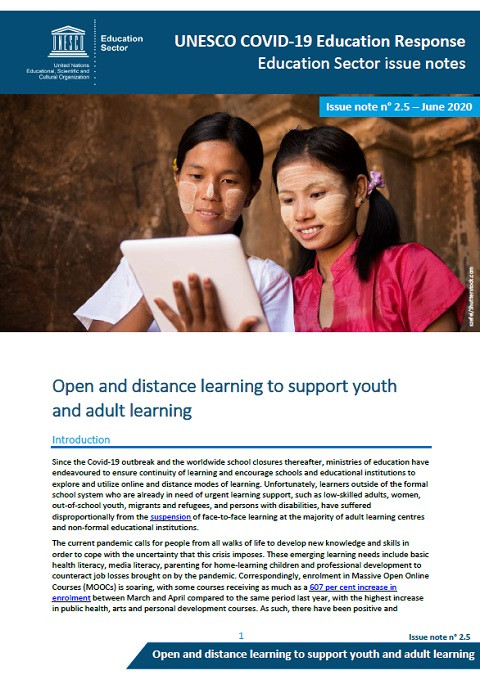 UNESCO COVID-19 Education Response: Open and Distance Learning to Support Youth and Adult Learning (Education Sector Issue Note; No. 2.5 – June 2020) Year of publication: 2020 Corporate author: UNESCO Institute for Lifelong Learning (UIL) A new UNESCO issue note, produced by the UNESCO Institute for Lifelong Learning (UIL), aims to support education policy-makers and planners in ensuring open and distance learning to support youth and adult learning in the context of the current pandemic, now and in its aftermath.Since the COVID-19 outbreak and the worldwide school closures that followed, ministries of education have endeavoured to ensure continuity of learning and encourage schools and educational institutions to explore and utilize online and distance modes of learning. Unfortunately, learners outside of the formal school system who are already in need of urgent learning support, such as low-skilled adults, women, out-of-school youth, migrants and refugees, and persons with disabilities, have suffered disproportionally from the suspension of face-to-face learning at the majority of adult learning centres and non-formal educational institutions.The current pandemic calls for people from people from all socio-economic backgrounds, wherever they live in the world, to develop new knowledge and skills in order to cope with the uncertainty that this crisis imposes. These learning needs include basic health literacy, media literacy, parenting for home-schooling children and professional development to counteract job losses brought on by the pandemic. Correspondingly, enrolment in massive open online courses (MOOCs) is soaring. As such, there have been positive and demand-driven trends in exploring alternative options, such as open and distance learning (ODL), to ensure the continuity and expansion of non-formal education and adult learning.This issue note takes stock of opportunities and challenges in using ODL, both online and offline as defined in the UNESCO Issue Note on Distance Learning Strategies, for youth and adult learners outside the formal education system. After examining key issues and illustrating promising cases from public and private sectors, it provides key messages for policy interventions to support inclusive lifelong learning for youth and adults during and after the current pandemic.UNESCO Education Sector’s issue notes cover key topics related to the COVID-19 education response.
  Addressing Global Citizenship Education in Adult Learning and Education; Summary Report Year of publication: 2019 Author: Christiana Nikolitsa-Winter | Werner Mauch | Philippe Maalouf Corporate author: UNESCO Institute for Lifelong Learning (UIL) | APCEIU The Asia-Pacific Centre of Education for International Understanding (APCEIU) has published the summary report on Addressing Global Citizenship Education in Adult Learning and Education (ALE) in partnership with UNESCO Institute for Lifelong Learning (UIL). In regard to GCED in ALE the publication looks at the developments, gaps and challenges in Finland, Mauritania, the Republic of Korea, South Africa, and Uruguay and highlights a number of good practices in the field. As the role of ALE and GCED has been emphasized in realizing the 2030 Sustainable Development Agenda, it aims to raise awareness of the significance of GCED in ALE and to inspire various stakeholders to develop and strengthen this field of education. ForewordIntroduction Part I: Thematic Studies Global citizenship education(GCED): Conceptual considerationsRealizing the 2030 Sustainable Development Agenda: The role of GCED in ALEALE’s contribution to fostering GCED - ALE as GCEDLiteracy: The foundation of ALE and GCED - Contribution of adult literacy programmes to GCED outcomes - GCED in ALE: Global trends and outcomesProfessionalization of adult educators in GCED - Competency framework for adult educators in GCED - Curriculum framework for adult educators in GCED - Examples of curricula for adult educatorsConclusion on the thematic studies Part II: Case Studies GCED in ALE: Case studies from the five UNESCO regions - State of the art of ALE in the five countries - Legal frameworks and discourse - Selected ALE programmes and mechanisms that touch on GCED in the case studies - Professionalizing ALE educators as a means of fostering GCED in ALE: examples - Key outcomes of the country case studies - Addendum: GCED in ALE as a response to acute need - The BEF Alpha programme Conclusion and way forwardBibliography
 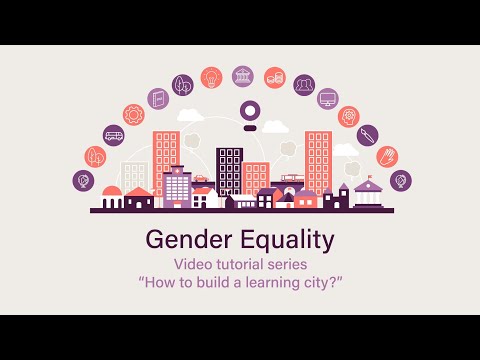 How to Build a Learning City? Make Gender Equality a Priority Year of publication: 2020 Corporate author: UNESCO Institute for Lifelong Learning (UIL) This video tutorial explains how gender equality must be prioritized in learning cities to empower women through learning, eliminate gender-based discrimination and foster equitable, inclusive, resilient and sustainable cities. Comment créer une ville apprenante: Égalité des genres Year of publication: 2020 Corporate author: UNESCO Institute for Lifelong Learning (UIL) Ce tutoriel vidéo explique comment développer une compréhension commune de l’égalité des genres dans l'éducation et l'apprentissage, identifier les défis que rencontre la ville apprenante, impliquer les parties prenantes concernées, renforcer les capacités et encourager une programmation inclusive, consolider les politiques d'éducation et d'apprentissage, mener des recherches et sensibiliser.