
Resources
Explore a wide range of valuable resources on GCED to deepen your understanding and enhance your research, advocacy, teaching, and learning.
154 Results found
 Гражданское общество и неправительственные организации в Республике Казахстан Year of publication: 2021 Author: Madiyar Kozhakhmet | Evgeny Zhovtis | Dosym Satpayev | Roman Podoprigora | Natalia Yantsen | Kaisha Atakhanova | Vadim Nee | Banu Nurgaziyeva | Zulfiya Baysakova | Shakhnoza Khasanova | Saken Zhanazarov | Diana Okremova | Gulmira Birzhanova | Lyazzat Kaltayeva | Saniya Arapova | Sergey Gulyaev | Sergey Khudyakov | Vitaly Kulik Corporate author: Civil Society Development Association (ARGO) Настоящая книга представляет собой сборник статей по широкому кругу вопросов, касающихся развития НПО и гражданского общества в Казахстане. Издание предназначено для неправительственных организаций, государственных органов, студентов, научного сообщества, а также широкого круга читателей.
  المواطنة Year of publication: 2020 Author: Zeyad Alawana Corporate author: Ministry of Political and Parliamentary Affairs يهدف الكتيب إلى تعميق ثقافة المواطنة الصالحة والفعّالة لدى الشباب، وتعريفهم بحقوقهم وواجباتهم الواردة في الدستور الاردني، وتعريفهم أيضاً بقيم المواطنة الصالحة الي تقوم على أساس سيادة القانون، واحرام المساواة، والتسامح وتقبّل الآخر، وتقبل التعددية والتنوع في المجتمع. وبشكل أكثر تفصيلاً، يحتوي الكتيب على موضوعات ومعارف وأسئلة وخبرات تهدف إلى ما يلي:•أولاً، التعريف بمفهوم المواطنة والحقوق والواجبات والتمييز بين المواطن الصالح وغير الصالح.•ثانياً، التعريف بمبادئ المواطنة الصالحة ، كالحرية والمشاركة الفاعلة والمساواةوتكافؤ الفرص والتضامن والمحافظة على الممتلكات العامة.•ثالثاً، التعريف بأهداف المواطنة، كالالتزام بمبادئ الديمقراطية، والتحرر من التعصب والتميز، والايمان بالأخوّة الإنسانية والمنهج العلمي في التفك وسيادة القانون، والالزام بالدستور، والمشاركة السياسية الفاعلة، واحرام كرامة الانسان، واكتساب قيم المواطنة الحقة. Citizenship Year of publication: 2020 Author: Zeyad Alawana Corporate author: Ministry of Political and Parliamentary Affairs The booklet aims to deepen the culture of good and effective citizenship among young people, inform them of their rights and duties contained in the Jordanian constitution, and also introduce them to the values of good citizenship that are based on the rule of law, respect for equality, tolerance and acceptance of others, and acceptance of pluralism and diversity in society. In more detail, the booklet contains topics, knowledge, questions and experiences aimed at:First, the definition of the concept of citizenship, rights and duties, and the distinction between a good and a good citizen.Second, introducing the principles of good citizenship, such as freedom, active participation, and equalityEquality of opportunity, solidarity and preservation of public property.Third, the definition of the goals of citizenship, such as commitment to the principles of democracy, freedom from fanaticism and distinction, belief in human brotherhood and the scientific method in disunity and the rule of law, commitment to the constitution, active political participation, respect for human dignity, and the acquisition of true citizenship values.
  مظاهر المواطنة المجتمعية في المقررات الدراسية في العلوم الاجتماعية من وجهة نظر المعلمين Year of publication: 2011 Author: Zeiad Barakat | Laila Abu Ali Corporate author: Jerash Universtiy هدفت هذه الدراسة التعرف إلى مظاهر المواطنة المجتمعية في المجالات الاجتماعية والقانونية والاقتصادية والسياسية في المقررات الدراسية الفلسطينية المتعلقة بالعلوم الاجتماعية (التاريخ والجغرافية والتربية المدنية والتربية الوطنية ) من وجهة نظر المعلمين لهذ ه المقررات، لهذا الغرض طبقت استبانة مكونة من ( 40 ) فقرة لقياس مظاهر المواطنة المجتمعية في المظاهر المختلفة على عينة من المعلمين في المدارس الحكومية في محافظة طولكرم يدرسون هذه المقررات قو امها ( 134 ) معلمًا ومعلمة. Manifestations of Community Citizenship in the Curriculums in Social Sciences from the Viewpoint of the Teachers Year of publication: 2011 Author: Zeiad Barakat | Laila Abu Ali Corporate author: Jerash Universtiy The purpose of this study was to investigate the manifestations of community citizenship in domains of social, legal, economic and political in the Palestinian social science curriculum (history, geography, civic education and national education) from the viewpoint of the teachers of these courses, for this purpose applied a questionnaire consisting of (40) items to measure aspects of community citizenship, in the various manifestations on a sample of teachers in government schools in the province of Tulkarem who teach these courses consisted of (134) teachers.
 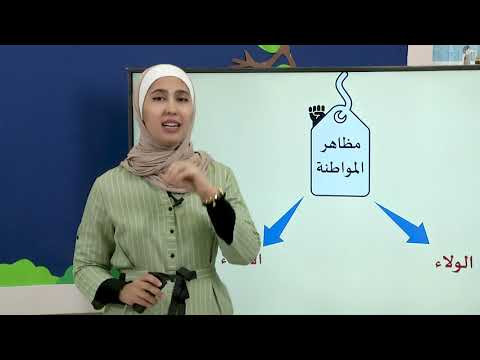 مقومات المواطنة الفاعلة Year of publication: 2020 Corporate author: Qatar. Ministry of Education and Higher Education الفيديو هو عبارة عن درس من دروس الدراسات الاجتماعية للصف الثالث بدولة قطر. يركز الفيديو على مقومات المواطنة الفاعلة في المجتمع. يبدأ الفيديو بالتعريف بمفهوم المواطنة، ويصف المواطن الفاعل. كما يتضمن الفيديو أهمية المواطنة الفاعلة في المجتمع. Elements of Active Citizenship Year of publication: 2020 Corporate author: Qatar. Ministry of Education and Higher Education This video is a lesson from the third grade social studies lessons in Qatar. The video focuses on the components of active citizenship in society. The video begins by introducing the concept of citizenship, and describes the active citizen. The video also includes the importance of active citizenship in society.
  Are Journalists Objective?: The Keys to the Media Year of publication: 2021 Corporate author: Centre pour l’éducation aux médias et à l’information (CLEMI) Dans cette vidéo proposée par Clemi nous suivons l'arrivée d'une nouvelle professeur de mathématiques dans un collège. Chacun a un avis très tranché sur elle. Kamel l’adore, Cindy ne comprend rien à ce qu’elle raconte, Leonard la trouve sévère et Fama l’aime bien. Qui a raison, qui a tort ? Peut-être un peu tout le monde… Chacun la regarde selon son point de vue. Cette comparaison permet de s'interroger sur l'objectivité des médias. In this video from Clemi, we follow the arrival of a new maths teacher at a secondary school. Everyone has a very strong opinion of her. Kamel adores her, Cindy doesn't understand a word she says Leonard thinks she's harsh and Fama likes her. Who's right, who's wrong? Maybe a bit of everyone... Everyone looks at her from their own point of view. This comparison raises questions about the objectivity of the media. Les journalistes sont-ils objectifs ? : Les clés des médias Year of publication: 2021 Corporate author: Centre pour l’éducation aux médias et à l’information (CLEMI) Dans cette vidéo proposée par Clemi nous suivons l'arrivée d'une nouvelle professeur de mathématiques dans un collège. Chacun a un avis très tranché sur elle. Kamel l’adore, Cindy ne comprend rien à ce qu’elle raconte, Leonard la trouve sévère et Fama l’aime bien. Qui a raison, qui a tort ? Peut-être un peu tout le monde… Chacun la regarde selon son point de vue. Cette comparaison permet de s'interroger sur l'objectivité des médias. In this video from Clemi, we follow the arrival of a new maths teacher at a secondary school. Everyone has a very strong opinion of her. Kamel adores her, Cindy doesn't understand a word she says Leonard thinks she's harsh and Fama likes her. Who's right, who's wrong? Maybe a bit of everyone... Everyone looks at her from their own point of view. This comparison raises questions about the objectivity of the media.
 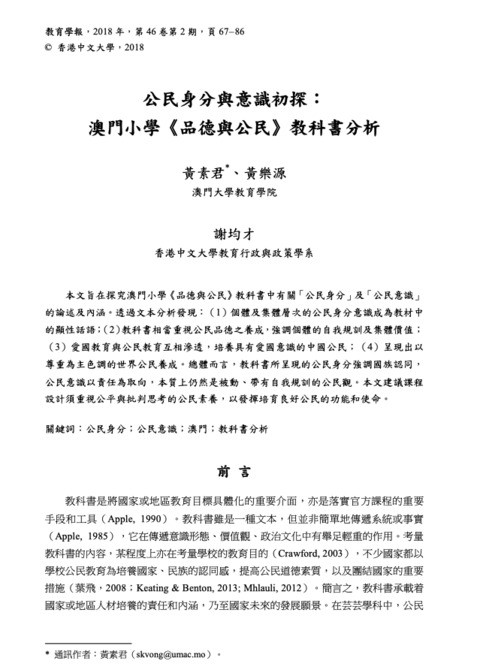 An Exploration of Citizenship Identity and Civic Awareness: An Analysis of Moral and Civic Education Primary School Textbooks in Macao (Educational Journal ; Vol.48, No.1) Year of publication: 2018 Author: 黄素君 | 黄乐源 | 谢均才 This article aims to explore the discourses of citizenship identity and civic awareness embedded in the series of Moral and Civic Education primary school textbooks in Macao. The study reveals that: (a) the personal and collective level of civic awareness is the dominant discourse in the textbooks; (b) the textbooks give an important weighting to the cultivation of the character of citizens as well as the importance of individual self-discipline and collective value; (c) patriotic education and civic education intertwine in order to cultivate a patriotic Chinese citizen; (d) “respect” is the key concept in cultivating the global citizen in the textbooks. The citizenship presented in the textbooks emphasizes the formation of national identity, and a form of responsibility-driven civic awareness. In essence, the cultivation of citizenship identity and civic awareness still demonstrates a passive and self-disciplined view. This article suggests that curriculum design should emphasize on the cultivation of fairness and critical thinking in order to fulfill a comprehensive mission and function of citizenship education.