
Resources
Explore a wide range of valuable resources on GCED to deepen your understanding and enhance your research, advocacy, teaching, and learning.
71 Results found
 Getting Every School Climate-ready: How Countries are Integrating Climate Change Issues in Education Year of publication: 2021 Corporate author: UNESCO This document summarizes the findings of selected studies by UNESCO and its partners on how climate change issues are integrated in education.These findings shed light on four key questions: where do we stand on climate change education; what do teachers say; what are the examples of country good practices on climate change education; and what does inter-ministerial collaboration on education for sustainable development look like?
  Asia-Pacific Regional Synthesis: Climate Change, Displacement and the Right to Education Year of publication: 2023 Corporate author: UNESCO | United Nations University Institute for the Advanced Study of Sustainability (UNU-IAS) | UNESCO Bangkok In 2020, 30.7 million people were displaced by natural disasters – disasters which the scientific community acknowledges are more frequent and more intense as a result of climate change. In Asia and the Pacific alone, 21.3 million people were displaced, making it the region the most impacted by national disasters and climate change in the world. Therefore, country case studies were carried out in Bangladesh, India, Indonesia, Tuvalu, and Viet Nam to examine not only specific vulnerabilities to climate change and related mobility, but also the impacts of climate change on the right to education in Asia and the Pacific. These case studies show that climate change directly threatens education – through the destruction of schools and property – but also indirectly puts education in peril by forcing people to cross borders, ensuring neither legal residency nor the right to education. This regional synthesis report aims to guide policy-makers through providing operational policy recommendations on how to ensure education is protected in Asia and the Pacific in the face of climate change and displacement from a human rights-based approach. The report is one of four being developed and will contribute to the global initiative on climate change and displacement and the right to education – launched by UNESCO in 2020 – by informing the development of a Global Report with global policyrecommendations.How climate change impacts the right to education in Asia and the Pacific21.3million displacementstook place in Asia and the Pacific
  UNESCO Science Report: The Race Against Time for Smarter Development Year of publication: 2021 Author: Susan Schneegans | Tiffany Straza | Jake Lewis Corporate author: UNESCO This seventh edition of the report monitors the development path that countries have been following over the past five years from the perspective of science governance. It documents the rapid societal transformation under way, which offers new opportunities for social and economic experimentation but also risks exacerbating social inequalities, unless safeguards are put in place.The report concludes that countries will need to invest more in research and innovation, if they are to succeed in their dual digital and green transition. More than 30 countries have already raised their research spending since 2014, in line with their commitment to the Sustainable Development Goals. Despite this progress, eight out of ten countries still devote less than 1% of GDP to research, perpetuating their dependence on foreign technologies.
  Climate Change and Sustainability in Science and Social Science Secondary School Curricula Year of publication: 2024 Author: Marcia McKenzie | Aaron Benavot Corporate author: UNESCO There is an urgent need to transform the way climate change and sustainability are taught in classrooms and at schools. Learners must grasp the environmental impacts of climate change, how climate change relates to their own context and what actions can be undertaken and contribute to making societies more sustainable, equitable, just and climate-resilient. The findings presented in this publication indicate that accelerated efforts are needed. In a study of over 530 Grade 9 science and social science curricula from 85 countries worldwide, we found that 69 per cent of curricula contained no references to climate change, while 66 per cent had no references to sustainability. Furthermore, while 69 per cent of surveyed teachers from eight of the countries studied reported that environment, sustainability and climate change topics were included in the science and social science curricula in their schools only 50 per cent included them in their teaching. While there is a notable inclusion of environment, sustainability and climate change in science and social science curricula across countries, the depth of focus of this inclusion varies widely. Cognitive learning prevails over social and emotional or action-oriented learning. Climate change and sustainability in school practices must be strengthened, with teachers playing a key role in enhancing integration through teaching methods and materials.
 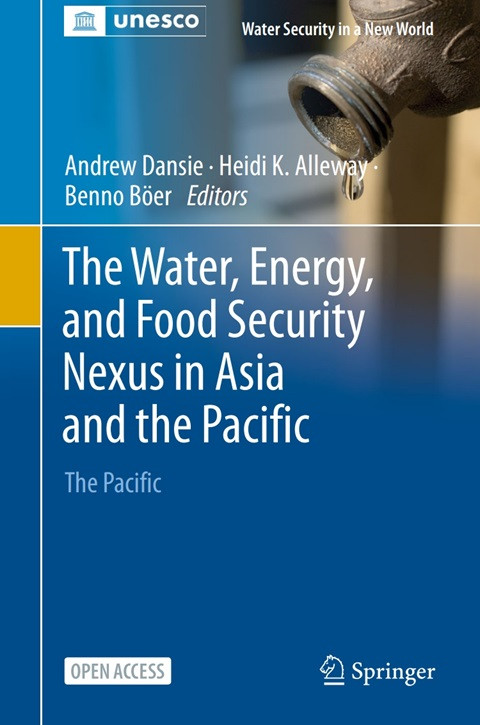 The Water, Energy, and Food Security Nexus in Asia and the Pacific: The Pacific Year of publication: 2024 Corporate author: UNESCO | UNESCO Bangkok | UNESCO Jakarta Global climate targets and the call to action from the Pacific must be heeded while major environmental, societal and economical progress is needed in the region. Leadership from Pacific Island Countries and Territories needs to be supported with action and resourcing to meet both global net zero goals and regional SDGs. This volume applies the water, energy, and food security nexus approach solely in a Pacific context for the first time, bringing together the region’s 17 countries and 7 Territories. This approach improves the security of each sector and supports regional climate and environmental priorities. Effective intersectoral solutions exist with connectivity between the water-food and water-energy sectors of particular benefit. Traditional knowledge and crop production have historically and will continue to play a major role in food security and water resources management in the region. Increased energy demand needs to be met with increased renewables installation as well as new technologies that encompass storage and transport considerations.
  The Impact of Climate Displacement on the Right to Education Year of publication: 2020 Corporate author: UNESCO Ce rapport tente d'expliquer les conséquences du réchauffement climatique sur l'éducation des populations, vouées à se déplacer pour fuir la dégradation de leur environnement, ce qui empêche les enfants de suivre une scolarisation complète et de qualité. This report attempts to explain the consequences of global warming on the education of populations, who are forced to move to escape the degradation of their environment, preventing children from receiving a complete, quality education.
  Green School Quality Standard: Greening Every Learning Environment Year of publication: 2024 Corporate author: UNESCO Climate change threatens our planet and future. Schools and other learning institutions are central places for accelerating climate action among learners and local communities. By empowering teachers and students to understand climate change in their own context contribute to making societies more sustainable and climate resilient. This publication provides for the first time ever a quality standard for greening schools and other learning environments. It outlines four core areas for integrating sustainability principles and climate action: 1) school governance, 2) facilities and operation, 3) teaching and learning, and 4) community engagement. Through the Greening Education Partnership, this standard establishes a common language for all stakeholders to jointly reach the global target of greening at least 50% of schools in all countries by 2030. Policy-makers and ministries in charge of education accreditation schemes, as well as educators, learners and communities are encouraged to use the green school quality standard and join the climate-ready school movement to ensure that every learner is equipped to address climate challenges.
  Greening Curriculum Guidance: Teaching and Learning for Climate Action Year of publication: 2024 Corporate author: UNESCO This Guidance responds to the calls from young people for a holistic approach to climate change and sustainability in the curriculum. It outlines a common language on how quality climate change and sustainability can be reflected in the curriculum by setting expected learning outcomes per age group (from 5-year olds and up to 18+ age group, including a lifelong learning approach).This is crucial for accelerating country-level action and ensuring joint monitoring of progress. The objective is to have 90 per cent of all countries include climate change in their curricula by 2030, as established by the Greening Education Partnership.This Guidance aims to support countries, schools or individual practitioners in reassessing their ongoing practices to adopt a more action-oriented, holistic, scientifically accurate, justice-driven and lifelong learning approach to climate change.
 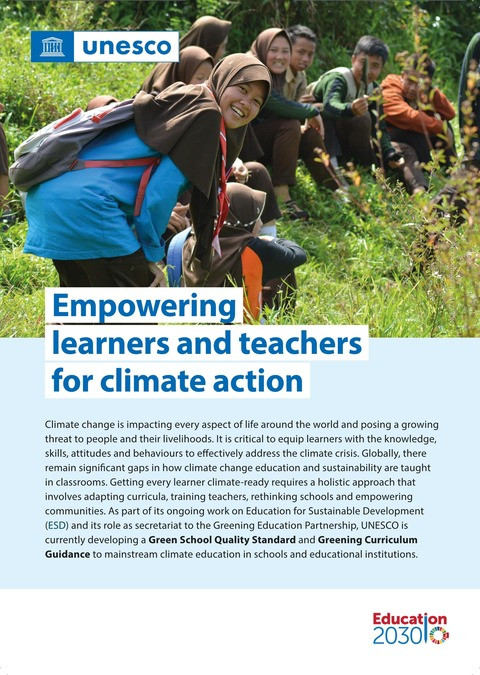 Empowering Learners and Teachers for Climate Action Year of publication: 2023 Corporate author: UNESCO Climate change is impacting every aspect of life around the world and posing a growing threat to people and their livelihoods. It is critical to equip learners with the knowledge, skills, attitudes and behaviours to effectively address the climate crisis. Globally, there remain significant gaps in how climate change education and sustainability are taught in classrooms. Getting every learner climate-ready requires a holistic approach that involves adapting curricula, training teachers, rethinking schools and empowering communities. As part of its ongoing work on Education for Sustainable Development (ESD) and its role as secretariat to the Greening Education Partnership, UNESCO is currently developing a Green School Quality Standard and Greening Curriculum Guidance to mainstream climate education in schools and educational institutions.
  World Heritage Glaciers: Sentinels of Climate Change Year of publication: 2022 Corporate author: UNESCO | International Union for Conservation of Nature (IUCN) It outlines the importance of glaciers for sustaining life, their role as indicators of climate change, and their accelerated retreat due to global warming. The report emphasizes the urgent need to drastically reduce greenhouse gas emissions to limit global warming to 1.5°C, which could save glaciers in two-thirds of World Heritage sites. Additionally, it underscores the importance of adaptive measures like improved monitoring networks, early warning systems, and targeted policies to address the inevitable changes in glacierized areas. It also advocates for inclusive stakeholder engagement, particularly involving Indigenous Peoples and local communities, to develop effective responses to the challenges posed by climate change. The document serves as a call to action for international cooperation and collaboration to protect the Outstanding Universal Value of World Heritage glaciers and ensure their continued benefits for humanity.