
Resources
Explore a wide range of valuable resources on GCED to deepen your understanding and enhance your research, advocacy, teaching, and learning.
219 Results found
 Empowering Students for Just Societies: A Handbook to Teach Integrity in Secondary Schools Year of publication: 2024 Corporate author: UNESCO | UN. Office on Drugs and Crime (UNODC) The importance of education lies in its power to shape the values of upcoming generations and equip them with the knowledge to make informed decisions. Contemporary challenges, including corruption must be addressed through education, transparency, accountability and the rule of law, among other efforts. This joint publication by UNODC and UNESCO is a response to this important issue. It is aimed at educators who are striving to inspire and prepare future generations to actively contribute to societies grounded in integrity, ethics and respect for the rule of law. The handbook builds on the first two launched in 2019. This publication highlights the transformative power of education in strengthening the knowledge, skills, attitudes and values necessary for addressing global challenges, especially those that stem from a lack of integrity, like corruption. It underlines the crucial role education plays in nurturing critical thinking, empathy, ethical behaviour, and a commitment to justice and equality among people. The handbook presents a catalogue of educational activities, lesson plans and outside the classroom resources designed to empower youth to reject corrupt practices and become agents of change, promoting integrity and upholding democratic values.
  UNESCO Futures of Education Report Explained by Members of the International Commission Year of publication: 2022 Corporate author: UNESCO Initiated by UNESCO, the International Commission on the Futures of Education has prepared a new report on how education can best shape the future of humanity and the planet. In this video, members of the Commission and its chair explain the main recommendations and defining features of their report, Reimagining our futures together: A new social contract for education. The report is part of UNESCO’s Futures of Education initiative which aims to rethink education and shape the future. The initiative is catalyzing a global debate on how knowledge, education and learning need to be reimagined in a world of increasing complexity, uncertainty, and precarity.
  Recommendation on Education for Peace, Human Rights and Sustainable Development: An Implementation Guide Year of publication: 2025 Corporate author: UNESCO There is no peace without education. With conflicts rising on so many fronts, there has never been a more urgent need for a transformed education geared towards building and sustaining peace.The Recommendation on Education for Peace and Human Rights, International Understanding, Cooperation, Fundamental Freedoms, Global Citizenship and Sustainable Development, adopted by all 194 Member States of UNESCO in 2023, articulates a humanistic and transformative vision of education that can help address contemporary and future affronts to peace. These challenges range from the resurgence of conflicts driven by systemic inequalities and injustices, the rise and spread of hate speech, racism and discrimination particularly online, to the adverse effects of digital technologies and the existential threat of climate change.UNESCO has developed this Guide as the first of several tools to assist Member States in unpacking and fully implementing the 2023 Recommendation. The Guide elaborates its contents, integrating the 2023 Recommendation’s transdisciplinary lens to connect key concepts and issues. It also provides concrete ideas and curated resources for action at different levels and types of education, while calling for a multi-stakeholder and whole-of-society approach that includes everyone and builds on existing positive efforts.The Guide is a timely addition to the pool of available collective resources to fully implement the 2023 Recommendation and foster an education that is transformative for a just and peaceful world.
 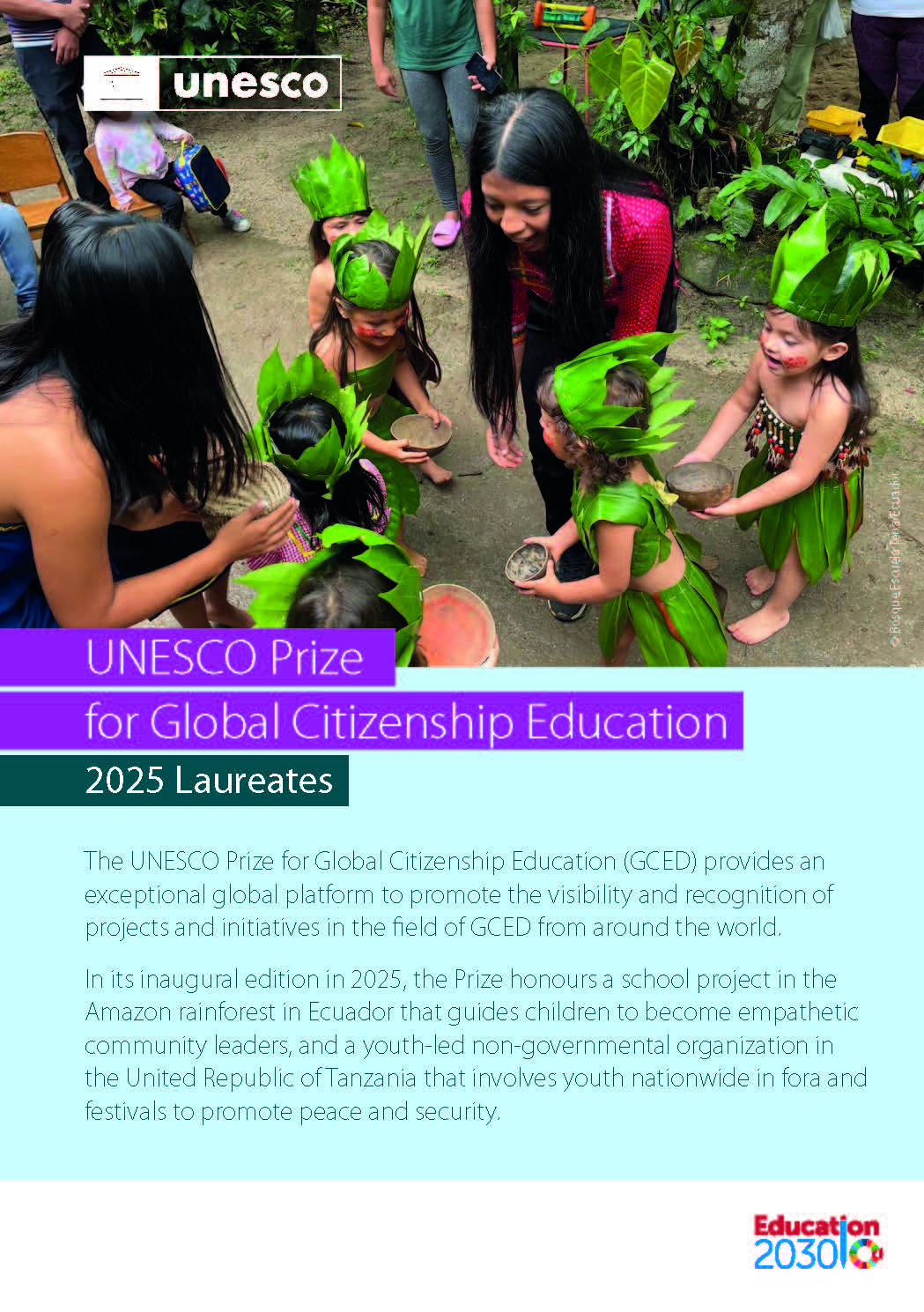 UNESCO Prize for Global Citizenship Education 2025 Laureates Year of publication: 2025 Corporate author: UNESCO The UNESCO Prize for Global Citizenship Education (GCED) provides an exceptional global platform to promote the visibility and recognition of projects and initiatives in the field of GCED from around the world.In its inaugural edition in 2025, the Prize honours a school project in the Amazon rainforest in Ecuador that guides children to become empathetic community leaders, and a youth-led non-governmental organization in the United Republic of Tanzania that involves youth nationwide in fora and festivals to promote peace and security.
  Strategies to Counter Antisemitism: A Handbook for Educators Year of publication: 2025 Corporate author: UNESCO Education is the first line of defence against hate and prejudice. By targeting the root causes of hate ideologies, deconstructing the stereotypes that underlie them from an early age, and promoting inclusive models, education is the keystone of a holistic approach to combating discrimination. Tackling antisemitism through education requires tailored content that addresses its complex, shifting and multilayered forms, both past and present.Acknowledging the topic’s complexity and the paucity of resources available to education stakeholders, this concise guide developed by UNESCO and funded by the European Commission aims to provide a roadmap for policymakers, curriculum developers and educators on current approaches and initiatives. It presents ten educational practices, each grounded in academic literature and illustrated by a promising educational initiative that operationalizes core pedagogical principles. The handbook is built around the three core learning domains which inform UNESCO’s approach to Global Citizenship Education: cognitive, socio-emotional, and behavioural learning.Conceived as an accessible operational guide for practitioners, this resource sets out to start a larger conversation about the needs of educators for tackling contemporary forms of antisemitism. It aims to encourage investments in high-quality empirical research that can pave the way for a better approach to combat antisemitism.
 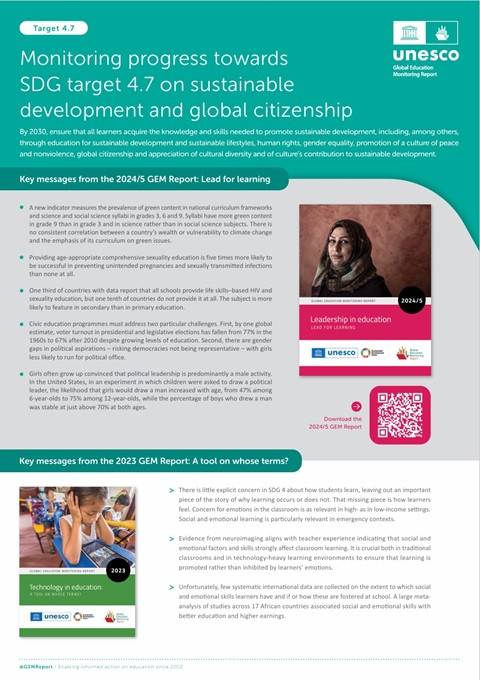 Monitoring Progress towards SDG Target 4.7 on Sustainable Development and Global Citizenship Year of publication: 2024 Corporate author: UNESCO | Global Education Monitoring Report Team This document introduces key messages from the GEM Reports and other related publications and online resources regarding the progress towards SDG Target 4.7.
 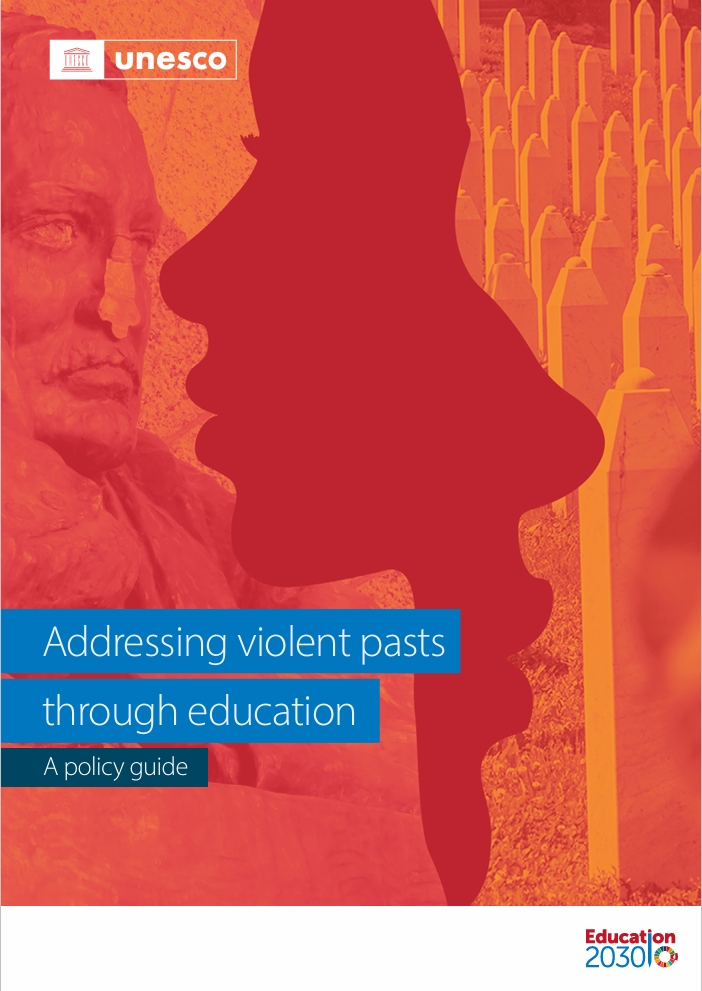 Addressing Violent Pasts through Education: A Policy Guide Year of publication: 2025 Corporate author: UNESCO Teaching about violent pasts and their legacies is a powerful way to foster sustainable peace.Education can build a nuanced understanding of complex histories, raise awareness of the roots and legacies of violence, nationally and internationally, and sensitize learners for their own agency as actors of change for reconciliation and conflict prevention.Educating about violent pasts is a challenging yet critical endeavour for policy-makers globally. It entails tailored approaches and an important support for educators to address traumatic pasts sensitively and to navigate related emotions and narratives successfully.Building on UNESCO’s programme on Global Citizenship Education, this guide offers education policy-makers a set of strategies, principles, and education practices to effectively integrate education about violent pasts into local education systems. It suggests a comprehensive approach that spans formal and informal education and aligns with the 2023 Recommendation on Education for Peace, Human Rights and Sustainable Development, opening new perspectives on history education, dialogue, and conflict transformation.
  Reimagining Our Futures Together: A New Social Contract for Education Year of publication: 2021 Corporate author: International Commission on the Futures of Education | UNESCO Our humanity and planet Earth are under threat. The pandemic has only served to prove our fragility and our interconnectedness. Now urgent action, taken together, is needed to change course and reimagine our futures. This report by the International Commission on the Futures of Education acknowledges the power of education to bring about profound change. We face a dual challenge of making good on the unfulfilled promise to ensure the right to quality education for every child, youth and adult and fully realizing the transformational potential of education as a route for sustainable collective futures. To do this, we need a new social contract for education that can repair injustices while transforming the future.This new social contract must be grounded in human rights and based on principles of non-discrimination, social justice, respect for life, human dignity and cultural diversity. It must encompass an ethic of care, reciprocity, and solidarity. It must strengthen education as a public endeavour and a common good.This report, two years in the making and informed by a global consultation process engaging around one million people, invites governments, institutions, organizations and citizens around the world to forge a new social contract for education that will help us build peaceful, just, and sustainable futures for all.The visions, principles, and proposals presented here are merely a starting point. Translating and contextualizing them is a collective effort. Many bright spots already exist. This report attempts to capture and build on them. It is neither a manual nor a blueprint but the opening up of a vital conversation.
 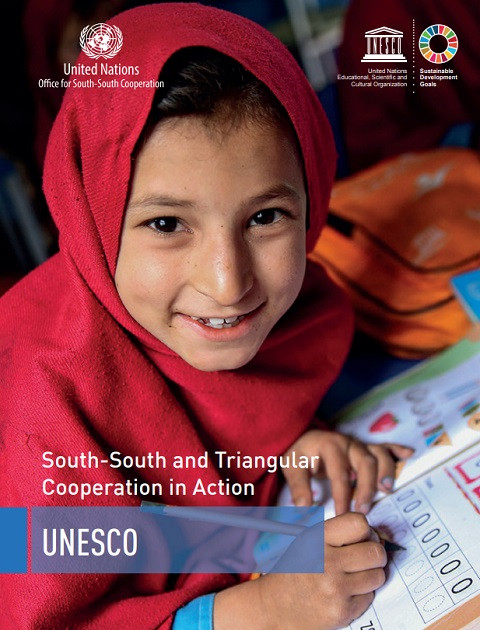 South-South and Triangular Cooperation in Action Year of publication: 2018 Corporate author: UNESCO | UN. Office for South-South Cooperation (UNOSSC) This publication is UNESCO’s first dedicated report on South-South cooperation and triangular cooperation. It presents an overall picture of the progress achieved to support technical cooperation, capacity building and knowledge sharing through South-South and triangular cooperation in UNESCO’s areas of competence with highlights of specific examples. It paves the way for deepening future cooperation in this area.