
Resources
Explore a wide range of valuable resources on GCED to deepen your understanding and enhance your research, advocacy, teaching, and learning.
49 Results found
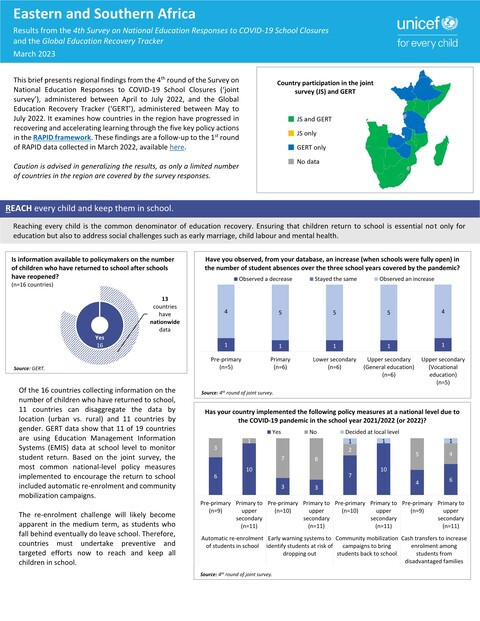 Education in a Post-COVID World: Towards a Rapid Transformation; Eastern and Southern Africa Regional Brief Year of publication: 2023 Corporate author: United Nations Children's Fund (UNICEF) On March 11, 2020, the World Health Organization declared COVID-19 a global pandemic, resulting in disruptions to education at an unprecedented scale. In response to the urgent need to recover learning losses, countries worldwide have taken RAPID actions to: Reach every child and keep them in school; Assess learning levels regularly; Prioritize teaching the fundamentals; Increase the efficiency of instruction; and Develop psychosocial health and wellbeing. This brief presents regional findings from the 4th round of the Survey on National Education Responses to COVID-19 School Closures (‘joint survey’), administered between April to July 2022, and the Global Education Recovery Tracker (‘GERT’), administered between May to July 2022. It examines how countries in the region have progressed in recovering and accelerating learning through the five key policy actions in the RAPID framework. These findings are a follow-up to the 1st roundof RAPID data collected in March 2022.
 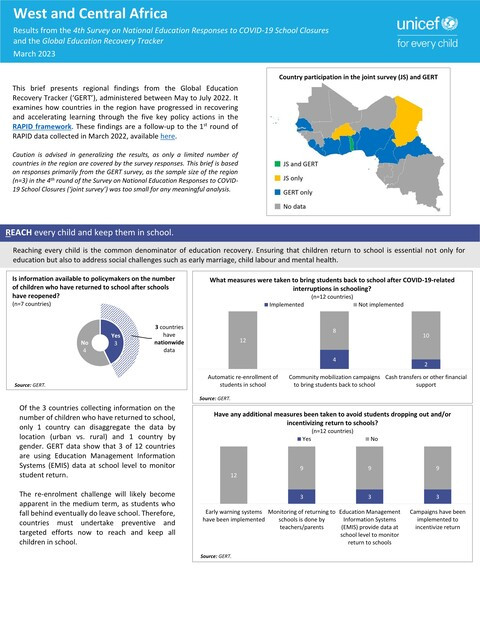 Education in a Post-COVID World: Towards a Rapid Transformation West and Central Africa Regional Brief Year of publication: 2023 Corporate author: United Nations Children's Fund (UNICEF) On March 11, 2020, the World Health Organization declared COVID-19 a global pandemic, resulting in disruptions to education at an unprecedented scale. In response to the urgent need to recover learning losses, countries worldwide have taken RAPID actions to: Reach every child and keep them in school; Assess learning levels regularly; Prioritize teaching the fundamentals; Increase the efficiency of instruction; and Develop psychosocial health and wellbeing. This brief presents regional findings from the Global Education Recovery Tracker (‘GERT’), administered between May to July 2022. It examines how countries in the region have progressed in recovering and accelerating learning through the five key policy actions in the RAPID framework. These findings are a follow-up to the 1st round of RAPID data collected in March 2022.
 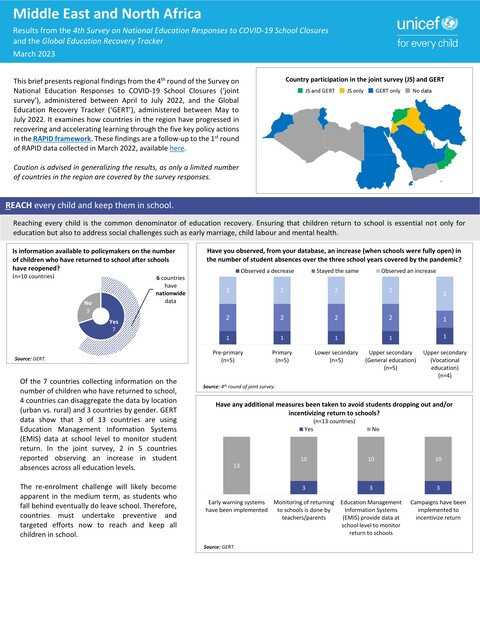 Education in a Post-COVID World: Towards a Rapid Transformation; Middle East and North Africa; Regional Brief Year of publication: 2023 Corporate author: United Nations Children's Fund (UNICEF) On March 11, 2020, the World Health Organization declared COVID-19 a global pandemic, resulting in disruptions to education at an unprecedented scale. In response to the urgent need to recover learning losses, countries worldwide have taken RAPID actions to: Reach every child and keep them in school; Assess learning levels regularly; Prioritize teaching the fundamentals; Increase the efficiency of instruction; and Develop psychosocial health and wellbeing. This brief presents regional findings from the 4th round of the Survey on National Education Responses to COVID-19 School Closures (‘joint survey’), administered between April to July 2022, and the Global Education Recovery Tracker (‘GERT’), administered between May to July 2022. It examines how countries in the region have progressed in recovering and accelerating learning through the five key policy actions in the RAPID framework. These findings are a follow-up to the 1st round of RAPID data collected in March 2022.
 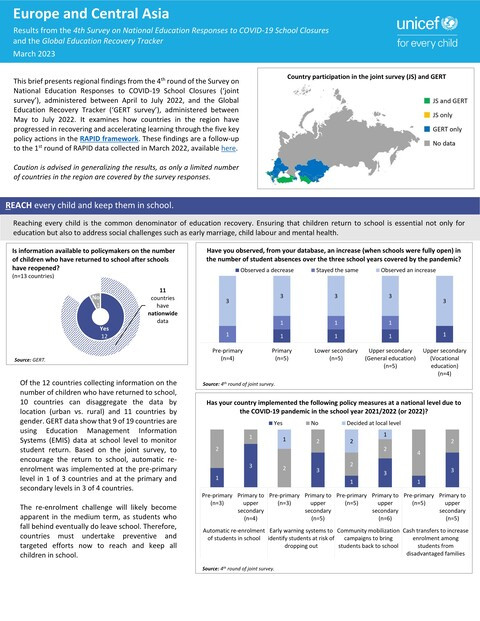 Education in a Post-COVID World: Towards a Rapid Transformation; Europe and Central Asia Regional Brief Year of publication: 2023 Corporate author: United Nations Children's Fund (UNICEF) On March 11, 2020, the World Health Organization declared COVID-19 a global pandemic, resulting in disruptions to education at an unprecedented scale. In response to the urgent need to recover learning losses, countries worldwide have taken RAPID actions to: Reach every child and keep them in school; Assess learning levels regularly; Prioritize teaching the fundamentals; Increase the efficiency of instruction; and Develop psychosocial health and wellbeing. This brief presents regional findings from the 4th round of the Survey on National Education Responses to COVID-19 School Closures (‘joint survey’), administered between April to July 2022, and the Global Education Recovery Tracker (‘GERT survey’), administered between May to July 2022. It examines how countries in the region have progressed in recovering and accelerating learning through the five key policy actions in the RAPID framework. These findings are a follow-up to the 1st round of RAPID data collected in March 2022.
  Education à la citoyenneté et aux droits de l'homme: manuel pour les jeunes en Mauritanie Year of publication: 2015 Author: Sidi Mohamed Ould Mohamed Abdellahi | Bamariam Koita | Mohamed El Moctar Ould Sidina | Abdel Wedoud Corporate author: Mauritania. Ministère de la culture et de l'artisanat | Mauritanian National Commission for Education, Science and Culture | UNESCO Rabat Prepared by UNESCO in cooperation with the Mauritanian Ministry of Culture and Crafts, and with the support of the Spanish Agency for International Development Cooperation (AECID), this manual aims to - with the active help of trainers and facilitators - sensitize young Mauritanians to the fundamental concepts of citizenship and human rights. This educational tool, which includes practical exercises adapted to a young audience, consists of 20 didactic cards that describe and explain Mauritania national legislation on human rights.Ce Manuel, composé de 20 fiches thématiques, offre de manière inédite des connaissances sur les conventions et standards internationaux en matière de démocratie et de droits de l’homme, ainsi qu’une contextualisation aux cadres normatifs nationaux de la Mauritanie. Des questions clés, des exercices interactifs, et des références pour aller plus loin sont autant d’outils pédagogiques pour familiariser les jeunes avec des notions fondamentales, dans le cadre de l’éducation aussi formelle que non formelle. Car Si l’éducation à la citoyenneté est rattachée à un territoire national dans la mesure où est citoyenne toute personne disposant de droits et de devoirs attachés à une nationalité, à un État, à une histoire sociale et culturelle, l’éducation aux droits de l’homme se réfère quant à elle à un cadre normatif universel et déterritorialisé : sa mission est de cultiver le sentiment d’appartenance de chacun(e) à l’humanité, caractérisée par une dignité propre. Dans une démarche éducative, ce Manuel conjugue les deux dimensions, les interpé- nètre et les met en perspective. L’objectif est de permettre aux jeunes, avec l’aide de formateurs et d’animateurs, d’approfondir et de mettre en perspective leurs connaissances relatives aux valeurs de citoyenneté et aux principes de droits de l’homme, à travers un va-et vient constant entre l’idéal universel et le contexte politique, social, culturel et environnemental dans lequel ils se trouvent.Fruit de la collaboration entre l’UNESCO et le Ministère de la Culture et de l’Artisanat de Mauritanie, et bénéficiant du soutien de l’Agence espagnole pour la coopération internationale pour le développement (AECID), ce Manuel propose des pistes pour explorer et interroger les conditions d’exercice de la citoyenneté, ainsi que des problématiques sociétales émergeantes. Mieux comprendre, pour mieux agir, c’est aussi cela être un agent de changement, de paix et de développement.
  Higher Education and Democratic Culture: Citizenship, Human Rights and Civic Responsibility (Council of Europe Higher Education Series No.8) Year of publication: 2008 Author: Josef Huber | Ira Harkavy Corporate author: Council of Europe This book on the responsibility of higher education for a democratic culture is the 8th volume in the Council of Europe's Higher Education series. It is the direct result of a Higher Education Forum held in June 2006 on the responsibility of higher education for citizenship, human rights and sustainability. This forum was a part of the Council of Europe's long-standing commitment to work in the area of education for democratic citizenship and human rights. It complements earlier work on the public responsibility for higher education and research which led to a recommendation of the Committee of Minister to the member states of the Council of Europe in 2007. If our aim is to work for sustainable democratic societies, the responsibility of public authorities for a high-quality higher education system must go hand in hand with the responsibility of higher education institutions towards the advancement of society.
  Comprehensive Sex Education Year of publication: 2021 Corporate author: Ministry of Education, Argentina What are we talking about when we say Comprehensive Sex Education? What challenges does integrality take on? In this issue of the Human Rights, Gender and CSE at school collection you will find a series of activities to work in the classroom and a theoretical framework to think about CSE.
  Human Rights: 13 Ideas Received To Be Deconstructed Year of publication: 2022 Author: Céline Branaa | Louise Pluyaud | Louise Savri Corporate author: Commission nationale consultative des droits de l'homme (CNCDH) Aimed at 14-20 year-olds, this book aims to raise awareness of human rights and reminds us of the major role they play in our lives and in the organization of contemporary society. Today, human rights are being challenged by various movements that question their usefulness, effectiveness and universality. The links between certain violations of fundamental rights, climate change, the dangers of digital technology and so many other contemporary issues are often misunderstood or even ignored. The NCCHR is convinced of the urgent need to reaffirm that human rights are the foundation of a democratic society. To this end, the members of the NCCHR set out to deconstruct 13 of the most common misconceptions heard or disseminated in the media and on social networks. Through 13 illustrated chapters, each corresponding to a preconceived idea, human rights appear at the heart of our civilization as a current and indispensable reference. Readers are invited to become actively involved in their promotion. This book is a reminder that fundamental rights are not a construct of the past, but a necessary tool for the present. Highlighting the richness of human rights, this book is an invitation to anticipate a common future in which the dignity and freedom of the human person represent an accessible promise.
  Teaching Two Lessons about UNESCO and Other Writings on Human Rights Year of publication: 2017 Author: Fernando Reimers This book presents two lessons for use in college or high school, to educate students on the mission and work of UNESCO as it relates to the advancement of Human Rights. It includes also a series of a short essays on Human Rights, the Right to Education, Teaching Human Rights and the role of Teachers and Universities in Teaching Human Rights which will be useful to educators interested in educating their students to advance the values of freedom and justice. For more information about this book, please visit the link below.URL: https://www.amazon.com/Teaching-Lessons-Unesco-writings-Rights/dp/1978367996#reader_1978367996 The lessons(Two Lessons About UNESCO) are designed to help high school and college students understand the mission of UNESCO, the reason the organization was created, the work it does, how it is structured and funded, and how its work relates to the Universal Declaration of Human Rights. The lessons can be taught at the High School or College level. They can be taught in a variety of courses including social studies, history, humanities, and can be integrated in courses in other disciplines. For more information, please visit the link below.URL: https://medium.com/@fernandomreimers/teaching-two-lessons-about-unesco-7531c5fe9395
  Building Intercultural Citizenship through Education: A Human Rights Approach Year of publication: 2008 Author: Rodolfo Stavenhagen This article analyses the challenges posed by traditional ethnic and linguistic minorities in multicultural states and more specifically the problems faced by indigenous peoples and communities. Their educational and cultural needs and demands are increasingly being framed in the language of human rights, based on the expanding international legal and institutional human rights system. The United Nations World Conference on Human Rights, held in Vienna in 1993, endorsed a rights-based approach to development, human rights education is a growing field in educational practice, respect for cultural diversity is now enshrined in international and domestic laws, and the right of every person to education and to culture has become a mainstay of international human rights principles to which a majority of the world's states has subscribed.