
Resources
Explore a wide range of valuable resources on GCED to deepen your understanding and enhance your research, advocacy, teaching, and learning.
25 Results found
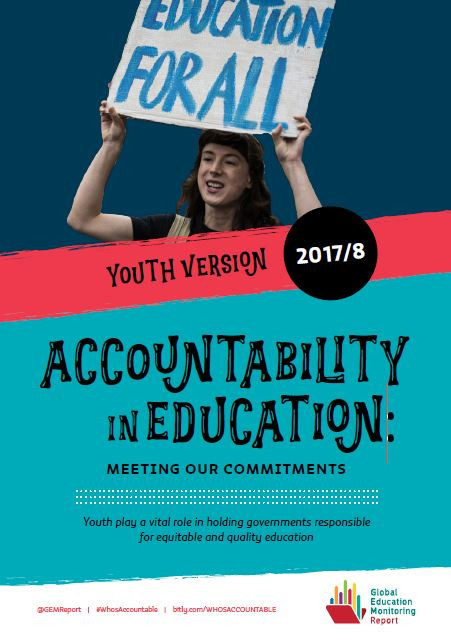 Accountability in Education: Meeting our Commitments; Global Education Monitoring Report, Youth Version, 2017/8 Year of publication: 2017 Corporate author: UNESCO This Youth Report, based on findings and conclusions from the 2017/8 Global Education Monitoring report, asks how young people are involved in the process of accountability in education. As students, what are we responsible for in our education and how are we held accountable? How can we make sure other actors – like schools, universities and governments – are held accountable for their responsibilities? These are critical questions, because we know that there’s a long way to go before all young people around the world have access to a quality education: absent teachers, overcrowded classrooms, illegitimate diplomas, unregulated private schools and truancy are all issues that education systems are struggling to overcome.It’s sometimes tempting to say that these problems aren’t ours to fix, that the responsibility lies with the government or with an older generation. But this simply isn’t true: education is a shared responsibility, and young people have an important role to play. In this Report, you’ll hear the stories of young people around the world who have stood up for the right to education in their communities and who have been integral in triggering change. You’ll also read about how you can become involved in our campaign to make sure governments can be held to account for education. This means making sure that citizens can take their governments to court if they are not meeting their education responsibilities. From creating video clips to holding awareness-raising events, there is a range of ways to make your voice heard. Your involvement is integral in making sure the world is on the right path to meeting our education goals.
  Implementing the Right to Education: a Compendium of Practical Examples Year of publication: 2016 Corporate author: UNESCO This publication is a compilation of practical examples of measures taken by Member States in implementing the provisions of the UNESCO Convention and Recommendation against Discrimination in Education. These examples are taken from national reports submitted to UNESCO for the Eighth Consultation of Member States on the implementation of these two international standard-setting instruments. The Convention and the Recommendation celebrated their fi fty-fi fth anniversary in 2015. Both express the fundamental principles of non-discrimination and equality of educational opportunities enshrined in UNESCO’'s Constitution. Since these fundamental principles were essential in the process of Education for All, the instruments have naturally become the cornerstone of this important domain.The Education 2030 development agenda will provide further opportunity to mobilise the Convention and the Recommendation in guiding Member States in the effective realization of the right to education. This compendium seeks to provide an overview of promising measures taken to ensure equality of educational opportunities and non-discrimination, while also serving as a tool for information sharing and advocacy in connection with the right to education.
 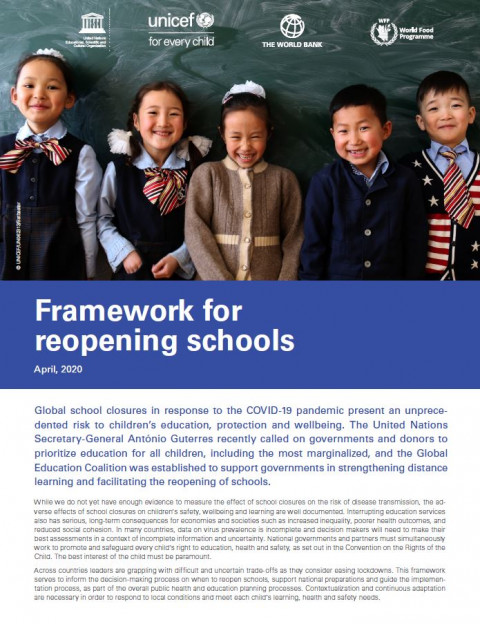 Framework for Reopening Schools; April, 2020 Year of publication: 2020 Corporate author: UNESCO | United Nations Children's Fund (UNICEF) | World Bank | World Food Programme By late April, nationwide school closures were still disrupting the learning of more than 73 per cent of students, or more than 1.2 billion children and youth. When deciding whether to reopen schools, authorities should look at the benefits and risks across education, public health and socio-economic factors, in the local context, using the best available evidence. The best interest of every child should be paramount.The guidelines aim to inform the decision-making process regarding school reopening, support national preparations and guide the implementation process, as part of overall public health and education planning processes. It is designed to be a flexible tool that can be adapted to each context and updated as the situation changes. The guidelines outline six key priorities to assess the readiness of those schools and inform planning.
  The right to higher education and gender equality: briefing note compendium Year of publication: 2023 Corporate author: UNESCO International Institute for Higher Education in Latin America and the Caribbean (IESALC) The right to higher education and gender equality Table of ContentsForeword ................................................................................................................................................................................4Introduction ..........................................................................................................................................................................5UNESCO and the right to higher education ..............................................................................................................5Aim of this compendium..................................................................................................................................................6Key findings...........................................................................................................................................................................7Gender equality in Higher Education - Maximising impacts– Gillian Cowell................................................8Gender equality and higher education: The Afghan case – Aisha Khurram............................................... 12An analysis of gender equality policies and practices in higher education institutions and their effectiveness in promoting gender equity – Angel Mbuthia........................................................ 14Gender identity and access to higher education – Martin Perea.................................................................... 16What can be done to ensure the right to higher education? – Bhavani Rao.............................................. 18Gender equality in higher education still a pending issue in Peru – Patricia Ruiz Bravo ....................... 22Gender equality in higher education: state of play and implications across OECD countries, and reflections on potential responses for policy and practice – François Staring.................................. 24
  Education in Africa: placing equity at the heart of policy; executive summary Year of publication: 2023 Corporate author: UNESCO Dakar | Union Africaine This report follows the request made by the Member States of the African Union during the 2018 Pan-African High-Level Conference on Education. It aims to support the efforts undertaken by African countries to accelerate the achievement of the targets and strategic objectives set out in the 2030 Agenda and the Continental Education Strategy for Africa (CESA). This first report highlights the need to place equity at the heart of efforts to improve access to and the quality of education, without which efforts to improve access to and the quality of education could inadvertently widen existing inequalities.
  Rising Beyond: Aiming towards a Brighter Future Year of publication: 2021 Author: Aarya Chavda As children, how do we truly define a better understanding towards the right to choose, right to dream and right to self-express? This book emphasizes on the true meaning that there is no duty more important than ensuring that children’s rights are respected.
  Together for Peace: Silent Manga Catalogue Year of publication: 2020 Author: Walden Schertz | Jeremy Clay | Santibhap Ussavasodhi Corporate author: UNESCO Bangkok | Coamix This Together for Peace Silent Manga Catalogue is a compilation of silent manga – manga stories told entirely through illustration without the use of dialogue. These works of art were selected from 274 entries submitted by artists in 117 countries worldwide to join SILENT MANGA AUDITION® Round 13 held under the theme Together for Peace, in collaboration with UNESCO Bangkok, the Asia and Pacific Regional Bureau for Education. Silent manga is a powerful medium of communication in the Asia-Pacific. Although the region is the most diverse in the world, it can be enjoyed by anyone regardless of their background. Silent manga has no language barrier. These works showcase different reflections of peace as expressed by artists around the world while conforming to the Japanese manga style.
  Refugee Education; Five Years on from the Launch of the 2030 Refugee Education Strategy Year of publication: 2024 Author: Cirenia Chavez Villegas | Kate Bond Corporate author: UN. Office of the United Nations High Commissioner for Refugees (UNHCR) The 2024 UNHCR Refugee Education Report draws on data from more than 65 countries worldwide to provide the most detailed picture yet of the state of refugee education and enrolment. The report reflects on the 2030 Refugee Education Strategy (launched in 2019) and where notable progress has been made as well as areas where greater investment and enhanced collaboration are needed to meet the strategic objectives of the Strategy.
  Report on the Right to Education in Human Mobility in Central America, the Dominican Republic and Mexico: Towards Inclusive, Equitable, Quality Education With Lifelong Learning Opportunities Year of publication: 2024 Corporate author: UNESCO San José | Central American Educational and Cultural Coordination | Central American Integration System Although human mobility is not a new phenomenon, data indicate that the number of people in this situation has reached its highest point since records began and there are no signs that the trend will decrease in the coming years. This scenario threatens to become a structural situation, strongly impacting the right to education and educational systems. Therefore, it is imperative that States and other key actors make a deep commitment to guarantee the fundamental right to education of people in situations of mobility through urgent measures, in line with the provisions of Sustainable Development Goal (SDG) 4 of the United Nations 2030 Agenda. For this reason, the preparation of this Report on the right to education of people in situations of mobility in Belize, Costa Rica, El Salvador, Guatemala, Honduras, Mexico, Nicaragua, Panama and the Dominican Republic has been undertaken. The Report is an effort by UNESCO and the Central American Educational and Cultural Coordination (CECC/SICA) in collaboration with UNHCR, IOM, UNICEF, the Norwegian Refugee Council and RET International, and with the technical support of the SES Foundation and the UNESCO Chair for the Development of International Education at George Washington University (United States).
  Educational Route: Lessons Learned Year of publication: 2024 Corporate author: Save the Children This report, prepared by Save the Children in partnership with HIAS and funded by ECHO, sets out the main lessons learned from the Educational Route project, which has had areas of intervention in Mexico, Panama, Costa Rica, Guatemala, Honduras and El Salvador. The objective of the project has been to contribute to reducing barriers to access to education for children, adolescents and families on the move along the Central American migratory routes. Within the framework of the project, a methodological package has been created containing an evaluation tool “HALDO on the move” (Holistic Assessment of Learning and Development Outcomes) that allows different humanitarian actors to quickly assess the educational level of children and adolescents and record their data on a platform in order to offer an emergency education response adapted to real learning needs, as well as achieve greater coordination to promote educational continuity along the route.