
Resources
Explore a wide range of valuable resources on GCED to deepen your understanding and enhance your research, advocacy, teaching, and learning.
56 Results found
 A Comprehensive Methodology for Monitoring Social Media to Address and Counter Online Hate Speech Year of publication: 2024 Corporate author: UN. Office on Genocide Prevention and the Responsibility to Protect This report introduces a standardized methodology for monitoring online hate speech, to identify, assess, and mitigate risks, including when it constitutes risks of genocide, war crimes, and crimes against humanity. This methodology is based on an extensive review of existing methodologies used for this purpose across academia, technology companies, governments, the United Nations, and NGOs, and synthesizes those approaches into a standard set of practices that best fit the use cases relevant to the UN and its partners.
  خطاب الكراهية في شبكة الفيس بوك في الأردن: دراسة مسحية Year of publication: 2018 Author: Nasser Al-Rahamna Corporate author: Middle East University هدفت الدراسة الى تحديد مفهوم خطاب الكراهية وأشكاله المتنوعة. وركزت على دراسة خطاب الكراهية في شبكة الفيس بوك ودرست انعكاسات هذا الخطاب على المجتمع الأردني. استخدمت الدراسة المنهج الوصفي. وانتهت بوضع مجموعة من الحلول لهذه الظاهرة. Hate Speech on Facebook in Jordan: A Survey Year of publication: 2018 Author: Nasser Al-Rahamna Corporate author: Middle East University This study aimed to define the concept of hate speech and its various forms. It focused on studying hate speech on Facebook, and studied the implications of this speech on Jordanian society. The study used the descriptive method. It ended with a set of solutions to this phenomenon.
  Countering and addressing online hate speech: a guide for policy makers and practitioners Year of publication: 2023 Corporate author: UN. Office on Genocide Prevention and the Responsibility to Protect Online hate speech remains a critical challenge to advancing the objectives set out in the UN Strategy and Plan of Action on Hate Speech and the pillars of the United Nations work, namely Peace and Security, Human Rights and Sustainable Development. The recommendations outlined in this policy paper, provide a framework for countering hate speech, in line with international human rights norms and standards. The recommendations are based on three years of consultations and dialogue, including with the technology and social media companies, experts, the UN Working Group on Hate Speech and civil society. Their implementation should be part of broader efforts to address hate speech globally, including its root causes and impact offline, in line with the UN Strategy and Plan of Action. The pursuit of these recommendations should also prioritize participation and engagement directly with the victims of hate speech, underpinned by the principles of non-discrimination and leaving no one behind.
  United Nations Global Principles for Information Integrity : Recommendations for Multi-stakeholder Action Year of publication: 2024 Corporate author: United Nations (UN) Technological advances have revolutionized communications, connecting people on a previously unthinkable scale. They have supported communities in times of crisis, elevated marginalized voices and helped mobilize global movements for racial justice and gender equality. Yet these same advances have enabled the spread of misinformation, disinformation and hate speech at an unprecedented volume, velocity and virality, risking the integrity of the information ecosystem. New and escalating risks stemming from leaps in AI technologies have made strengthening information integrity one of the urgent tasks of our time. This clear and present global threat demands coordinated international action. The United Nations Global Principles for Information Integrity show us another future is possible. Principes mondiaux des Nations Unies pour l’intégrité de l’information: Recommandations pour une action multipartite Year of publication: 2024 Corporate author: United Nations (UN) Les avancées technologiques ont révolutionné les communications, connectant les personnes à une échelle autrefois inimaginable. Elles ont soutenu les communautés en temps de crise, amplifié les voix marginalisées et contribué à la mobilisation mondiale pour la justice raciale et l’égalité des genres. Pourtant, ces mêmes avancées ont également favorisé la propagation de la désinformation, des informations fallacieuses (ou « fake news ») et des discours de haine à une vitesse, une ampleur et une viralité sans précédent, menaçant ainsi l’intégrité de l’écosystème informationnel. Les risques émergents et croissants liés aux progrès rapides de l’intelligence artificielle font du renforcement de l’intégrité de l’information l’un des défis les plus urgents de notre époque. Cette menace mondiale, claire et actuelle, exige une action internationale coordonnée. La publication Principes mondiaux des Nations Unies pour l’intégrité de l’information nous montrent qu’un autre avenir est possible.
  The Butterfly Effect on Social Networks Year of publication: 2021 Corporate author: Canada Learning Code This video shows the dangers of the internet and social networks through the story of 12-year-old Amira in the form of a comic strip. L'effet papillon sur les réseaux sociaux Year of publication: 2021 Corporate author: Canada Learning Code Cette vidéo montre les dangers d'internet et des réseaux sociaux à travers l'histoire d'Amira 12 ans sous la forme d'une bande dessinée.
 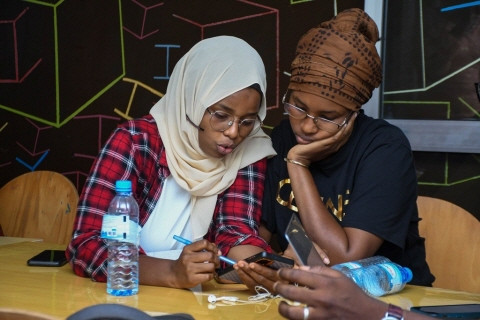 Fighting Against Disinformation and Hate Speech Year of publication: 2024 Corporate author: Association of Guinean Bloggers (ABLOGUI) This online MOOC is completely free. It is offered by the Association des Blogueurs de Guinée (ABLOGUI) through the IMPACT project (Implication of Digital Media in the Active Prevention of Conflicts and Tensions). It aims at raising awareness among young Guineans of the dangers of misinformation and hate speech, and to equip them with the knowledge and skills they need to combat information disorder in a digital world. Lutte contre la désinformation et les propos haineux Year of publication: 2024 Corporate author: Association of Guinean Bloggers (ABLOGUI) Ce MOOC en ligne est entièrement gratuit. Il est proposé par l'Association des Blogueurs de Guinée (ABLOGUI) dans le cadre du projet IMPACT (Implication des médias numériques dans la prévention active des conflits et des tensions). Il vise à sensibiliser les jeunes Guinéens aux dangers de la désinformation et des discours de haine, et à les doter des connaissances et des compétences nécessaires pour lutter contre le désordre de l'information dans un monde numérique.