
Resources
Explore a wide range of valuable resources on GCED to deepen your understanding and enhance your research, advocacy, teaching, and learning.
141 Results found
 Tenth Meeting of the High-level Group on Education for All (EFA), 22-24 March 2011, Jomtien, Thailand: Jomtien Statement Year of publication: 2011 Corporate author: UNESCO This statement is the outcome of 10th meeting of the High-level Group on Education for All. The meeting was held from 22 to 24 March 2011 in Jomtien, Thailand to urge to progress towards the EFA goals. Dixième Réunion du Groupe de Haut Niveau sur l'Éducation pour Tous (EPT), 22-24 Mars 2011, Jomtien, Thaïlande: Déclaration de Jomtien Year of publication: 2011 Corporate author: UNESCO Cette déclaration est le résultat de la 10e réunion du Groupe de haut niveau sur l'éducation pour tous. La réunion a eu lieu du 22 au 24 Mars 2011 à Jomtien, en Thaïlande pour pousser à progresser vers les objectifs de l'EPT. Eleventh meeting of the working group on Education for All, 2-3 February 2011, Paris, France: summary report Year of publication: 2011 Corporate author: UNESCO The eleventh meeting of the Working Group (WG) on Education for All (EFA) took place on 2 and 3 February 2011 at UNESCO headquarters in Paris. The meeting brought together people representing governments, bilateral and multilateral organizations, regional organizations, civil society organizations (CSOs), research institutes, foundations and the private sector. Consisting of seven sessions, the meeting aimed to review the world’s progress towards EFA and identify policy actions that can accelerate EFA progress, in particular as regards quality education, effective advocacy for education, violent conflicts and education and financing for education. The recommendations of the meeting were to be taken to the tenth meeting of the High Level Group (HLG) on EFA (Jomtien, Thailand, 22–24 March 2011). Eleventh meeting of the working group on Education for All, 2-3 February 2011, Paris, France: summary report Year of publication: 2011 Corporate author: UNESCO La onzième réunion du Groupe de travail(GT) sur l'éducation pour tous(EPT) a eu lieu les 2 et 3 Février 2011 au Siège de l'UNESCO à Paris. La réunion a rassemblé des personnes représentant les gouvernements, les organisations bilatérales et multilatérales, les organisations régionales, les organisations de la société civile (OSC), les instituts de recherche, les fondations et le secteur privé. Composée de sept sessions, la réunion visait à examiner les progrès accomplis dans le monde pour l'EPT et identifier les actions politiques qui peuvent accélérer les progrès de l'EPT, en particulier que l'éducation concerne la qualité, le plaidoyer efficace pour l'éducation, les conflits violents et de l'éducation et le financement de l'éducation. Les recommandations de la réunion devaient être prises à la dixième réunion du Groupe de haut niveau (GHN) sur l'EPT (Jomtien, Thaïlande, 22-24 Mars 2011). Десятое совещание Группы высокогоуровня по образованию для всех (ОДВ): Джомтьенское заявление Year of publication: 2011 Corporate author: UNESCO This statement is the outcome of 10th meeting of the High-level Group on Education for All. The meeting was held from 22 to 24 March 2011 in Jomtien, Thailand to urge to progress towards the EFA goals. Décima Reunión del Grupo de Alto Nivel sobre Educación para Todos (EPT): Declaración de Jomtien Year of publication: 2011 Corporate author: UNESCO This statement is the outcome of 10th meeting of the High-level Group on Education for All. The meeting was held from 22 to 24 March 2011 in Jomtien, Thailand to urge to progress towards the EFA goals. Dixième Réunion du Groupe de Haut Niveau sur l’Éducation pour Tous (EPT): Déclaration de Jomtien Year of publication: 2011 Corporate author: UNESCO This statement is the outcome of 10th meeting of the High-level Group on Education for All. The meeting was held from 22 to 24 March 2011 in Jomtien, Thailand to urge to progress towards the EFA goals. 第十次全民教育(EFA)高级工作组会议: 宗滴恩宣言 Year of publication: 2011 Corporate author: UNESCO This statement is the outcome of 10th meeting of the High-level Group on Education for All. The meeting was held from 22 to 24 March 2011 in Jomtien, Thailand to urge to progress towards the EFA goals. لاجتماع العاشر للفريق الرفيع المستوى المعني بالتعليم للجميع Year of publication: 2011 Corporate author: UNESCO This statement is the outcome of 10th meeting of the High-level Group on Education for All. The meeting was held from 22 to 24 March 2011 in Jomtien, Thailand to urge to progress towards the EFA goals.
 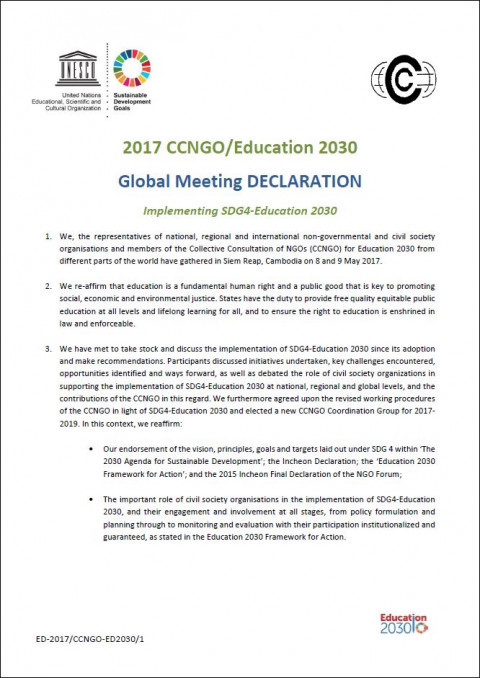 2017 CCNGO, Education 2030: implementing SDG4-Education 2030; Global meeting declaration Year of publication: 2017 Corporate author: UNESCO | Collective Consultation of NGOs on Education for All We, the representatives of national, regional and international non-governmental and civil society organisations and members of the Collective Consultation of NGOs (CCNGO) for Education 2030 from different parts of the world have gathered in Siem Reap, Cambodia on 8 and 9 May 2017.We re-affirm that education is a fundamental human right and a public good that is key to promoting social, economic and environmental justice. States have the duty to provide free quality equitable public education at all levels and lifelong learning for all, and to ensure the right to education is enshrined in law and enforceable.We have met to take stock and discuss the implementation of SDG4-Education 2030 since its adoption and make recommendations. Participants discussed initiatives undertaken, key challenges encountered, opportunities identified and ways forward, as well as debated the role of civil society organizations in supporting the implementation of SDG4-Education 2030 at national, regional and global levels, and the contributions of the CCNGO in this regard. We furthermore agreed upon the revised working procedures of the CCNGO in light of SDG4-Education 2030 and elected a new CCNGO Coordination Group for 2017- 2019. In this context, we reaffirm:· Our endorsement of the vision, principles, goals and targets laid out under SDG 4 within ‘The 2030 Agenda for Sustainable Development’; the Incheon Declaration; the ‘Education 2030 Framework for Action’; and the 2015 Incheon Final Declaration of the NGO Forum;· The important role of civil society organisations in the implementation of SDG4-Education 2030, and their engagement and involvement at all stages, from policy formulation and planning through to monitoring and evaluation with their participation institutionalized and guaranteed, as stated in the Education 2030 Framework for Action.