
Resources
Explore a wide range of valuable resources on GCED to deepen your understanding and enhance your research, advocacy, teaching, and learning.
1,364 Results found
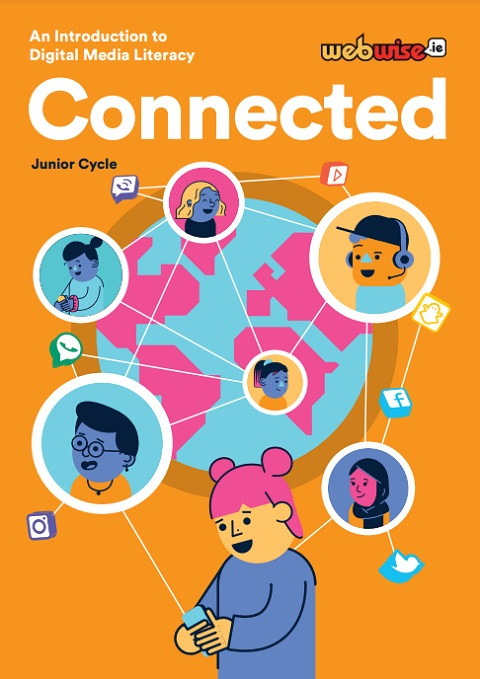 Connected: An Introduction to Digital Media Literacy Year of publication: 2020 Corporate author: Webwise | Professional Development Service for Teachers (PDST) Connected comprises five modules exploring young people’s rights and responsibilities online, emerging digital technologies and topics including big data and the data economy, deep fakes, false information and online wellbeing. The five modules are:1. My Online Wellbeing2. News, Information and Problems of False Information3. Big Data & the Data Economy4. My Rights Online5. Publishing Online - Group ProjectThe programme is mapped to the Junior Cycle Digital Media Literacy Short Course and will give students an understanding of the role of digital technologies and will help students develop key digital media literacy skills to responsibly navigate the online environment.
  How to Understand Misinformation, Disinformation and Malinformation Year of publication: 2020 Corporate author: Shout Out UK | U.S. Embassy London | Association for Citizenship Teaching (ACT) We live in a world where information is very easy to fabricate. Now more than ever, media literacy (the ability to critically analyse information) is critical for us as citizens and for our democracy to function. This video explains the difference between Misinformation, Disinformation and Malinformation and presents you with some examples! This video is part of a resource pack created and designed by Shout Out UK, supported by the US Embassy in London and in collaboration with the Association For Citizenship Teaching.For more info: https://www.shoutoutuk.org/media-literacy/
  Information Neighbourhoods Year of publication: 2020 Corporate author: Shout Out UK | U.S. Embassy London | Association for Citizenship Teaching (ACT) We live in a world where information has a variety of purposes. So how can you identify what each type of information is trying to do? Now more than ever, media literacy (the ability to critically analyse information) is critical for us as citizens and for our democracy to function. This video explains what Information neighbourhoods exist and how to identify them.
  Making the Case For Inclusive Quality Physical Education Policy Development: A Policy Brief Year of publication: 2021 Author: Nancy McLennan Corporate author: UNESCO This evidence-based policy brief presents the benefits of investing in inclusive quality physical education (QPE) policy development. Content draws directly on findings from in-country interventions which demonstrate the value of inter-sectoral partnerships in QPE policy development and the delivery of low cost/high impact QPE programming which stands to accelerate post-COVID recovery efforts. A series of practical recommendations are included for public and private stakeholders in the sport-education ecosystem, alongside resources to support the implementation of recommendations. S’engager en faveur de l’élaboration inclusive de politiques d’éducation physique de qualité: Note de politique Year of publication: 2021 Author: Nancy McLennan Corporate author: Organisation des Nations Unies pour l'éducation, la science et la culture (UNESCO) Cette note de politique, fondée sur des faits, présente les avantages à investir dans l’élaboration inclusive de politiques d’Éducation Physique de Qualité (EPQ). Le contenu s’inspire directement des résultats issus d’interventions menées dans quatre pays, qui démontrent l’intérêt des partenariats intersectoriels dans le développement des politiques d’EPQ et de la mise en œuvre de programmes d’EPQ à faible coût/à fort impact qui devraient accélérer les efforts de rétablissement post-COVID. Cette note contient une sélection de recommandations pratiques à destination des acteurs publics et privés de l’écosystème sport-éducation, ainsi que des ressources pour soutenir la mise en œuvre de ces recommandations. En defensa de un desarrollo inclusivo de políticas de educación física de calidad: Informe de políticas Year of publication: 2021 Author: Nancy McLennan Corporate author: Organización de las Naciones Unidas para la Educación, la Ciencia y la Cultura (UNESCO) Este informe presenta los beneficios de la inversión en el desarrollo de políticas inclusivas de educación física de calidad (EFC). Su contenido se funda directamente en evidencias observadas durante intervenciones en países que demuestran la importancia de las asociaciones intersectoriales en el desarrollo de políticas de EFC y en la ejecución de programas de EFC de bajo costo y alto impacto que ayudarán a agilizar los esfuerzos de recuperación tras la COVID. Se incluye una serie de recomendaciones para socios de los sectores público y privado en el ecosistema deportivo – educativo, así como también recursos para apoyar la aplicación de las recomendaciones.
 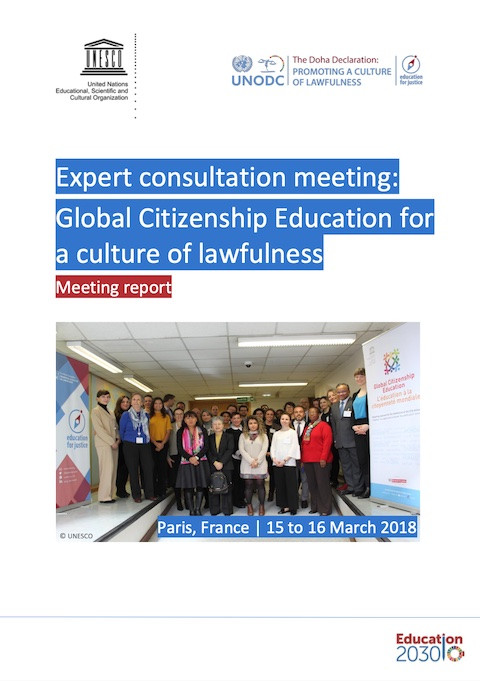 Expert Consultation Meeting: Global Citizenship Education for a Culture of Lawfulness, Paris, France, 15 to 16 March 2018; Meeting Report Year of publication: 2018 Corporate author: UNESCO | UN. Office on Drugs and Crime (UNODC) In the context of a UNESCO/UNODC partnership on “Global Citizenship Education for a Culture of Lawfulness”, an expert consultation meeting was held in Paris on March 15 and 16 of 2018. The purpose of the partnership is to strengthen the capacities of educational systems to promote the rule of law. To this end, the partnership aims to empower and equip learners to act and engage in society as constructive and ethically responsible agents of change, supporting peace, justice, and strong institutions. This notably contributes to the achievement of the 2030 Agenda for Sustainable Development, and in particular Sustainable Development Goals 4 and 16. Additionally, the partnership intends to enable learners to be both motivated and capable to respond resiliently to crime and violence. The meeting had three broad objectives:To help clarify the conceptual foundation of the partnership;to identify the measures that can be taken in the education sector to promote a culture of lawfulness;and to identify effective educational approaches. Thus, the meeting is meant to elucidate core concepts and identify promising educational approaches in the promotion of a culture of lawfulness by asking fundamental questions, including: What constitutes the rule of law and a culture of lawfulness? How do we create demand for the rule of law? How do we ensure learners apply these principles? How do we ensure they survive in a context where there is no rule of law?
 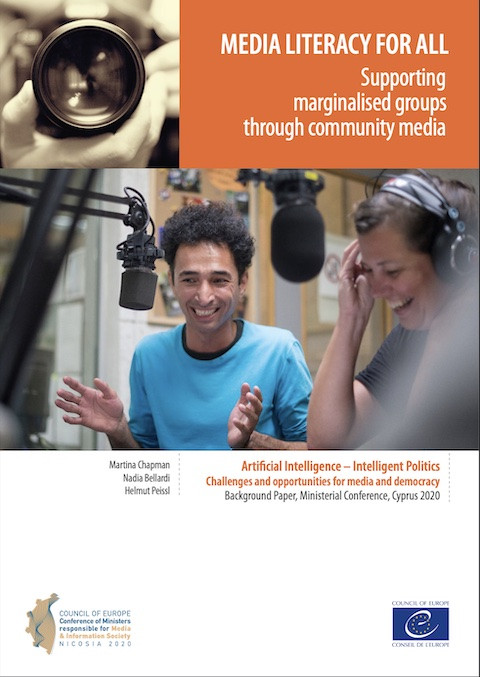 Media Literacy for All: Supporting Marginalised Groups Through Community Media Year of publication: 2020 Author: Martina Chapman | Nadia Bellardi | Helmut Peiss Corporate author: Council of Europe Being media literate means being able to critically understand and evaluate media content and to responsibly and safely use digital media services. Media literacy helps us engage with others in the public sphere, using the creative and participatory potential that new technologies and services can offer. Nowadays, it also includes understanding how data is used and how algorithms and AI can influence media production and choices.The importance of community media in supporting the formation of an ‘informed citizenry’ is well recognised by the Council of Europe. Community media have the ability to empower community groups with the neces- sary access and skills to create their own communica- tion channels and to foster their participation in the public sphere in a structured and professional man- ner. However, in many European countries community media still lack formal, legal recognition, fair access to distribution platforms and sustainable funding.This background paper explores how the community media sector promotes media literacy and how this work can strengthen marginalised communities’ partic- ipation in the media environment and public discourse. Comparing five models of community media from Cyprus, Ireland, Luxembourg, Spain and the United Kingdom, it seeks to inform and inspire practitioners and policy-makers, highlighting a number of findings and policy responses that can help member States fully realise the potential of community media.
 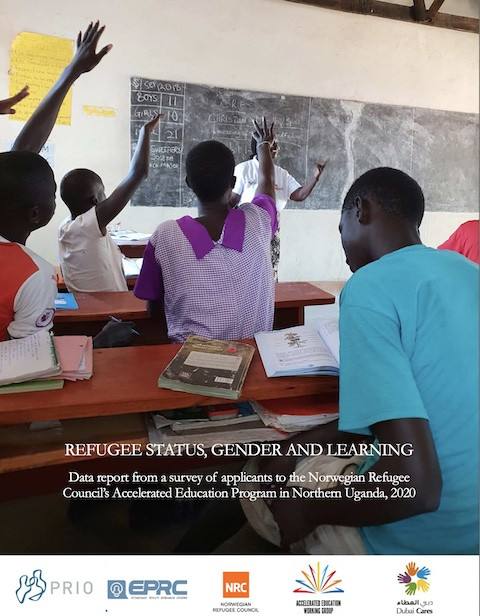 Refugee Status, Gender and Learning: Data Report From a Survey of Applicants to the Norwegian Refugee Council’s Accelerated Education Program in Northern Uganda, 2020 Year of publication: 2020 Author: Kendra Dupuy | Martin Flatø | Haakon Gjerløw | Andreas Kotsadam | Mette Løvgren | Francis Mwesigye | Siri Aas Rustad | Gudrun Østby Corporate author: Economic Policy Research Center (EPRC) | Peace Research Institute Oslo (PRIO) This data report provides details from a survey of applicants to the Norwegian Refugee Council’s Accelerated Education Program in Northern Uganda, 2020. The surveys covered a range of topics, such as demographic and socioeconomic background, school attendance, academic skills, social control, feelings and perceptions on various topics, and future aspirations.
  Social Contract Pedagogy: A Dialogical and Deliberative Model for Global Citizenship Education; Background Paper for the Futures of Education Initiatives Year of publication: 2020 Author: Richard Desjardins | Carlos Alberto Torres | Susan Wiksten Corporate author: UNESCO We propose that together Social Contract Pedagogy (SCP) and Global Citizenship Education (GCE) offer a comprehensive vision including key principles and core elements that are important for rethinking education and shaping the future of the world. We introduce the novel concept of Social Contract Pedagogy (SCP) as a means to adapt the social contract in liberal democracies which has been (conceptually) located at the level of the state, to the level of the classroom and other pedagogically relevant contexts. A key feature of this pedagogy is the negotiation of values and norms in ways that maintain cohesion and inclusion and avoids too much power in the hands of sectarian extremes (of any kind) which tend to impose their views on others, oppress and exclude. This includes using fake news, denying scientific debates and/or any extremely politicized interpretations of evidence and facts to obfuscate or deny consequences of individual and group choices and behavior, but also ‘othering’ of any kind whether from the political right or the political left. In our view, this is an essential premise for the education of democratic citizens. Citizenship education of this kind is seen as essential for the survival and growth of liberal democracies in the future.