
Resources
Explore a wide range of valuable resources on GCED to deepen your understanding and enhance your research, advocacy, teaching, and learning.
3,182 Results found
 Developing Holocaust Curricula: The Content Decision-Making Process The content decision-making process involved in developing Holocaust curricula is unusually complex and problematic. Educators must consider factors such as historical accuracy, selection of topics covered, potential teaching materials (such as textbooks and literary texts), and graphic materials (such as films and photographs) as they plan their Holocaust units. Judiciously considered decisions regarding these factors allow teachers to present accurate, appropriate and meaningful units on the subject, thus conveying the story of the Holocaust in ways that are pedagogically sound and historically viable. Accordingly, the author does not focus on the content to be included in a Holocaust unit but rather considers several factors important to selecting that content. (By the author) “What Happened to Their Pets?”: Third Graders Encounter the Holocaust Though widely believed to contain moral lessons of import for audiences of all ages, the Holocaust is often considered too complex, too appalling, too impenetrable, or too emotionally disturbing a subject to be taught to young children, even if taught only in its most “preparatory version,” to use Jerome Bruner’s famous phrasing. The subject matter, after all, deals at its core with human brutality, barbarous indifference, and industrialized mass murder. Nonetheless, a burgeoning market in materials designed to expose young children to the Holocaust implies that students are learning about the topic in earlier and earlier grades, a phenomenon that may be referred to as “curricular creep.” Such a trend raises the question of whether students should be exposed, purposefully and formally, to the horrors of the Holocaust, or, conversely, whether curricular creep should be somehow corralled. Although authors have weighed in on the ethics of Holocaust education, its history, practices, and materials, few have discussed its rightful place in the elementary school curriculum. Fewer still have empirically examined what the Holocaust looks like when taught to a young audience. (By the author) Una reflexión sobre la importancia de la enseñanza de la shoá en Argentina This paper intends to share some dilemmas encountered when drafting a bill for the incorporation of the Holocaust - Shoah in the content of school curricula in the province of Buenos Aires. (By the author)
 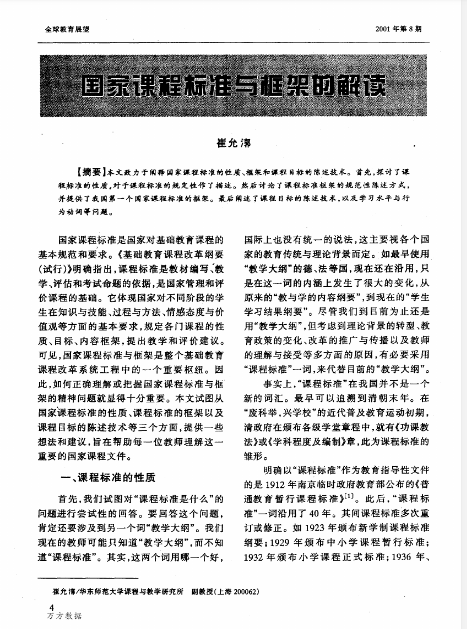 Research on National Curriculum Standards and Framework Year of publication: 2001 Author: Cui Yunkuo This article is devoted to explaining the nature and framework of the national curriculum standards and the presentation techniques of the curriculum objectives. First, this article discusses the nature of the curriculum standard, describing the prescriptiveness of the curriculum standards, and then discussed the normative presentation of the curriculum standard framework. It also provides the framework of the first national curriculum standards in China and finally explains the presentation techniques of the course objectives, as well as the level of learning and behavioral verbs. 国家课程标准与框架的解读 Year of publication: 2001 Author: Cui Yunkuo 本文致力于阐释国家课程标准的性质、框架和课程目标的陈述技术。首先,探讨了课程标准的性质,对于课程标准的规定性作了描述。然后讨论了课程标准框架的规范性陈述方式,并提供了我国第一个国家课程标准的框架。最后阐述了课程目标的陈述技术,以及学习水平与行为动词等问题。
  Ten Clues for Rethinking Curriculum (In-Progress Reflection; No. 42, 2021) Year of publication: 2021 Author: Renato Opertti Corporate author: UNESCO International Bureau of Education (IBE) This discussion document highlights the urgency of rethinking curriculum in light of reinforcing the commitments of the Education 2030 Agenda on learning, disruptive systemic worldwide societal changes, and crucially, the profound transformation of education and education systems post Covid-19. Curriculum is always at the core of giving effect to social aspirations and ideals on the why, what, how, when, and where of teaching, learning, and assessing. We propose a series of 10 interconnected clues to deepen on the systemic and holistic understanding of curriculum as contributing to lay foundations for a better, sustainable and fair future. These clues are: understanding the new generations; combatting factors related to vulnerability; reinforcing understanding between school and families; deepening glo-local education; enhancing the focus on the person; promoting synergies among values; valuing diversity; focusing on education that enhances freedom; moving toward hybrid modes of education; and inspiring affection for educators.
  세계시민 양성을 위한 교육과정 모형 개발 연구: 2015 개정교육과정 성취기준 분석을 중심으로 Year of publication: 2017 Author: 강혜영 | 장준호 | 하은나 | 양은주 | 임윤정 | 최은정 | 최윤경 | 하승관 | 홍근태 Corporate author: 인천교육과학연구원 교육정책연구소 세계시민교육에 대한 중요성이 점차 강조되고 있음에도 현재 단위학교 현장에서는 세계시민교육의 개념과 관점이 혼재되어 있고 이를 교육과정 속에서 운영하는 사례도 부족한 실정이다. 이에 세계시민교육에 대한 방향을 제시하고 교육 현장에 보편적 가치를 반영하면서도 국가와 지역의 특수성을 기반으로 하는 경험중심의 세계시민교육이 뿌리 내릴 수 있도록 다양한 연구와 함께 시도교육청 차원의 노력이 시도되고 있다.인천광역시 교육청 역시 이러한 노력의 일환으로 다양한 연구를 수행하였고 본 연구는 학교가 교육과정 내에서 세계시민을 양성할 수 있는 교육과정 모형으로서 국가수준 교육과정에 해당하는 2015 개정교육과정의 성취기준 분석과 수업설계방법에 대한 제안을 목적으로 하고 있다.
  General Framework of Curriculum Standards: National Education and Social Studies Year of publication: 2014 Author: Khalid Abdaslam Corporate author: United Arab Emirates. Ministry of Education The file is a reference document for the general framework of curriculum standards in national education and social studies in the United Arab Emirates. The file outlines study plans for social studies subjects, learning outcomes, performance standards, and general guidelines for planning. The file ends with a set of lesson design templates. الإطار العام لمعايير المناهج: التربية الوطنية والدراسات الاجتماعية Year of publication: 2014 Author: Khalid Abdaslam Corporate author: United Arab Emirates. Ministry of Education يعتبر الملف وثيقة مرجعية للإطار العام لمعايير المناهج في التربية الوطنية والدراسات الاجتماعية بدولة الامارات العربية المتحدة. يوضح الملف الخطط الدراسية لمواد الدراسات الاجتماعية ونواتج التعلم ومعايير الأداء وموجهات عامة للتخطيط. وينتهي الملف بمجموعة من نماذج تصميم الدروس.
 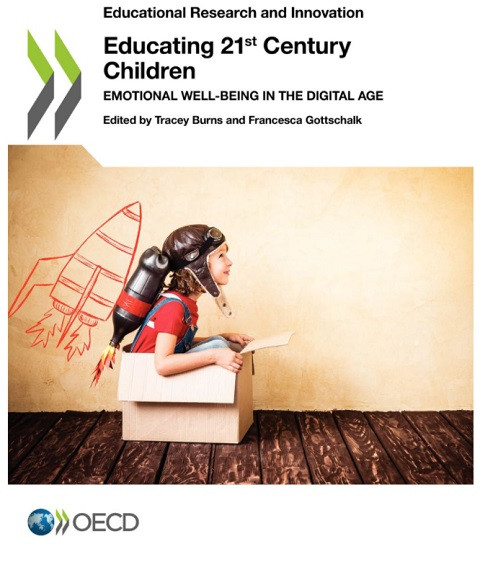 Education 21st Century Children: Emotional Well-being in the Digital Age (Educational Research and Innovation) Year of publication: 2019 Corporate author: Organisation for Economic Co-operation and Development (OECD) This report examines modern childhood, looking specifically at the intersection between emotional well-being and new technologies. It explores how parenting and friendships have changed in the digital age. It examines children as digital citizens, and how best to take advantage of online opportunities while minimising the risks. The volume ends with a look at how to foster digital literacy and resilience, highlighting the role of partnerships, policy and protection.