
Resources
Explore a wide range of valuable resources on GCED to deepen your understanding and enhance your research, advocacy, teaching, and learning.
3,126 Results found
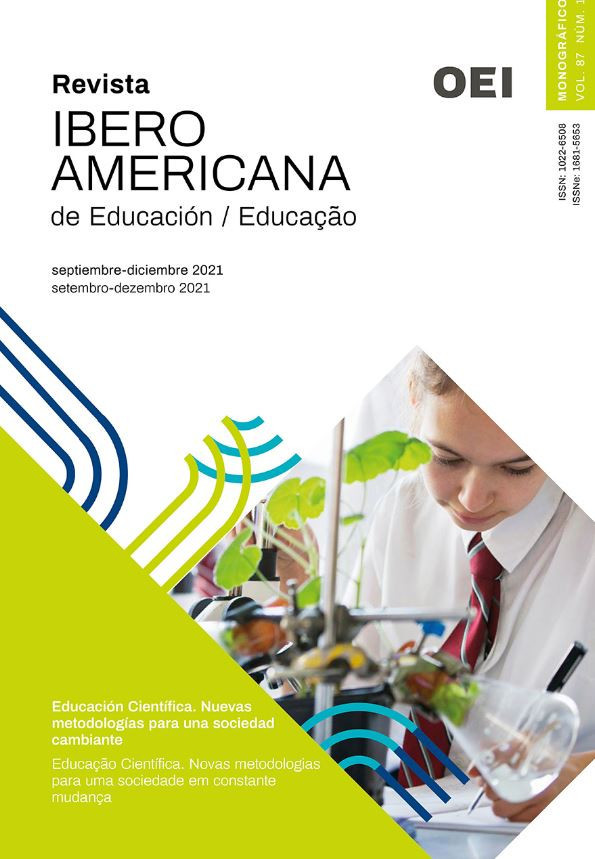 Scientific Education: New Methodologies for a Changing Society (Iberoamerican Journal of Education; vol. 87, no. 1) Year of publication: 2021 Author: F. Javier Perales | David Aguilera Corporate author: Organization of Ibero-American States for Education, Science and Culture (OEI) A society as changing as ours needs changes (innovations) and adaptations in the educational field that allow academics to be combined with social demands. We believe that this first monograph is representative of the richness and diversity of the proposals received which, in turn, constitute a sample of the strength of the community of teachers and researchers in their desire to make science education an attractive and efficient for new generations. Educación científica: Nuevas metodologías para una sociedad cambiante (Revista Ibero-americana de Educação; vol. 87, núm. 1) Year of publication: 2021 Author: F. Javier Perales | David Aguilera Corporate author: Organización de Estados Iberoamericanos para la Educación, la Ciencia y la Cultura (OEI) Una sociedad tan cambiante como la nuestra necesita de cambios (innovaciones) y adaptaciones en el ámbito educativo que permitan compaginar lo académico con las demandas sociales. Este primer monográfico estimamos que resulta representativo de la riqueza y diversidad de las propuestas recibidas que, a su vez, constituyen un muestrario de la pujanza de la comunidad de docentes e investigadores en su afán de hacer de la enseñanza de las ciencias una oferta atractiva y eficiente para las nuevas generaciones.
 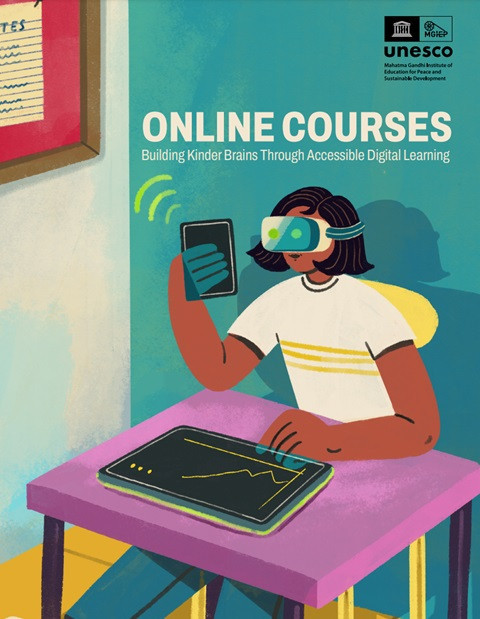 Online Courses: Building Kinder Brains Through Accessible Digital Learning Course Brochure Year of publication: 2023 Corporate author: Mahatma Gandhi Institute of Education for Peace and Sustainable Development (MGIEP) UNESCO MGIEP focuses on achieving the United Nations (UN) Sustainable Development Goal (SDG) 4, Target 7 towards education for building peaceful and sustainable societies across the world by developing programmes that promote social and emotional learning, innovate digital pedagogies and empower the youth. UNESCO MGIEP‘s Social Emotional Learning (SEL) courses are research and evidence based with built-in assessments. The courses are multi-modal, interactive and self-paced, and are designed to build intellectual and emotional intelligence among learners. Currently the courses are available in English and are being adapted to Hindi, Spanish and Russian.
 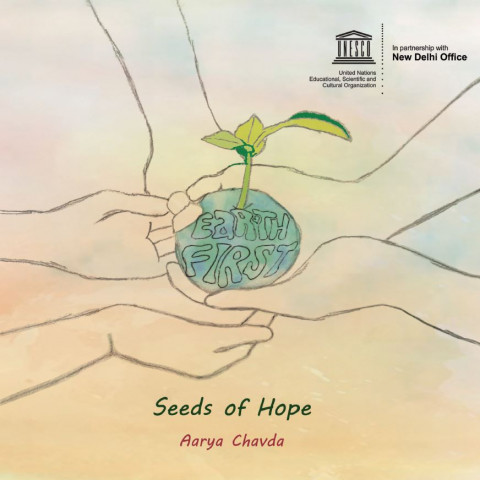 Seeds of Hope Year of publication: 2020 Author: Aarya Chavda Corporate author: UNESCO At an age of 10, author and illustrator of her 3 books, Aarya Chavda extends her support by donating her art proceeds to fundraise for the welfare of underpriviledge Cancer patients.Through her campaign on 'Preservation of Cultural Heritage', She also demonstrates her commitment and contributes in spreading awareness through her programs at government and private institutions.In this series of narrative illustrations, she portrays that climate change will not occur at some point in the distance future - "It is happening her and now". She urges everyone to treasure this thought of saving our planet for the future generation.
 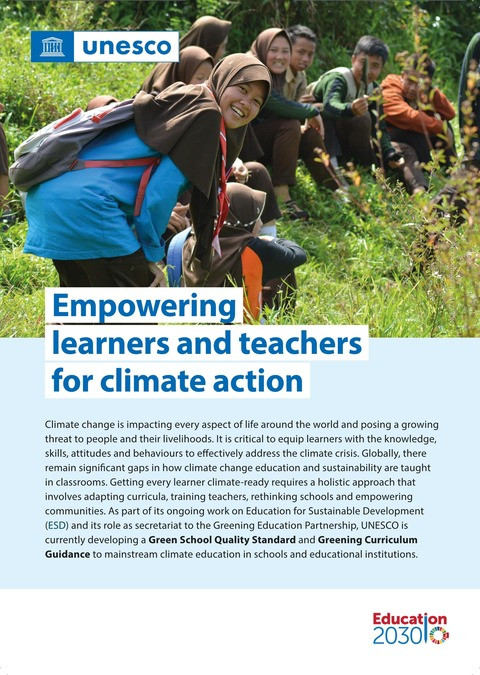 Empowering Learners and Teachers for Climate Action Year of publication: 2023 Corporate author: UNESCO Climate change is impacting every aspect of life around the world and posing a growing threat to people and their livelihoods. It is critical to equip learners with the knowledge, skills, attitudes and behaviours to effectively address the climate crisis. Globally, there remain significant gaps in how climate change education and sustainability are taught in classrooms. Getting every learner climate-ready requires a holistic approach that involves adapting curricula, training teachers, rethinking schools and empowering communities. As part of its ongoing work on Education for Sustainable Development (ESD) and its role as secretariat to the Greening Education Partnership, UNESCO is currently developing a Green School Quality Standard and Greening Curriculum Guidance to mainstream climate education in schools and educational institutions.
 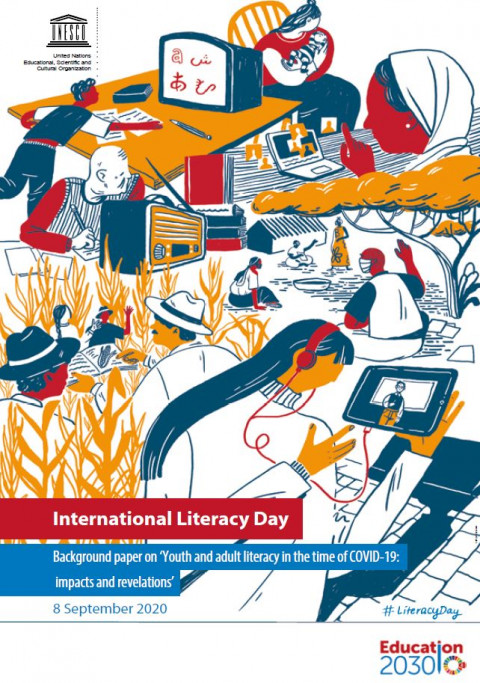 International Literacy Day: Background Paper on 'Youth and Adult Literacy in the Time of COVID-19; Impacts and Revelations' Year of publication: 2020 Corporate author: UNESCO Specially prepared on the occasion of International Literacy Day 2020, this background paper illustrates the impact of the COVID-19 crisis on youth and adult literacy, based on the limited information that is currently available. It provides five regional snapshots and identifies preliminary lessons learned thus far, while aiming to inspire continued reflection and subsequent action. It also makes the case for the ongoing importance of advancing youth and adult literacy, a priority that was already neglected even before the pandemic but which deserves all our attention. ILD 2020 thus seeks to trigger reimaginations of literacy teaching and learning in the COVID-19 crisis and beyond, with a particular focus on the role of educators.
  AI Competency Framework for Students Year of publication: 2024 Author: Fengchun Miao | Kelly Shiohira Corporate author: UNESCO Artificial intelligence is increasingly integral to our lives, necessitating proactive education systems to prepare students as responsible users and co-creators of AI. Integrating AI learning objectives into official school curricula is crucial for students globally to engage with AI safely and meaningfully.The UNESCO AI Competency Framework for Students aims to help educators in this integration, outlining 12 competncies across four dimensions:- A human-centred mindset- Ethics of AI- AI techniques and applications- AI system designThese competencies span three progression levels:- Understand- Apply- Create The framework details curricular goals and domain-specific pedagogical methodologies.Grounded in the vision of students as AI co-creators and responsible citizens, the publication emphasizes critical judgement of AI solutions, awareness of citizenship responsibilities in the AI era, foundational AI knowledge for lifelong learning, and inclusive, sustainable AI design.
  AI Competency Framework for Students Year of publication: 2025 Author: Fengchun Miao | Kelly Shiohira Corporate author: UNESCO Préparer les apprenants à devenir des citoyens responsables et créatifs à l’ère de l’IAL’intelligence artificielle (IA) fait tous les jours davantage partie intégrante de nos vies, ce qui implique d’avoir des systèmes éducatifs proactifs en mesure de préparer les élèves et les étudiants à être des utilisateurs responsables et des cocréateurs de l’IA. L’intégration d’objectifs d’apprentissage de l’IA dans les programmes scolaires officiels est essentielle pour que les apprenants du monde entier puissent s’intéresser en toute sécurité et de manière pertinente à l’IA.Le Référentiel de compétences en IA pour les apprenants de l’UNESCO vise à aider les éducateurs dans cette démarche, en décrivant 12 compétences réparties en quatre dimensions, à savoir une perspective centrée sur l’humain, l’éthique de l’IA, les techniques et applications de l’IA, et la conception de systèmes d’IA. Ces compétences se déploient selon trois niveaux de progression : Comprendre, Appliquer et Créer. Le référentiel détaille les objectifs du programme d’études et les méthodes pédagogiques spécifiques au domaine.Fondé sur une vision des élèves et des étudiants considérés comme cocréateurs de l’IA et citoyens responsables, le référentiel met l’accent sur le jugement critique vis-à-vis des solutions d’IA, la prise de conscience des responsabilités citoyennes à l’ère de l’IA, les connaissances fondamentales en matière d’IA pour l’apprentissage tout au long de la vie, ainsi que la conception d’une IA inclusive et durable.
  AI Competency Framework for Students Year of publication: 2025 Author: Fengchun Miao | Kelly Shiohira Corporate author: UNESCO Preparar a los estudiantes para ser ciudadanos responsables y creativos en la era de la IALa inteligencia artificial (IA) está cada vez más presente en nuestras vidas, lo que requiere sistemas educativos proactivos que preparen a los estudiantes para que sean usuarios responsables y cocreadores de la IA. Integrar los objetivos de aprendizaje de IA en los programas de estudio oficiales de las escuelas es fundamental para que los estudiantes de todo el mundo interactúen de forma segura y significativa con la IA.El objetivo del Marco de competencias para estudiantes en materia de IA de la UNESCO es ayudar a los educadores con esta integración, para lo cual describe 12 competencias que atraviesan cuatro dimensiones: una forma de pensar centrada en el ser humano, la ética de la IA, las técnicas y aplicaciones de la IA, la pedagogía de la IA, y la IA para el diseño de sistemas de IA. Estas competencias abarcan tres niveles de progresión: comprender, aplicar y crear. El marco detalla las metas curriculares y las metodologías pedagógicas específicas para cada dominio.Basado en una visión de los estudiantes como cocreadores de IA y ciudadanos responsables, el marco pone énfasis en el juicio crítico de las soluciones de IA, la conciencia de las responsabilidades ciudadanas en la era de la IA, el conocimiento fundacional de la IA para el aprendizaje a lo largo de la vida, y el diseño de IA inclusiva y sostenible.
  AI Competency Framework for Teachers Year of publication: 2024 Author: Fengchun Miao | Mutlu Cukurova Corporate author: UNESCO AI processes vast information, generates new content, and helps decision-making through predictive analyses. In education, AI has transformed the traditional teacher–student relationship into a teacher–AI–student dynamic.This shift requires a re-examination of teachers’ roles and the competencies they need in the AI era. Yet, few countries have defined these competencies or developed national programmes to train teachers in AI, leaving many educators without proper guidance.The AI competency framework for teachers addresses this gap by defining the knowledge, skills, and values teachers must master in the age of AI. Developed with principles of protecting teachers’ rights, enhancing human agency, and promoting sustainability, the publication outlines 15 competencies across five dimensions: Human-centred mindset, Ethics of AI, AI foundations and applications, AI pedagogy, and AI for professional learning. These competencies are categorized into three progression levels: Acquire, Deepen, and Create.As a global reference, this tool guides the development of national AI competency frameworks, informs teacher training programmes, and helps in designing assessment parameters. It also provides strategies for teachers to build AI knowledge, apply ethical principles, and support their professional growth.