
Resources
Explore a wide range of valuable resources on GCED to deepen your understanding and enhance your research, advocacy, teaching, and learning.
3,505 Results found
 세계시민교육 국내 이행현황 연구보고서: 유·초중등학교 교육과정을 중심으로 Year of publication: 2018 Corporate author: 유네스코 아시아태평양 국제이해교육원 “세계시민교육 국내 이행현황 연구보고서 - 유·초중등학교 교육과정을 중심으로”가 발간되었다. 본 연구보고서는 세계시민교육의 실행과 성과에 대한 국가 수준의 모니터링 및 평가 연구가 희소하다는 문제의식에 기초하여 작성된 결과물이다. 특히, 국내 17개 시·도교육청 산하 유치원, 초·중·고등학교 교육과정 활동에서 세계시민의 개념이 어떻게 반영 및 실행되고 있는지를 살펴보기 위하여 탐색적 연구를 설계하고 관련 자료 조사를 실시하는데 주안점을 두었다. 또한 연구조사 결과를 토대로 동 보고서는 향후 세계시민교육이 교육현장에서 보다 명확하게 이행되고 확산될 수 있도록 하는 정책적 제언도 담고 있다.
  SDG 4.7: 세계시민교육 지표수립을 위한 기초연구 Year of publication: 2018 Corporate author: 유네스코 아시아태평양 국제이해교육원 “SDG 4.7 세계시민교육 지표수립을 위한 기초연구 보고서”가 발간되었다. 본 연구보고서는 국제적으로 합의된 글로벌 지표의 부재로 현재까지 정의가 완료되지 않은 지속가능발전목표 (SDG) 4.7 지표 개발을 위한 기초 연구이다. 즉, 동 보고서는 세계시민교육 및 SDG 4.7 지표에 관한 기존의 국내·외 연구결과를 종합적으로 검토하여 글로벌 지표에 관한 주요 논의를 정리하고, 국내 지표 개발을 위한 함의를 도출하는 데에 목적을 두고 있다. 이를 위하여 유네스코 통계원 (UIS)의 최신 SDG 4.7.1 메타데이터 연구와 국내·외 연구결과에 기초하여 국내에서 활용할 수 있는 정보와 데이터를 검토하고 있다.
 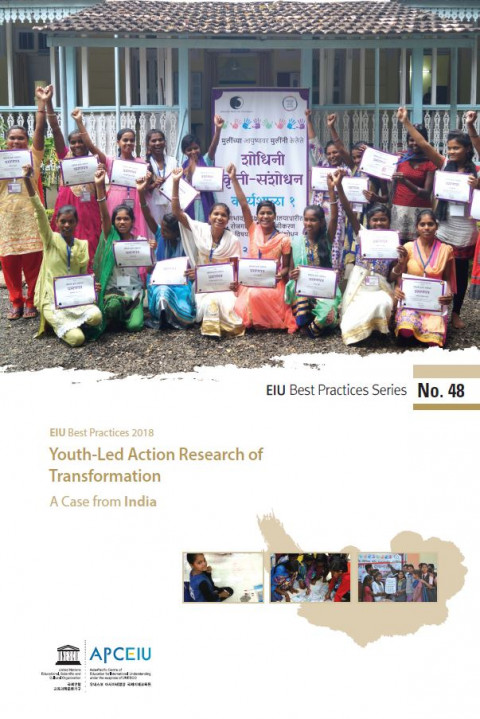 EIU Best Practices Series No. 48: Youth-Led Action Research of Transformation; A Case from India Year of publication: 2018 Corporate author: APCEIU This action research project is about the education for livelihood and life skills of marginalized young girls. This project was based from my experience in the Youth-Led Action Research Project organized by ASPBAE and UNESCO Institute of Lifelong Learning (UIL), which gradually led to the conception of the present action research project for the empowerment of the marginalized rural girls suppressed by patriarchal social systems. The Shodhinis are the subjects and objects of this action research. A hundred girls from ten villages conducted action research on the topics of gender, education, livelihood and life skills to young marginalized young girls aged between 14 to 25 years old in their respective communities. The Shodhinis discovered the joys of learning as they took positive steps in discovering and empowering themselves. The research enabled them to conduct various research methods like census and in-depth surveys of their fellow girls in their villages. As part of the research process, the girls also drew up a community map to understand their village. The relevance of this project to GCED values cannot be overemphasized especially in developing the cognitive, emotional and the behavioral dimensions of the girls themselves.This project not only focuses on analyzing the findings derived from the gathered data but also on generating action based on the data. It helped improve the way Shodhinis looked at themselves, their families, and their communities, inspiring them to become agents of change in their own lives as well as those of other girls in their villages. By amplifying their voices and opinions in the decision making processes at the family and community levels – for instance, by lobbying for the construction of libraries – the Shodhinis were able to demonstrate their leadership skills in shaping the development of their villages, thereby enhancing their dignity and self-worth.
 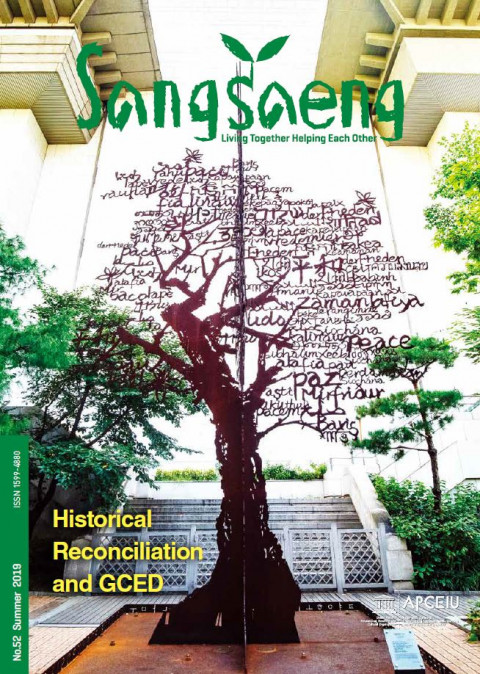 Historical Reconciliation and GCED (SangSaeng no. 52 Summer 2019) Year of publication: 2019 Corporate author: APCEIU The 52th issue of SangSaeng has been published with the theme “Historical Reconciliation and GCED.” This issue explores various endeavours aimed at attaining historical reconciliation and peace, as well as the important role education plays to achieve this goal. How we teach and learn about our past and present conflicts is critical in shaping our future. It can help enhance global citizenship and lead us to peaceful reconciliation and peacebuilding, or it can intensify the hatred of others and build up more conflicts. 3 Editor’s Note4 Special ColumnToward Reconciliation in a Divided, Dangerous World / Jonathan Jansen8 Focus: Historical Reconciliation and GCED8 Historical Dialogue among Korea, China and Japan / Jeongin Kim12 Teaching Shared Histories in Southeast Asia / Doung Bich Hanh16 Learning about Europe’s Common History / Dominik Pick19 Dual Narrative to Teach History / Sami Adwan21 Mystic of ‘General History of Afica’ / Ali Moussa Iye 24 Best Practices24 The Power of Silence / Dylan Wray27 Mobile Library / Andri Nurcahyani31 Special Report31 Migration, Displacement and Education: Building Bridges, Not Walls / Manos Antoninis33 Harmonizing ‘Heart, Head and Hand’ in Hanoi / APCEIU37 InterviewFour Students for One Common Good / Sabine Detzel41 Understanding the Asia-Pacific RegionUniting Under Legends of Ghandhara / Nadeem Omar Tarar44 Youth NetworkHELP Nurtures Youth Citizenship through Collaboration / Nephtaly Pierre-Louis and Meaghan Balzer48 LetterSpeaking Silently in the Loud World / Elvira Sarsenova50 APCEIU in Action
  Reconciliation, Peace and Global Citizenship Education: Pedagogy and Practice Year of publication: 2019 Corporate author: APCEIU The Asia-Pacific Centre of Education for International Understanding launched the publication entitled Reconciliation, Peace and Global Citizenship Education: Pedagogy and Practices. This book is the result of the fruitful discussions and presentations made during the 4th International Conference on Global Citizenship Education held on 3-4 September 2019 in Seoul, Republic of Korea.The intention of this publication is not only to continue and deepen the discourses made by the speakers of the Conference, but also to provide the readers with opportunity to explore how pedagogy and practices of Global Citizenship Education can contribute to building peace and reconciliation across the globe. Part. I Global Citizenship Education for peace and reconciliation: OverviewLearning to live together and a life worth livingHow GCED can contribute to peace, reconciliation and sustainable developmentTransformative pedagogy for building peacePromoting peace through mindfulness programmes in schoolsGlobal memory, global citizenship and reconciliationThe role of Media and Information Literacy Part. II Global Citizenship Education for peace and reconciliation: Putting it into practiceFacing History and Ourselves in South AfricaClassrooms in Peace in ColombiaPreparing young people to be global citizens through integrated schools in Northern Ireland Part. III Global Citizenship Education for peace and reconciliation: Supporting effective implementationPolicy development and implementationChallenges in curriculum and textbook development for low-and middle-income country
  Being and Becoming Global Citizens: Measuring Progress toward SDG 4.7 (Phase I: Monitoring teacher and school readiness to enact global citizenship in the Asia-Pacific region) Year of publication: 2023 Author: Rachel Parker | Jennie Chainey | Payal Goundar | Sarah Richardson | Anna Dabrowski | Amy Berry | Claire Scoular Corporate author: Australian Council for Educational Research (ACER) | APCEIU Since 2022, APCEIU and the Australian Council for Educational Research (ACER) have conducted a study to identify enhanced tools and resources for schools and systems in the Asia-Pacific region to monitor and evaluate GCED in line with SDG 4.7.The Report of the Research for Phase 1 is available in three forms: Full report; Summary; and Policy Brief.
 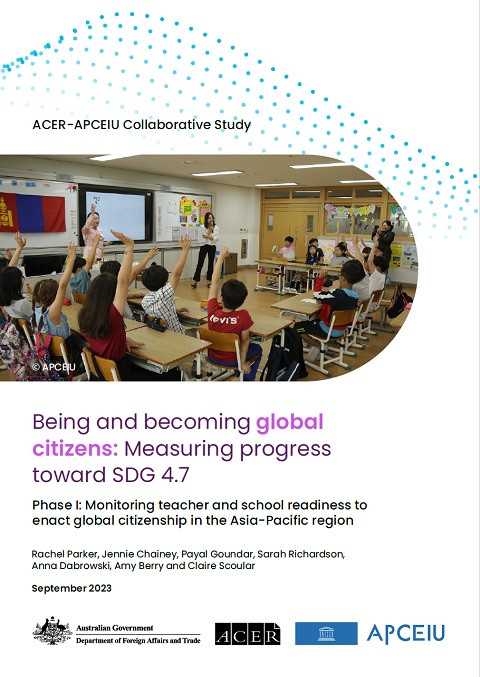 [Summary] Being and Becoming Global Citizens: Measuring Progress toward SDG 4.7 (Phase I: Monitoring teacher and school readiness to enact global citizenship in the Asia-Pacific region) Year of publication: 2023 Author: Rachel Parker | Jennie Chainey | Payal Goundar | Sarah Richardson | Anna Dabrowski | Amy Berry | Claire Scoular Corporate author: Australian Council for Educational Research (ACER) | APCEIU This is a summary report of the Being and Becoming Global Citizens: Measuring Progress toward SDG 4.7 (Phase I: Monitoring teacher and school readiness to enact global citizenship in the Asia-Pacific region), conducted by APCEIU and ACER in since 2022.
 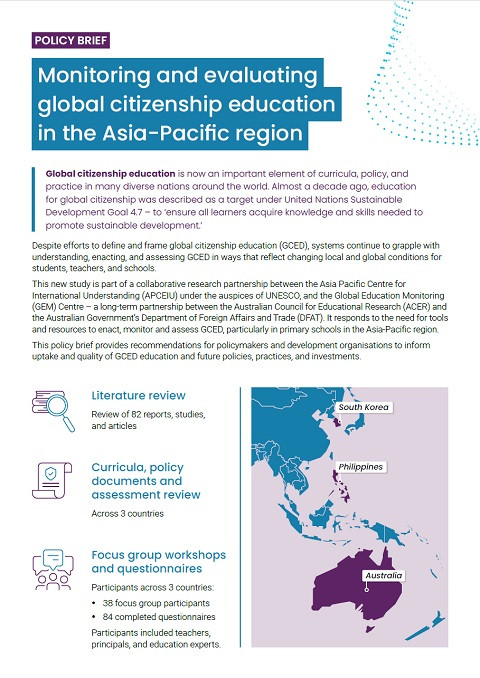 [Policy Brief] Monitoring and Evaluating Global Citizenship Education in the Asia-Pacific Region Year of publication: 2023 Author: Payal Goundar | Rachel Parker Corporate author: Australian Council for Educational Research (ACER) | APCEIU This is a policy brief version of the reserach report, Being and Becoming Global Citizens: Measuring Progress toward SDG 4.7 (Phase I: Monitoring teacher and school readiness to enact global citizenship in the Asia-Pacific region), conducted by APCEIU and ACER in since 2022.
 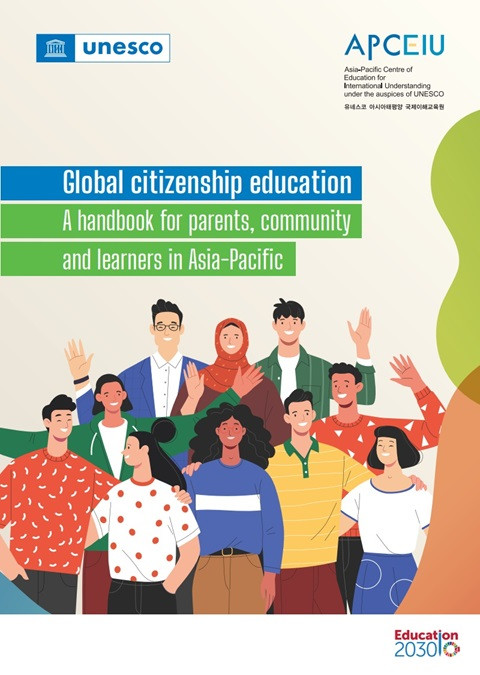 Global Citizenship Education: A Handbook for Parents, Community and Learners in Asia-Pacific Year of publication: 2023 Author: Darla K. Deardorff | Seek Ling Tan Corporate author: UNESCO Bangkok | APCEIU This handbook aspires to engage and involve parents, caregivers and the community to join the mission of developing every learner into a global citizen. To achieve this, parents, caregivers and the community will need to be empowered with the necessary GCED knowledge and skills too. In this handbook, GCED related concepts are introduced, alongside adaptable step-by-step action plans and best practices collected across the Asia-Pacific region to support parents and the community to take action in developing GCED competences in learners.
  2022 세계시민교육 국내 모니터링 체제 구축 연구 Year of publication: 2022 Author: 박환보 | 박경희 | 최원석 | 길혜지 | 조대훈 | 엄정민 Corporate author: 유네스코 아시아태평양 국제이해교육원 본 연구는 유네스코 아시아태평양 국제이해교육원(이하 유네스코 아태교육원)이 지속가능발전목표4.7(SDG4.7) 의 국내 이행 노력을 효과적으로 모니터링하기 위해 다년간 실시해온 연구의 일환으로, 국내 모니터링 체제 구축 방안 모색을 목적으로 한다. 특히 본 연구에서는 SDG4.7 목표 이행과 모니터링의 초점을 세계시민교육을 통한 학습자의 변화와 성장에 두고, 세계시민교육 정책, 교사의 세계시민교육 역량, 학습자의 세계시민역량의 세 가지 측면에서 모니터링 방안을 모색하였다. 이를 위해 우선 유네스코 아태교육원이 본 모니터링 연구 의 연속선상에서 수행해 온 선행연구에서 제안한 세계시민교육 주제영역과 개념틀을 활용하여 시·도교육청의 세계시민교육 이행 실태와 변화 추이를 분석하고, 정책의 주류화라는 관점에서 모니터링 방안에 관해 논의하였다. 그리고 기존 투입 중심의 연구 한계를 극복하기 위해, 세계시민교육의 이행 과정과 산출이라는 관점에서 교사의 세계시민교육 역량과 학습자의 세계시민성 수준을 측정하기 위한 문항을 개발하였다.