
Resources
Explore a wide range of valuable resources on GCED to deepen your understanding and enhance your research, advocacy, teaching, and learning.
2,768 Results found
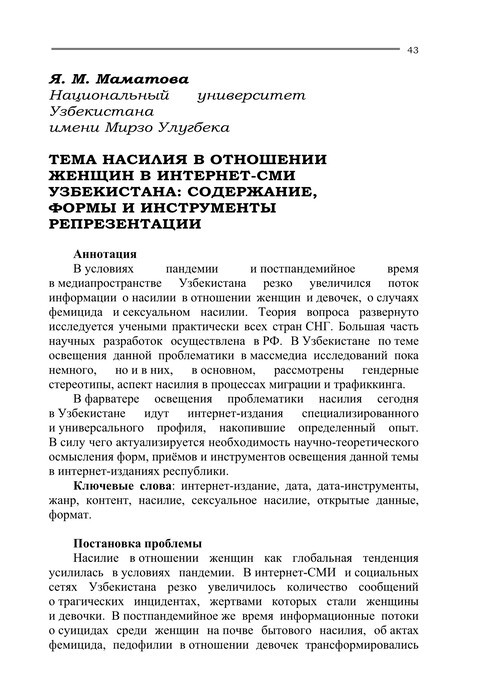 Тема насилия в отношении женщин в интеренет-СМИ Узбекистана: содержание, формы и инструменты репрезентации (PR и реклама в изменяющемся мире: региональный аспект; No.28, 2023) Year of publication: 2023 Author: Я. М. Маматова В условиях пандемии и постпандемийное время в медиапространстве Узбекистана резко увеличился поток информации о насилии в отношении женщин и девочек, о случаях фемицида и сексуальном насилии. В Узбекистане по теме освещения данной проблематики в массмедиа исследований пока немного, но и в них, в основном, рассмотрены гендерные стереотипы, аспект насилия в процессах миграции и трафиккинга.
  Citizens as Users of Languages and Digital Technology Year of publication: 2021 Corporate author: European Centre for Modern Languages (ECML) | Council of Europe A recent meta-analysis of the literature portrays male and female citizens who are users of languages and digital technologies. This helps to understand the goals of an education aimed at developing male and female citizens capable of using digital technology in a competent, informed, safe, responsible, ethical, and critical manner. Citoyens et citoyennes usagers et usagères des langues Year of publication: 2021 Corporate author: European Centre for Modern Languages (ECML) | Conseil de l'Europe Une méta-analyse de la littérature récente dresse le portrait des citoyens et citoyennes usagers et usagères de langues et du numérique. Cela permet de connaitre les objectifs d’une éducation qui vise le développement de citoyens et citoyennes capables d’utiliser le numérique d’une façon compétente, informée, sûre, responsable, éthique et critique.
  Ensuring Well-Being through Social-Emotional Learning in the Digital World Year of publication: 2023 Corporate author: Mahatma Gandhi Institute of Education for Peace and Sustainable Development (MGIEP) This document aims to identify the important elements addressed during the various TAGe discussions (social media discussion and live event) in addition to offering key recommendations for decision-makers. Concretely, this document has sought to highlight two social and emotional challenges faced today by youth, with a third issue present in each of them –(1) educational and employment disparities (economic exclusion),(2) poor civic engagement, and(3) the impact of the digital divide and misuse of social media platforms– in addition to showing how SEL competencies can be a tool to address the social and emotional challenges that may be encountered, supported by technological tools.
 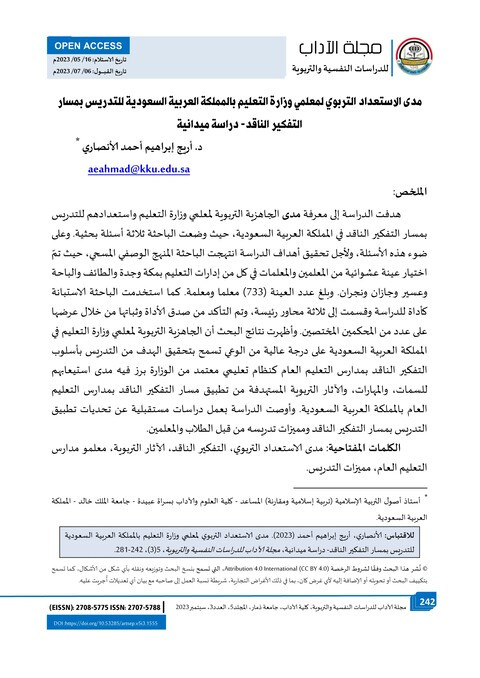 The Extent of Educational Readiness of Using Thinking Skills Strategy among Teachers at the Ministry of Education, Saudi Arabia: A Field Study (Arts for Educational & Psychological Studies; Vol.5, No.3) Year of publication: 2023 Author: Areej Ibrahim Ahmed Al Ansari Corporate author: Dhamar University This study aimed to identify educational readiness and willingness of teachers affiliated to the Ministry of Education to use critical thinking in their teaching, in Saudi Arabia. To achieve the study objectives, the descriptive survey method was adopted, and a questionnaire was used to collect data from the study sample which consisted of (733) male and female teachers, randomly selected from education directorates of Makkah, Jeddah, Taif, Al-Baha, Asir, Jazan, and Najran. The questionnaire included three main dimensions;and after testing its validity, and reliability, it was administered to the sample. The study results showed that teachers’ educational readiness scored a high degree of awareness that would allow achieving the goal of teaching by using critical thinking in schools as a teaching strategy approved by the Ministry of Education. The teachers also showed their understanding of the characteristics, skills and educational effects of the application of the critical thinking strategy in schools. The study recommended conducting future studies on the challenges and advantages of applying the critical thinking strategy from the perspective of students and teachers.Keywords: Extent of educational readiness, Critical thinking, Educational effects, School teachers. مدى الاستعداد التربوي لمعلمي وزارة التعليم بالمملكة العربية السعودية للتدريس بمسار التفكير الناقد- دراسة ميدانية (مجلة الآداب للدراسات النفسية والتربوية; Vol.5, No.3) Year of publication: 2023 Author: Areej Ibrahim Ahmed Al Ansari Corporate author: Dhamar University هدفت الدراسة إلى معرفة مدى الجاهزية التربوية لمعلمي وزارة التعليم واستعدادهم للتدريس بمسار التفكير الناقد في المملكة العربية السعودية، حيث وضعت الباحثة ثلاثة أسئلة بحثية. وعلى ضوء هذه الأسئلة، ولأجل تحقيق أهداف الدراسة انتهجت الباحثة المنهج الوصفي المسحي، حيث تمّ اختيار عينة عشوائية من المعلمين والمعلمات في كل من إدارات التعليم بمكة وجدة والطائف والباحة وعسير وجازان ونجران. وبلغ عدد العينة (733) معلما ومعلمة. كما استخدمت الباحثة الاستبانة كأداة للدراسة وقسمت إلى ثلاثة محاور رئيسة، وتم التأكد من صدق الأداة وثباتها من خلال عرضها على عدد من المحكمين المختصين. وأظهرت نتائج البحث أن الجاهزية التربوية لمعلمي وزارة التعليم في المملكة العربية السعودية على درجة عالية من الوعي تسمح بتحقيق الهدف من التدريس بأسلوب التفكير الناقد بمدارس التعليم العام كنظام تعليمي معتمد من الوزارة برز فيه مدى استيعابهم للسمات، والمهارات، والآثار التربوية المستهدفة من تطبيق مسار التفكير الناقد بمدارس التعليم العام بالمملكة العربية السعودية. وأوصت الدراسة بعمل دراسات مستقبلية عن تحديات تطبيق التدريس بمسار التفكير الناقد ومميزات تدريسه من قبل الطلاب والمعلمين.
 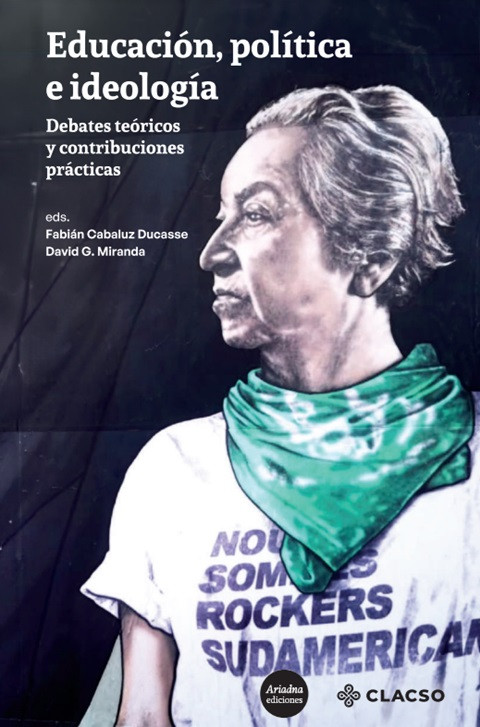 Education, Politics and Ideology: Theoretical Debates and Practical Contributions Year of publication: 2024 Author: David G. Miranda | Jorge Fabián Cabaluz Ducasse Corporate author: Latin American Council of Social Sciences (CLACSO) This book, "Education, Politics and Ideology: Theoretical Debates and Practical Contributions", is a work by the Latin American Pedagogies Research Group at the University of Playa Ancha, which is positioned from a critical perspective in the educational and pedagogical field. This currently implies, among other things, the relevance of discussing, polemizing and confronting those perspectives that have technified and instrumentalized pedagogy, reducing it to a merely practical, technical field, unrelated to epistemological, ethical, philosophical and/or political issues. In this direction, the essays that make up the book distance themselves substantially from those perspectives that conceive our field as a terrain that must advocate for neutrality, impartiality, and asepsis; and they propose clear and explicit positions with respect to social justice, democracy, equality, and dignity. Educación, política e ideología: Debates teóricos y contribuciones prácticas Year of publication: 2024 Author: David G. Miranda | Jorge Fabián Cabaluz Ducasse Corporate author: Latin American Council of Social Sciences (CLACSO) Este libro "Educación, política e ideología: debates teóricos y contribuciones prácticas", surge desde el Grupo de Investigación de Pedagogías Latinoamericanas de la Universidad de Playa Ancha, el cual se encuentra posicionado desde las perspectivas críticas del campo educativo y pedagógico, lo que implica en la actualidad, entre otras cosas, la relevancia de discutir, polemizar y confrontar aquellas perspectivas que han tecnificado e instrumentalizado la pedagogía, reduciéndola a un campo meramente práctico, técnico, ajeno a cuestiones epistemológicas, éticas, filosóficas y/o políticas. En esta dirección, los ensayos que componen el libro se distancian sustancialmente de aquellas perspectivas que conciben nuestro campo como un terreno que debe abogar por la neutralidad, la imparcialidad, la asepsia; y proponen posicionamientos claros y explícitos con respecto a la justicia social, la democracia, la igualdad, la dignidad.
 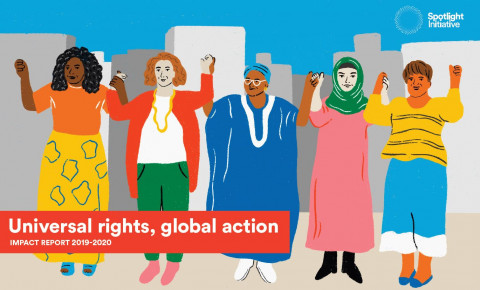 Universal Rights, Global Action: Impact Report 2019-2020 Year of publication: 2020 Corporate author: Spotlight Initiative Universal rights, global action is a shortened, visual adaptation of the 2019 Global Annual Narrative Progress Report. The Spotlight Initiative is a global, multi-year partnership between the European Union and the United Nations to eliminate all forms of violence against women and girls by 2030. This report outlines the Spotlight Initiative’s key signature results from 2019.The 32-page document highlights the ways the Spotlight Initiative country and regional programmes have meaningfully reached women and girls, including those facing multiple and intersecting forms of discrimination.
  Programs of Peace Education in Pre-University Education on the Light of Some Countries’ Experiences and the Extent of Benefit in Egypt Year of publication: 2014 Author: Amel Ahmed Hassan Mohamed Corporate author: Association of Arab Educators Education for peace has got an international, regional and local interests, in particular, today's world desperately needs more than ever before to face the problems afflicting the human race, and the conflict expected to increase in the coming years. This situation confirms the importance of achieving peace in all dimensions with oneself, family, society, and the environment.This study aimed to investigate the experiences of some countries in the field of education for peace and to draw some benefits from them. For achieving this aim, the study followed the Descriptive-Analytic Approach because of its appropriateness to the nature of the study. The sample of study dealt with three experiments in the field of education for peace in Northern Ireland, Bosnia and Herzegovina, and Sierra Leone, which were chosen after passing through a relatively long period of conflicts and disputes. By analyzing the three experiments, the similarities and differences among countries were reviewed in terms of, period and nature of conflict, foundations, objectives and content of the programs, teacher training. The study achieved some benefits through reviewing literature and analyzing the three experiences. The suggestions of the study were classified under some themes, including: foundations of peace education, its objectives, contents, and teacher training.