
Resources
Explore a wide range of valuable resources on GCED to deepen your understanding and enhance your research, advocacy, teaching, and learning.
1,951 Results found
 Educación Inclusiva Year of publication: 2008 Corporate author: UNESCO International Bureau of Education (IBE) La educación inclusiva: el camino hacia el futuro es el tema de la cuadragésimo octava reunión de la Conferencia Internacional de Educación (CIE) que tendrá lugar en Ginebra del 25 al 28 de noviembre de 2008. Creo que un genuino diálogo y un franco debate entre los ministros y otros actores de la educación sobre este tema central y sobre los cuatro subtemas relacionados: enfoques, alcance y contenido; políticas públicas; sistemas, interfaces y transiciones, y alumnos y docentes, resultarán a la vez oportunos y apropiados. Education pour l'inclusion Year of publication: 2008 Corporate author: UNESCO International Bureau of Education (IBE) L’auteur présente ce numéro spécial qui offre une sélection d’articles alliant recherche théorique et pratique sur la notion de l’éducation pour l’inclusion et sur les problèmes rencontrés dans l’élaboration de politiques et leur application pratique. Ces articles reflètent les approches diversifiées et à volets multiples de l’inclusion, eu égard aux aspects théoriques, disciplinaires et méthodologiques. Tout au long de ce numéro, l’inclusion est le principe de base qui oriente l’Éducation pour tous (EPT) de qualité —- c’est-à-dire, l’établissement de systèmes éducatifs tirant profit de la diversité et visant à édifier une société plus juste et plus démocratique.Ce numéro spécial est consacré au thème de la quarante-huitième session de la Conférence internationale de l’éducation (CIE) « L’éducation pour l’inclusion : la voie de l’avenir » (Genève, 25-28 novembre 2008).
  Jugendliche aus Einwandererfamilien und die Geschichte des Nationalsozialismus Year of publication: 2003 Author: V. B. Georgi Based on 55 interviews with young Germans with immigrant family background from the age of 15–20, Giorgi constructs a typology of how they position themesleves to the German Nazi past.
  The State of Global Education in Europe 2018 Year of publication: 2018 Corporate author: Global Education Network Europe (GENE) The State of Global Education in Europe reports on policy, strategy and funding for Global Education in European countries, based primarily on information submitted by the ministries, agencies and national coordinating bodies that participate in GENE (Global Education Network Europe). This third edition of the report identifies thematic trends and crosscutting issues and explores funding levels for Global Education across Europe. It also includes a chapter outlining some of the work done on evaluation across GENE, and concludes with a selection of highlights from the network. There are examples of national policy and practice throughout the report. This report on the State of Global Education in Europe has been developed to provide an overview of current key issues, policy priorities, funding trends and activities in Global Education in Europe. It draws on the expertise and information provided by organisations that participate in Global Education Network Europe – GENE. These comprise Ministries of Foreign Affairs, Ministries of Education, and their respective national agencies, and other bodies with responsibility for policymaking, support or coordination of Global Education in European countries.
  Botswana National Implementation Plan for Sustainable Development Goal (SDG) 4 - Education 2030 Year of publication: 2018 Corporate author: Botswana National Commission for UNESCO The Sustainable Development Goal (SDG) 4 is an ambitious and specific goal to drive the education development agenda from 2016 – 2030 and a means through which all the seventeen (17) SDGs will be achieved. The SDGs aim among others, to end poverty, hunger and inequality, take action on climate change and the environment, improve access to health and education, and build strong institutions and partnerships.To ensure adequate attention to the different thematic areas of education, SDG 4 has been broken down into seven targets and three means of implementation. The targets and the means of implementation are crafted in such a way that all the critical areas of education, both emerging and the unfinished Education for All (EFA) business could be addressed in some way through the global education agenda.This publication presents Botswana’s National Strategy for the Implementation of SDG 4 – Education 2030, which was developed with guidance from the Incheon Declaration on Education 2030. The Incheon Declaration on Education 2030 is a guide to Member States on the implementation of SDG 4. It provides an outline on how to translate the agenda into national priorities and further proposes some strategies and thematic indicators for measuring success on the different SDG 4 targets.
  Education à la citoyenneté en RDCONGO : Quelles strategies et pour quelle éducation à la démocratie en R.D.C? Year of publication: 2008 Author: Abbé Louis Mpala Cette brochure se veut une introduction générale à toutes les brochures qui seront consacrées à chaque type d'éducation proposé. Ce projet ne peut être réalisé que si Dieu le permet et si je trouve un mécène.Cet écrit peut servir d'un instrument de travail à toute personne soucieuse de voir notre pays avoir des fils dont le cour est circoncis. Comme tout travail humain, ma brochure a des limites. A vous de la parfaire. Destiné à être exposé aux journées scientifiques organisées par l'Institut Supérieur Pédagogique de Lubumbashi (I.S.P.), ce texte est mis à la disposition de tout éducateur. Cet écrit a mes empreintes d'agrégé de l'Enseignement Secondaire Degré Supérieur (E.S.D.S.)pour le cours de philosophie. Voilà qui justifie mon souci de voir les objectifs éducationnels opérationnels.A vous lectrice et lecteur engagés dans un groupe d'encadrement familial, politique ,scolaire, socio-culturel etc., je confie ma brochure.
  지속가능발전목표 4 Year of publication: 2018 Corporate author: 유네스코한국위원회 이 소책자는 2018년 10-12월 동안 유네스코한국위원회에서 연재한 SDG 4 카드뉴스 시리즈를 바탕으로 제작된 것으로 지속가능발전목표 4(SDG 4)에 대해 쉽게 설명하고 각 목표 달성을 위한 한국교육의 과제와 역할에 대해 다루고 있다. 모두가 함께 달성해가는 SDG 4 SDG 4 달성을 위해 대한민국이 하는 일 한국 교육과 SDG 4.1: 양질의 초등교육과 중등교육 보장 한국 교육과 SDG 4.2: 영유아 발달 교육 및 취학 전 교육 한국 교육과 SDG 4.3: 양질의 고등교육 제공 한국 교육과 SDG 4.4: 전문기술 및 직업기술을 지닌 청년과 성인의 수 향상 한국 교육과 SDG 4.5: 교육 형평성 한국 교육과 SDG 4.6: 문해력과 수리력 성취 한국 교육과 SDG 4.7: 지속가능발전과 세계시민의식 SDG 4 달성을 위한 정보통신기술(ICT)의 역할 SDG 4 달성을 위한 교육지표 개발과 모니터링
 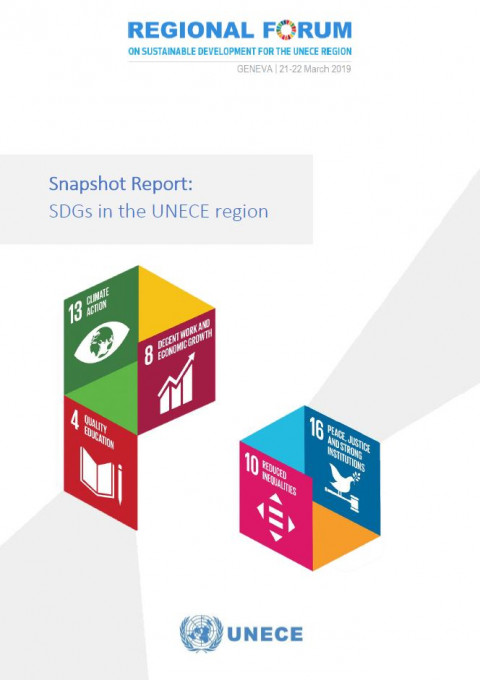 Snapshot Report: SDGs in the UNECE Region Year of publication: 2019 Corporate author: United Nations Economic Commission for Europe (UNECE) This document provides a brief snapshot of some aspects of SDG performance in the UNECE region. It covers the SDGs that will be discussed at the 2019 Regional Forum on Sustainable Development for the UNECE region but it does not attempt to provide an exhaustive assessment. It only uses the available information in the UN SDG Global Database and the sources referenced there to illustrate a selected number of SDG issues. In a very few cases, when no data is available from this database and associated sources, information from other international organizations is used to provide some context to the discussions.
  Global Education Digest 2015-2017: Compiled by the Development Education Research Centre Year of publication: 2018 Corporate author: Development Education Research Centre (DERC) This is the first edition the Global Education Digest, a bibliography of recent published academic and research material relevant to the field of global education. This Digest has been compiled by Development Education Research Centre (DERC) on behalf of Global Education Network Europe (GENE) in the framework of ANGEL activities. ANGEL (Academic Network on Global Education & Learning) is the academic network of global education researchers and academics. The Digest is divided into eight themes/ areas of work, and within each we have identified policy reports, books, academic articles and doctoral research related to global education. Items for inclusion were found through keyword searches of Scopus, Web of Science, Google Scholar, and British Library (including ETHOS and Proquest) databases, as well as through informal discussions with colleagues in the field. The core focus of the Digest is on literature on global education. Selected literature with a focus on related concepts, such as global citizenship, environmental education, and education for sustainable development, has also been included where these have clear links to concerns in global education.
 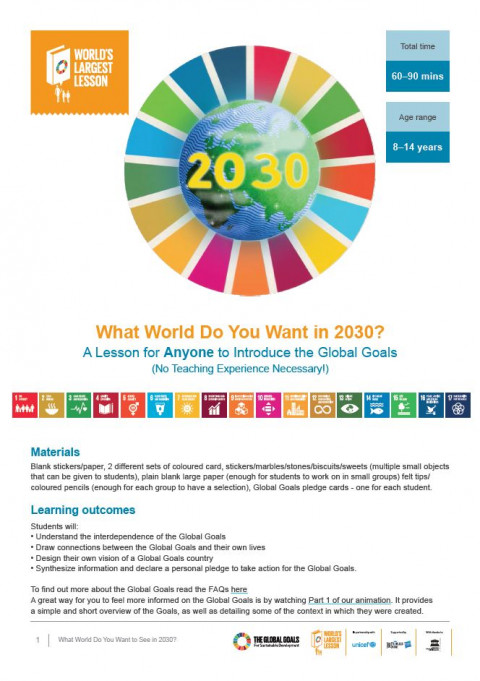 What World Do You Want in 2030?: A Lesson for Anyone to Introduce the Global Goals Year of publication: 2018 Corporate author: World’s Largest Lesson MaterialsBlank stickers/paper, 2 different sets of coloured card, stickers/marbles/stones/biscuits/sweets (multiple small objects that can be given to students), plain blank large paper (enough for students to work on in small groups) felt tips/coloured pencils (enough for each group to have a selection), Global Goals pledge cards - one for each student. Learning outcomesStudents will:• Understand the interdependence of the Global Goals• Draw connections between the Global Goals and their own lives• Design their own vision of a Global Goals country• Synthesize information and declare a personal pledge to take action for the Global Goals.