
Resources
Explore a wide range of valuable resources on GCED to deepen your understanding and enhance your research, advocacy, teaching, and learning.
948 Results found
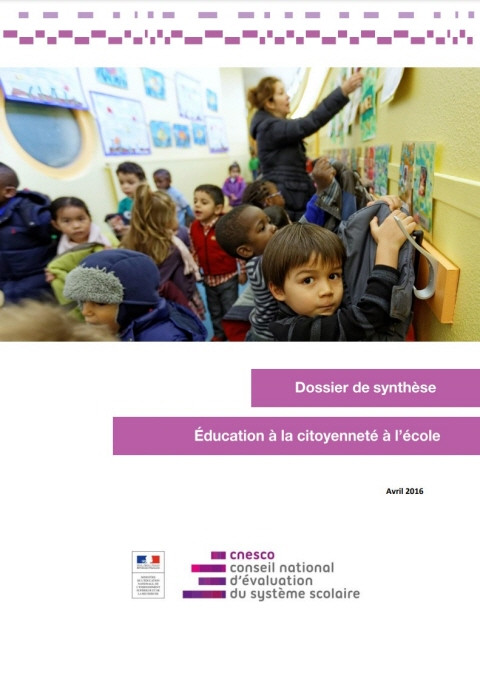 Citizenship Education in Schools: Summary Report Year of publication: 2016 Corporate author: National Center for the Study of School Systems (CNESCO) This report explores the evolution of citizenship education in French schools in response to contemporary challenges. It highlights the key principles of this education and its impact on students, supported by recent research and surveys. The report also compares international practices and presents innovative examples, offering insights to enhance citizenship teaching in France. Éducation à la citoyenneté à l'école : Dossier de synthèse Year of publication: 2016 Corporate author: National Center for the Study of School Systems (CNESCO) Ce dossier explore l'évolution de l'éducation à la citoyenneté dans les écoles françaises face aux défis contemporains. Il met en avant les principes clés de cette éducation et son impact sur les élèves, soutenu par des recherches et des sondages récents. Le rapport compare les pratiques internationales et présente des exemples innovants, offrant des perspectives pour améliorer l'enseignement de la citoyenneté en France.
  Bibliography: Citizenship Education Year of publication: 2021 Corporate author: France Education International Prepared at the request of the French Institute of the Netherlands, this selection of freely accessible digital resources is aimed at French as a Foreign Language (FLE) teachers who wish to educate their students about citizenship. Focused on secularism and the values of the French Republic, it includes international reports, articles and podcasts, didactic and pedagogical resources, as well as presentations of European projects and French academic and school projects that can be adapted to various contexts. Bibliographie: Éducation à la citoyenneté Year of publication: 2021 Corporate author: France Education International Réalisée à la demande de l’Institut français des Pays-Bas, cette sélection de ressources numériques en accès libre s’adresse aux enseignants de FLE désireux d’éduquer leurs élèves à la citoyenneté. Centrée sur la laïcité et les valeurs de la République française, elle comprend des rapports internationaux, des articles et des podcasts, des ressources didactiques et pédagogiques ainsi qu’une présentation de projets européens et de projetsacadémiques et d’établissement français, transposables en différents contextes.
  Discussing Controversial Issues in the Classroom Year of publication: 2012 Author: Michael Hand | Ralph Levinson Discussion is widely held to be the pedagogical approach most appropriate to the exploration of controversial issues in the classroom, but surprisingly little attention has been given to the questions of why it is the preferred approach and how best to facilitate it. Here we address ourselves to both questions. Discussing Controversial Issues in the Classroom Year of publication: 2012 Author: Michael Hand | Ralph Levinson Engager la discussion est largement considéré comme l'approche pédagogique la plus appropriée pour aborder les questions controversées dans la salle de classe. Toutefois, l’analyse et la compréhension de ce statut privilégié n’a soulevé que peu d’attention, de même que la question de savoir par quels moyens faciliter cette approche dans la salle de classe. L'article traite de ces deux questions.
  Interrupting Extremism by Creating Educative Turbulence Year of publication: 2014 Author: Lynn Davies Corporate author: Curriculum Inquiry This article begins from the premise that it is important to explore how people unlearn, as well as learn, specifically in terms of extremist or violent attitudes. Three different country examples are given of intergroup encounters that interrupt rigidities in attitudes: working across ethnic groups in Sri Lanka, tackling religious divides in Northern Ireland through shared classes, and initiatives to prevent violent extremism in the United Kingdom. Pedagogical implications of unlearning involve working with the four Ds of deradicalization, debiasing, disengagement and desistence. Interrupting Extremism by Creating Educative Turbulence Year of publication: 2014 Author: Lynn Davies Corporate author: Curriculum Inquiry Cet article développe l'idée qu'il est important d'analyser les processus de désapprentissage, autant que d'apprentissage, qui conduisent un individu à adopter des attitudes extrémistes ou violentes. Des exemples tirés de trois pays sont mobilisés pour montrer comment des rencontres intergroupes conduisent à infléchir des comportements rigides : le travail entre groupes ethniques au Sri Lanka, la lutte contre les divisions religieuses en Irlande du Nord à l'aide de classes mixtes, et des initiatives visant à prévenir l'extrémisme violent au Royaume-Uni. Les implications pédagogiques d'une approche par le "désapprentissage" nécessitent de mobiliser les quatre "D": déradicalisation, désubjectivation, désengagement et désistance.
  Beyond Bali Education Package Year of publication: 2012 Author: Lily Taylor | Saul Karnovsky The Beyond Bali Project funded by Building Community Resilience (BCR) aims to develop and produce an education resource for secondary school students (years 8/9) on the Bali bombings and the Bali Peace Park. The resource is designed to build social resilience to violent extremism by: - providing students with the skills and tools to critically analyze and challenge violent extremism, its causes and consequences - raising awareness and education on the social impacts of violent extremism - encouraging students to think about how societies can resist the influence of violent extremism - engaging students through activities and discussion about the Bali Peace Park as social resistance to terrorism. Beyond Bali Education Package Year of publication: 2012 Author: Lily Taylor | Saul Karnovsky Le projet Beyond Bali financé par Building Community Resilience (BCR) a pour objectif l’élaboration d’une ressource pédagogique pour les collégiens (de 5ème et 4ème) qui porte sur les attentats survenus à Bali et le Bali Peace Park. Cette ressource est conçue afin de renforcer la résilience sociale à l’extrémisme violent. Pour ce faire, elle :- Fournit aux étudiants les compétences et les outils nécessaires pour analyser de façon critique et remettre en question l’extrémisme violent, ses causes et ses conséquences,- Sensibilise aux impacts sociaux de l’extrémisme violent- Encourage les étudiants à réfléchir sur les façons dont les sociétés peuvent résister à l’influence de l’extrémisme violent- Propose aux étudiants de participer à des activités et à engager des discussions autour du Bali Peace Park.