
Resources
Explore a wide range of valuable resources on GCED to deepen your understanding and enhance your research, advocacy, teaching, and learning.
948 Results found
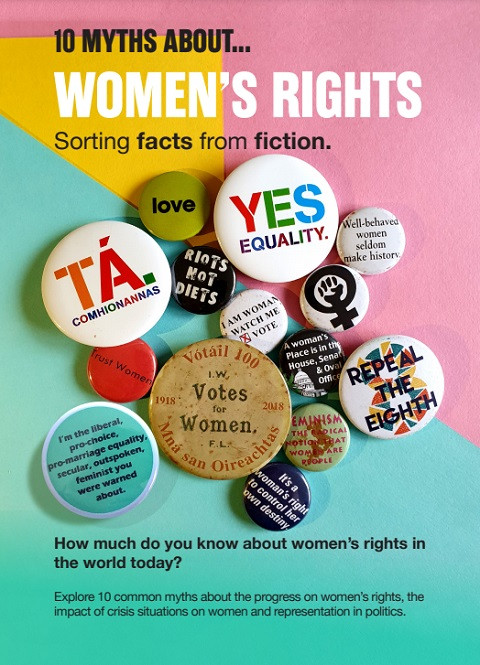 10 Myths About Women’s Rights: Sorting Facts From Fiction Year of publication: 2020 Author: Toni Pyke | Colm Regan Corporate author: DevelopmentEducation.ie Gender-based inequality is one of the most enduring and deep-seated discriminations. It affects all regions, classes and sectors. In most countries, it is maintained and defended in most of the same ways. One key component of that maintenance is a set of myths that are repeated time and time again.This pocket-size booklet includes:Why thinking about women’s rights matters10 short myths about progress on equality, who benefits from feminism, the realities of women’s health and the impact of COVID-19.Links to the Sustainable Development GoalsReferences per each myth following a fact or fiction approach and an explainerThe 10 Myths About…. series looks to sort facts from fiction on key global development, human rights and justice issues.Download 10 Myths About Women’s Rights PDFTest your knowledge and take the 10 Myths About Women’s Rights quiz or share with your group / class / friends For the latest fact checks and factsheets more on the fact checking project and development ideas, issues and debates, visit our What The Fact? project.
  Gender-Based Hate Crime Year of publication: 2021 Corporate author: Organization for Security and Co-operation in Europe (OSCE) Gender-based hate crimes are a consequence of gender inequalities and disproportionately affect women, as well as anyone perceived as not complying with prevailing gender norms. Gender-based hate crimes often seek to intimidate and suppress ways of life or expressions of identity that are perceived as not complying with traditional gender norms. They have a significant, long-lasting impact on the victims, and undermine security and social cohesion by perpetuating gender inequalities. The existence of such crimes also underscores wider trends of intolerance towards other groups. Everyone has a role to play in countering this and all forms of intolerance.
  Media and Information Literacy for Knowledge Societies Year of publication: 2013 Corporate author: Interregional Library Cooperation Centre | UNESCO This book includes communications by the participants and other materials of the International Conference on Media and Information Literacy for Knowledge Societies (Moscow, Russian Federation, 24–28 June, 2012), that offered a unique opportunity to identify the key existing challenges in the field, to outline policies and professional strategies for the advocacy of media and information literacy (MIL), to promote best practices and strengthen international cooperation among various stakeholders. It also contains the Media and Information Literacy Competencies Catalogue prepared by The Modern Poland Foundation (Warsaw, Poland). Медиа- и информационная грамотность в обществах знания Year of publication: 2013 Corporate author: Interregional Library Cooperation Centre | UNESCO Издание подготовлено на основе материалов Международной конференции «Медиа- и информационная грамотность в обществах знания», состоявшейся в Москве 24–28 июня 2012 г. в рамках председательства России в Межправительственном совете Программы ЮНЕСКО «Информация для всех».
  Religion and Belief Issues in the Countries of Central Asia (Kyrgyzstan, Kazakhstan, Uzbekistan, Tajikistan) and Russia in the Media; April 2016 - April 2017 Year of publication: 2017 Author: Evgeny Zavyalov Corporate author: Open Position (Kyrgyzstan) This publication is a review of news on religion and belief issues that appeared in the media from April 2016 to April 2017, in Central Asia (Kyrgyzstan, Kazakhstan, Uzbekistan, Tajikistan) and Russia. The materials included in the publication were distributed monthly on a newsletter including members of religious communities and experts working on issues of religion and belief. Вопросы религии и убеждений в странах Центральной Азии (Кыргызстан, Казахстан, Узбекистан, Таджикистан) и России в материалах СМИ. Апрель 2016 г. - апрель 2017 г. Year of publication: 2017 Author: Evgeny Zavyalov Corporate author: Open Position (Kyrgyzstan) Настоящее издание представляет собой обзор новостей по вопросам религии и убеждений, вышедших в СМИ в период с апреля 2016 по апрель 2017 года, по странам Центральной Азии (Кыргызстан, Казахстан, Узбекистан, Таджикистан) и России. Вошедшие в публикацию материалы ежемесячно рассылались по рассылке, включающей членов религиозных общин и экспертов, занимающихся вопросами религии и убеждений.
 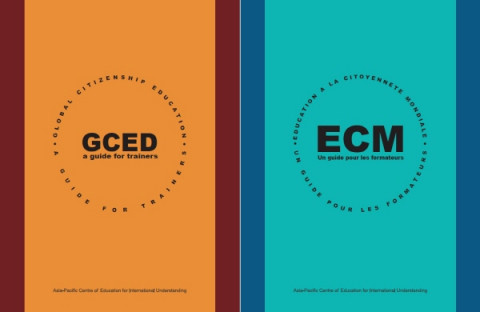 Global Citizenship Education: A Guide for Trainers Year of publication: 2018 Corporate author: APCEIU APCEIU has published Global Citizenship Education: A Guide for Trainers in order to aid trainers to conduct introductory workshops for educators on Global Citizenship Education (GCED). Designed as a training manual for trainers, the Guide offers overview of GCED, including backgrounds and core concepts as well as pedagogical principles, but also provides guidelines on the workshop design and facilitation. Consisting of five chapters, the Guide first introduces the rise of GCED within the latest shift in education and global development agendas. Under this framework, the next chapter explores the meanings of a ‘global citizen’ and ‘global citizenship,’ and introduces key concepts and principles of GCED. The next two chapters deal with how to teach GCED, presenting topic areas and themes as well as pedagogies and strategies. The Guide concludes with the last chapter that summarizes and integrates the contents learned in previous chapters by sharing case studies as examples and providing guidelines on how to design GCED activities.The Guide is available in English and French. <Contents> Chapter 1- Why GCED Now?Chapter 2- What is GCED?Chapter 3- GCED: What to Teach?Chapter 4- How to Teach GCED?Chapter 5- Preparing for ActionAnnex: Global Education AgendasUNESCO’s Topics and Learning ObjectivesGCED Resources & Reference Materials ECM: Un guide pour les formateurs Year of publication: 2018 Corporate author: Centre Asie-Pacifique d'éducation pour la compréhension internationale (APCEIU) Ce guide est un manuel de formation pour les formateurs qui organiseront un atelier de formation des éducateurs en éducation à la citoyenneté mondiale (ECM) avec les objectifs suivants: - Présenter les informations de base et les concepts clés de l’ECM aux participants de l’atelier- Aider les participants à découvrir les notions de base de l’ECM et les méthodes constructifs connexes en termes d’enseignement/apprentissage - Encourager les participants à explorer les méthodes et les opportunités à travers lesquelles ils peuvent pratiquer l’ECM à l’école et dans d’autres contextes éducatifs
 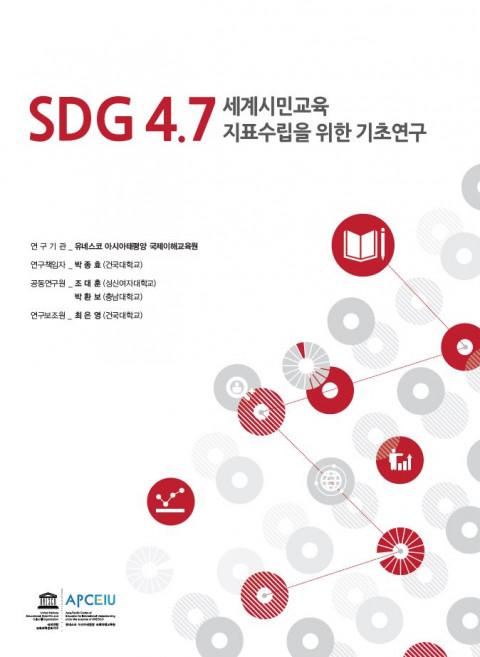 SDG 4.7: 세계시민교육 지표수립을 위한 기초연구 Year of publication: 2018 Corporate author: 유네스코 아시아태평양 국제이해교육원 “SDG 4.7 세계시민교육 지표수립을 위한 기초연구 보고서”가 발간되었다. 본 연구보고서는 국제적으로 합의된 글로벌 지표의 부재로 현재까지 정의가 완료되지 않은 지속가능발전목표 (SDG) 4.7 지표 개발을 위한 기초 연구이다. 즉, 동 보고서는 세계시민교육 및 SDG 4.7 지표에 관한 기존의 국내·외 연구결과를 종합적으로 검토하여 글로벌 지표에 관한 주요 논의를 정리하고, 국내 지표 개발을 위한 함의를 도출하는 데에 목적을 두고 있다. 이를 위하여 유네스코 통계원 (UIS)의 최신 SDG 4.7.1 메타데이터 연구와 국내·외 연구결과에 기초하여 국내에서 활용할 수 있는 정보와 데이터를 검토하고 있다.
  세계시민교육 전문가양성과정 종료평가: 최종보고서 Year of publication: 2023 Corporate author: 유네스코 아시아태평양 국제이해교육원 본 연구는 유네스코 아시아태평양 국제이해교육원에서 진행되는 다양한 세계시민교육 전문가양성과정 중 2022년 시행된 제8회 세계시민교육 청년리더십 워크숍과 제7회 세계시민교육 교사교육가 글로벌연수에 대한 종료평가로서, 사업성과에 대한 심층분석과 교훈 및 제언 도출을 주요 목표로 하였다. 적절성, 효율성, 효과성, 지속가능성 등 4개 기준을 적용하고, 문헌검토, 워크숍 참여자 대상 설문조사, 심층면담 등의 방법을 활용해 데이터를 확보하여 연구를 진행하였다. 연수 종료 후 확인 가능한 성과(outcome)에 대한 효과성과 지속가능성 항목에 대한 평가에는 2021년 연수 자료가 포함되었다.