
Resources
Explore a wide range of valuable resources on GCED to deepen your understanding and enhance your research, advocacy, teaching, and learning.
2,255 Results found
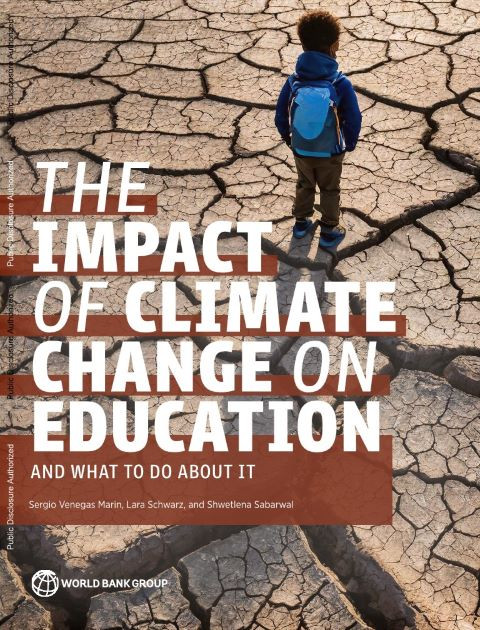 The Impact of Climate Change on Education and What to Do about It Year of publication: 2024 Author: Sergio Venegas Marin | Lara Schwarz | Shwetlena Sabarwal Corporate author: International Bank for Reconstruction and Development | World Bank Education can be the key to ending poverty in a livable planet, but governments must act now to protect it. Climate change is increasing the frequency and intensity of extreme weather events such as cyclones, floods, droughts, heatwaves and wildfires. These extreme weather events are in turn disrupting schooling; precipitating learning losses, dropouts, and long-term impacts. Even if the most drastic climate mitigation strategies were implemented, extreme weather events will continue to have detrimental impacts on education outcomes.
 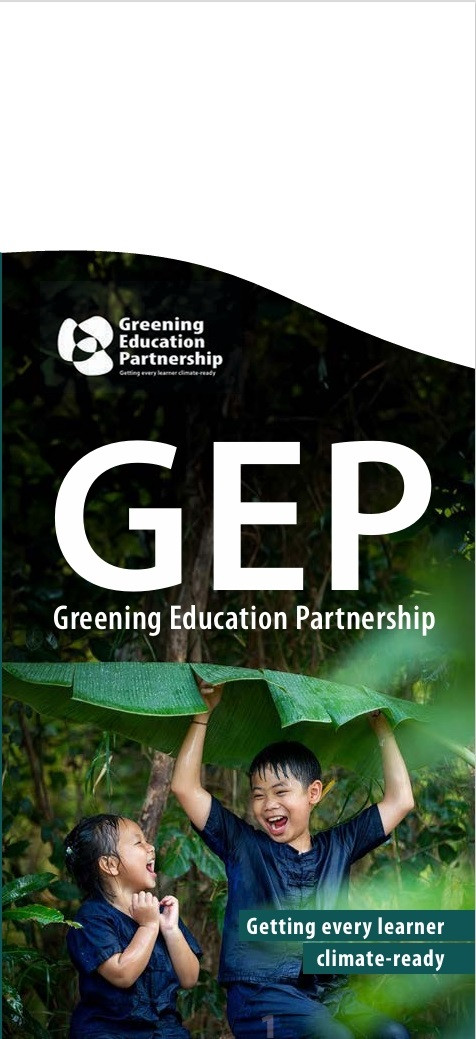 Greening Education Partnership: Getting Every Learner Climate-Ready Year of publication: 2024 Corporate author: UNESCO Bangkok The UN Secretary-General calls the climate crisis ‘a battle for our lives’, as we still struggle to transform our societies to reach the 1.5°C-degree path recommended by the Paris Agreement. Rapid and radical transformation at all levels and in many aspects of our life is required, with education as a central and powerful means to support the adaptation and strengthening of the resilience of learners and societies. It is also important to ensure that education systems become more resilient to climate change to create safe and climate-proof schools. Building off of the knowledge and practice accumulated in Education for Sustainable Development (ESD), a new Greening Education Partnership aims to deliver strong, coordinated and comprehensive action which will prepare every learner to acquire the knowledge, skills, values, and attitudes to tackle climate change and to promote sustainable development.
  Diagnosing and Enhancing Environmental Literacy of Citizens to Raise Green Awareness Year of publication: 2021 Author: Jeongyoon Yeom | Namsoo Kim | Haengwoon Jeong | Woohyeon Jeong Corporate author: Korea Environment Institute (KEI) 1. Research purposeA nationwide consensus on the understanding on and necessity of the environmental policy is needed in order to successfully achieve the policy objectives.The necessity of environmental education is being highlighted but in reality, there is a lack of objectives and specific indicators to verify its effect.The goal of environmental education should be the expansion of environmental literacy and indicators to measure this should be developed. 2. Research scopeSummarize the concept of environmental literacy and develop the scales for adultsMeasure the level of environmental literacy of citizensConfirm the predictors and consequences of environmental literacyUnderstand citizen types via cluster analysis 시민 인식의 녹색 전환을 위한 환경 리터러시 진단 및 강화 방안 Year of publication: 2021 Author: 염정윤 | 김남수 | 정행운 | 정우현 Corporate author: 한국환경연구원 1. 연구의 필요성 및 목적 환경 정책이 성공적으로 정책 목표를 달성하기 위해서는 정책 이해와 필요성에 대한 범국민적 공감대가 필수 환경교육의 중요성을 강조하고 있지만 실질적으로 교육의 효과를 확인할 수 있는 객관적이고 구체적인 지표가 부재함 환경교육의 목표를 환경 리터러시의 증대로 설정하고 이를 측정할 지표 개발이 필요2. 연구의 범위 환경 리터러시 개념 정리 및 성인 대상의 측정 도구 개발 일반 시민의 환경 리터러시 수준 측정 환경 리터러시의 예측 요인과 결과 요인 확인 군집 분석을 통한 시민 유형 파악* 본 저작물은 한국환경연구원에서 '2021'년에 작성하여 공공누리 제'4'유형으로 개방한 ‘시민 인식의 녹색 전환을 위한 환경 리터러시 진단 및 강화 방안(작성자: 염정윤)’을 이용하였으며 해당 저작물은 한국환경연구원 홈페이지(http://www.kei.re.kr)’에서 무료로 다운받으실 수 있습니다.
 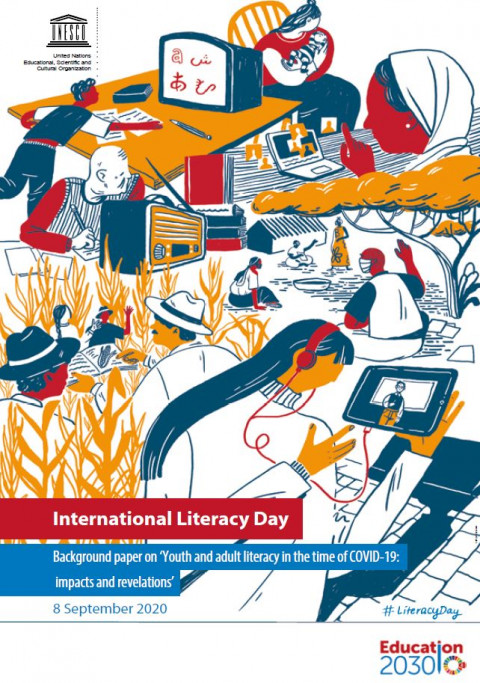 International Literacy Day: Background Paper on 'Youth and Adult Literacy in the Time of COVID-19; Impacts and Revelations' Year of publication: 2020 Corporate author: UNESCO Specially prepared on the occasion of International Literacy Day 2020, this background paper illustrates the impact of the COVID-19 crisis on youth and adult literacy, based on the limited information that is currently available. It provides five regional snapshots and identifies preliminary lessons learned thus far, while aiming to inspire continued reflection and subsequent action. It also makes the case for the ongoing importance of advancing youth and adult literacy, a priority that was already neglected even before the pandemic but which deserves all our attention. ILD 2020 thus seeks to trigger reimaginations of literacy teaching and learning in the COVID-19 crisis and beyond, with a particular focus on the role of educators.
  Envision 4.7: Bridge 47 Global Event; Helsinki, Finland 5–7 November 2019: Report Year of publication: 2019 Corporate author: Bridge 47 | Frinland. Ministry of Education and Culture | Finland. Ministry for Foreign Affairs Global event Envision 4.7 was held in Helsinki in November 2019. The event brought around 200 people together to discuss ways to take the SDG Target 4.7 forward. In this report you can find summaries of all the speeches, panel discussions, workshops and working groups that were held at the event, together with a summary of discussions around all the different topics. You can also find pictures and drawings from the event at the report.
 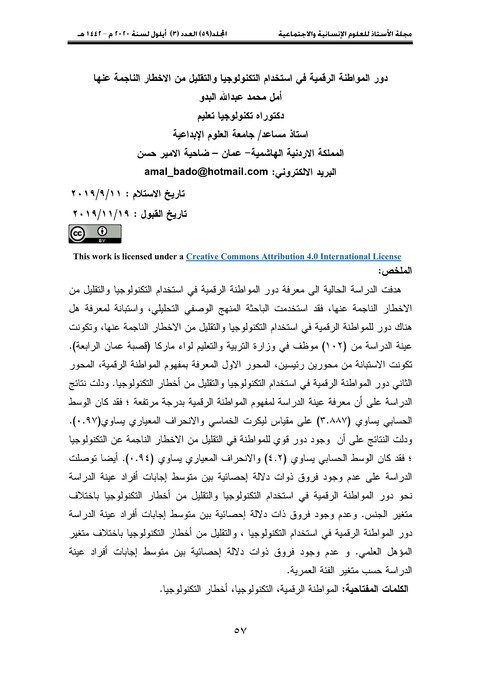 The Role of Digital Citizenship in the Use of Technology and Reducing the Risks Resulting from it (Alustath Journal for Human and Social Sciences; vol.59, no.3) Year of publication: 2020 Author: Amal Mohammed Abdullah Albado Corporate author: University of Baghdad. College of Education Ibn Rushd The current study aims to know the role of digital citizenship in the use of technology and reducing the risks resulting from it. The researcher uses the descriptive analytical approach and makes a questionnaire to know if there is a role for the digital citizenship in the use of technology and reducing the dangers caused by it. The study sample consists of (102) employees in the Ministry of Education Marka Brigade (the fourth Amman qasaba). The questionnaire consists of two main axes: the first axis, which is defined as the concept of digital citizenship, the second axis is the role of digital citizenship in the use of technology and reducing the dangers of technology. The results of the study show that the awareness of the sample of the study of the concept of digital citizenship is on a high level, on average that equals (3.887) of the Likert quinary scale and the standard deviation is equal to (0.97). The results also show a strong role for citizens in reducing the dangers caused by technology where the arithmetic mean equals (4.2) and the standard deviation was (0.94). دور المواطنة الرقمية في استخدام التكنولوجيا والتقليل من الاخطار الناجمة عنها (الاستاذ للعلوم الانسانية والاجتماعية; no.3, vol.59) Year of publication: 2020 Author: Amal Mohammed Abdullah Albado Corporate author: University of Baghdad. College of Education Ibn Rushd هدفت الدراسة الحالية الى معرفة دور المواطنة الرقمية في استخدام التكنولوجيا والتقليل من الاخطار الناجمة عنها، فقد استخدمت الباحثة المنهج الوصفي التحليلي، واستبانة لمعرفة هل هناك دور للمواطنة الرقمية في استخدام التكنولوجيا والتقليل من الاخطار الناجمة عنها، وتكونت عينة الدراسة من (102) موظف في وزارة التربية والتعليم لواء ماركا (قصبة عمان الرابعة). تكونت الاستبانة من محورين رئيسين، المحور الاول المعرفة بمفهوم المواطنة الرقمية، المحور الثاني دور المواطنة الرقمية في استخدام التكنولوجيا والتقليل من أخطار التكنولوجيا. ودلت نتائج الدراسة على أن معرفة عينة الدراسة لمفهوم المواطنة الرقمية بدرجة مرتفعة ؛ فقد كان الوسط الحسابي يساوي (3.887) على مقياس ليكرت الخماسي والانحراف المعياري يساوي(0.97). ودلت النتائج على أن وجود دور قوي للمواطنة في التقليل من الاخطار الناجمة عن التكنولوجيا ؛ فقد كان الوسط الحسابي يساوي (4.2) والانحراف المعياري يساوي (0.94).
 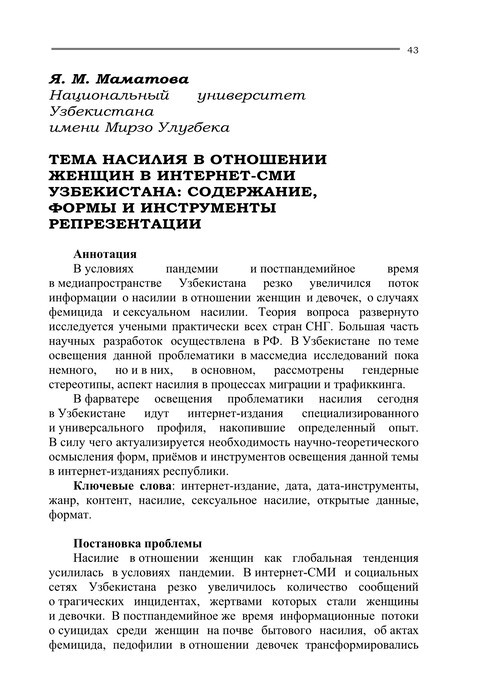 The Theme of Violence Against Women on the Internet Media of Uzbekistan: Content, Tools of Representation (PR and Advertising in a Changing World: Regional Aspect; No.28, 2023) Year of publication: 2023 Author: Я. М. Маматова In the context of the pandemic and post-pandemic in the media space of Uzbekistan, the flow of information about violence against women and girls, about cases of femicide and sexual violence has increased dramatically. In Uzbekistan, there are still few studies on the topic of coverage of this issue in the mass media, but they also mainly consider gender stereotypes, the aspect of violence in the processes of migration and trafficking. Тема насилия в отношении женщин в интеренет-СМИ Узбекистана: содержание, формы и инструменты репрезентации (PR и реклама в изменяющемся мире: региональный аспект; No.28, 2023) Year of publication: 2023 Author: Я. М. Маматова В условиях пандемии и постпандемийное время в медиапространстве Узбекистана резко увеличился поток информации о насилии в отношении женщин и девочек, о случаях фемицида и сексуальном насилии. В Узбекистане по теме освещения данной проблематики в массмедиа исследований пока немного, но и в них, в основном, рассмотрены гендерные стереотипы, аспект насилия в процессах миграции и трафиккинга.