
Resources
Explore a wide range of valuable resources on GCED to deepen your understanding and enhance your research, advocacy, teaching, and learning.
1,828 Results found
 국제이해교육 사진교실 개선 방안 연구 Year of publication: 2020 Author: 박순용 | 김종훈 Corporate author: 유네스코 아시아태평양 국제이해교육원 본 연구는 아태교육원이 운영한 국제이해교육 사진교실 (EIU Photo Class)의 역사와 기록들을 되짚어보며 청소년의 세계시민교육 함양 및 글로벌 역량 강화를 위해 나아갈 방향과 개선점을 모색하는데 그 목적이 있다. 본 연구에서는 관련 아카이브 자료를 검토 및 분석하고, 그동안 사진교실에 참가하였던 아시아·태평양 지역의 학생, 작가, 주최·협력기관 관계자들과의 면담을 실시하였으며, 사진교실을 통해 세계시민교육의 취지가 어떻게 구현되었는가와 앞으로의 진행방향을 청소년 및 교육관계자들의 관점에서 점검하였다.
 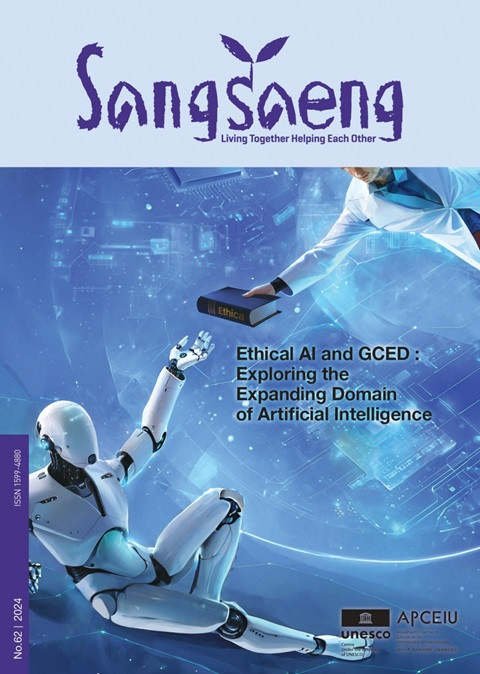 Ethical AI and GCED: Exploring the Expanding Domain of Artificial Intelligence (SangSaeng; No. 62, 2024) Year of publication: 2024 Corporate author: APCEIU The 62nd issue of SangSaeng has been published with the theme of “Ethical AI and GCED: Exploring the Expanding Domain of Artificial Intelligence.” AI has never been as pervasive and influential as it is in today’s rapidly changing world. Despite the convenience and cutting-edge technology AI has offered us, it has the potential to pose a threat to humanity. This is where ethics for AI should come forward. In this regard, this issue will lead readers to the alarming side of AI as well as its future developments, focusing on the importance of GCED and AI ethics in tackling any potential problems. Contents03 Editor's Note 04 Special ColumnEmbracing Change to Cultivate Success — Integrating Global Citizenship Education into Tertiary Education / Dendev Badarch 08 FOCUS: Ethical AI and GCED: Exploring the Expanding Domain of Artificial IntelligenceRole of Ethics in the Era of AI — Protecting and Guiding AI Processes for Humanity to Flourish / Emma Ruttkamp-BloemPaying Attention to AI Ethics — An Avenue for a New Competitive Edge in Business / Myoungshin KimDriving Innovative Education — Balancing Future Possibilities and Ethical Concerns: How GCED Can be Used to Address AI Issues / Angelique Southern 20 Special ReportEmpowering a Climate Generation — From Classrooms to Climate Frontlines: The Transformative Role of Education highlighted at COP28 / Djian Sadadou 22 Best PracticesNavigating an AI Future — Ethical AI and the Importance of Critical Thought / Hannah GrantGLACE Brings the World to a City — Empowering Youth as Global Citizens: Lessons from Navotas City’s Project GLAC / Marco D. MedurandaLowering Eco-Anxiety — Teaching Climate Change Through Media and Information Literacy / Laetitia Legrand 33 GCED YOUTH NETWORK New Wave of Youth Advocacy — Role of AI in Youth Advocacy and its Ethical Implications to Global Citizenship / Oshan M. Gunathilake and Diego Manrique 36 Understanding the Asia Pacific RegionDiscovering Auroville — Where Boundaries Fade, Nature Thrives, and Global Minds Unite / Akanksha Arya 39 Peace in My MemoryHappiness without Violence — Mindanao Peace ForumCelebrates Building a Culture of Peace / Ludivina Borja-DekitPeace Scholar Passes Away Amidst Turbulent Times / Kwang-Hyun KIM 45 Story TimeThe Right Footing — My Life Has Purpose Thanks to Football / Hajar Abulfazl 48 LetterShared Challenges of Global Citizens / Natsuki Nagata 50 APCEIU in Action
  Road Map to Implement UNESCO’s ‘Recommendation on Education for Peace, Human Rights and Sustainable Development’ in Asia-Pacific Year of publication: 2024 Corporate author: UNESCO Bangkok | APCEIU The Road Map is a product of the Regional Policy Dialogue and the Launch of the Recommendation on Education for Peace, Human Rights, and Sustainable Development (hereafter referred to as the 2023 Recommendation), held in Bangkok in June 2024. This document aims to promote the regional implementation of the 2023 Recommendation and outlines the challenges and priorities within the Asia-Pacific educational landscape, making it a valuable resource for policymakers, researchers, and practitioners.
 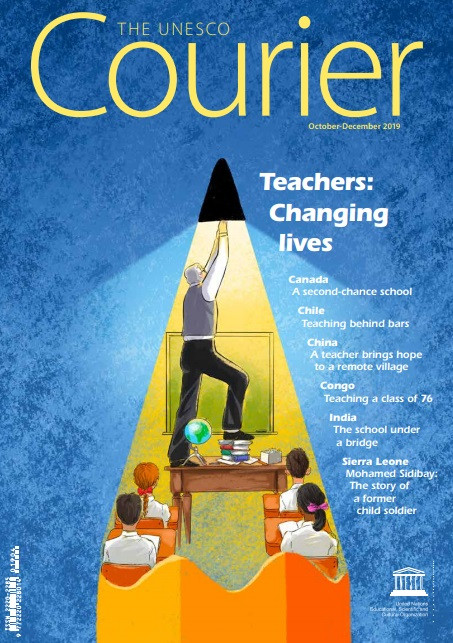 Teachers: changing lives (The UNESCO Courier no. 4, October-December 2019) Year of publication: 2019 Corporate author: UNESCO Certainly, everyone recognizes the key role teachers play. On a personal level, we can all name at least one teacher who made a difference – sometimes to such an extent that it redirected our whole lives. At the international level, the United Nations Sustainable Development Goals (SDGs), Goal 4 in particular, recognize the importance of teachers in the implementation of the Sustainable Development Agenda by 2030. Yet, the profession is being undermined. The development of cognitive neuroscience and the many applications of new technologies in the field of education are forcing the profession to adapt and reinvent itself. Ces profs qui changent le monde (Le Courrier de l'UNESCO 4, octobre-décembre 2019) Year of publication: 2019 Corporate author: Organisation des Nations Unies pour l'éducation, la science et la culture (UNESCO) Certes, tout le monde reconnaît le rôle clé que jouent les enseignants. À titre personnel, chacun peut citer le nom d’au moins un professeur qui a compté, parfois au point de réorienter une vie entière. Sur le plan international, les Objectifs de développement durable (ODD) des Nations Unies, en particulier l’Objectif no 4, reconnaissent l’importance des enseignants dans la mise en œuvre du Programme de développement durable à l’horizon 2030. Pourtant, la profession est mise à mal. Le développement des neurosciences cognitives, les multiples applications des nouvelles technologies dans le domaine de l’éducation obligent la profession à s’adapter, se réinventer. Docentes que cambian el mundo (El Correo de la UNESCO 4, Octubre-Diciembre 2019) Year of publication: 2019 Corporate author: Organización de las Naciones Unidas para la Educación, la Ciencia y la Cultura (UNESCO) Sin duda, todo el mundo reconoce la función esencial que desempeñan los docentes. A título individual, cada uno de nosotros puede mencionar el nombre de al menos un maestro que le influyó decisivamente, a veces hasta el punto de reorientar toda su vida. En el ámbito internacional, los Objetivos de Desarrollo Sostenible (ODS) de las Naciones Unidas, en particular el ODS 4, destacan la importancia del profesorado en la consecución de la Agenda 2030 de desarrollo sostenible.Y, sin embargo, la profesión docente está en crisis. El desarrollo de la neurociencia cognitiva y las múltiples aplicaciones de las nuevas tecnologías en el sector educativo imponen al magisterio la necesidad de adaptarse, de reinventarse.
 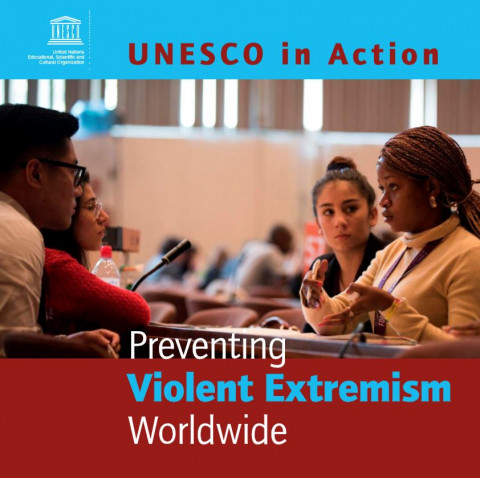 UNESCO in action: preventing violent extremism worldwide Year of publication: 2018 Corporate author: UNESCO UNESCO supports countries in crafting education programmes that build young people’s resilience to violent extremist messaging and foster a positive sense of identity and belonging. From this angle, the role of education is not to intercept violent extremists or identify individuals who may potentially become violent extremists, but to create conditions to build the defences of peace within learners through values, skills and behaviours that reject violent extremism, and by strengthening their commitment to non-violence and peace. This work is undertaken within the broader framework of Global Citizenship Education, where UNESCO leads implementation of Target 4.7 of the Sustainable Development Goal 4 on Education. The work undertaken in the field of Global Citizenship Education also embraces activities pertaining to human rights and peace education, Holocaust and genocide education, and activities to combat all forms of intolerance, racism and anti-Semitism.
 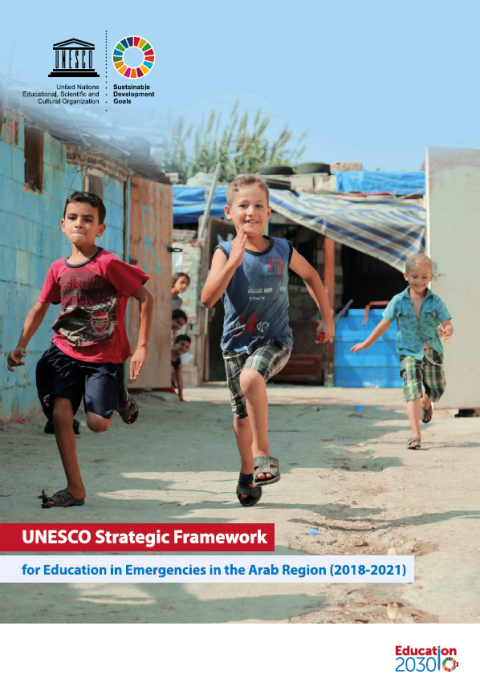 UNESCO Strategic Framework for Education in Emergencies in the Arab Region (2018-2021) Year of publication: 2017 Corporate author: UNESCO The Strategic Framework consists of four strategic goals that are anchored in the three pillars of education (Access, Quality and System Strengthening) and which emphasize the importance of relevant and inclusive education to meet the challenges confronting learners, educators, and education systems in both crisis and post-crisis settings. The strategic goals are: Strategic Goal 1: Children and youth affected by crisis access inclusive and quality learning opportunitiesStrategic Goal 2: Learners affected by crisis are empowered with values, knowledge, and skills for life and workStrategic Goal 3: Education actors provide quality education for better learning outcomesStrategic Goal 4: Education systems are responsive and resilient to crisis
  Strengthening accountability in the implementation of SDG4 - Education 2030 Year of publication: 2017 Corporate author: UNESCO SDG4-Education 2030 is a renewed commitment to ensure the right to quality education and the promotion of lifelong learning opportunities, as the foundation for sustainable development. As outlined in the 2015 Incheon Declaration and the 2030 Framework for Action (FfA), strengthened governance, partnerships and accountability are essential in translating global education targets and commitments into effective policy and practice at the national level. The range of partners engaged in education - whether government, schools and teachers, families and communities, civil society organizations, or the business sector – have important roles in this collective societal endeavor. They also each have important responsibilities for which they must be accountable in the collective effort to realize the global commitment to ensure the right to quality education for all. As duty bearers, governments have the primary responsibility to deliver on the right to education, and a central role as custodians of efficient, equitable and effective management and financing of public education. Renforcer l'obligation de rendre des comptes dans le cadre de la mise en oeuvre de l'ODD 4 - Education 2030 Year of publication: 2017 Corporate author: Organisation des Nations Unies pour l'éducation, la science et la culture (UNESCO) L’ODD 4 - Éducation 2030 réaffirme l’engagement mondial garantissant le droit à l’éducation et à l’apprentis-sage tout au long de la vie, qui sert de base au développement durable. Comme le soulignent la Déclaration d’Incheon et le Cadre d’action Éducation 2030 adoptés en 2015, il est indispensable de renforcer la gouver-nance, les partenariats et l’obligation redditionnelle pour concrétiser, dans des pratiques et des politiques nationales, les cibles et les engagements mondiaux relatifs à l’éducation. Qu’il s’agisse de gouvernements, d’établissements scolaires et d’enseignants, de familles et de citoyens, d’organisations de la société civile ou encore du secteur privé, les différents partenaires engagés au service de l’éducation ont un rôle important à jouer dans cette entreprise sociétale collective. Chacun d’entre eux a également d’importantes responsabili-tés dans les efforts menés collectivement pour tenir l’engagement mondial qui vise à garantir à tous le droit à une éducation de qualité, et est à ce titre tenu de rendre des comptes. Porteurs de devoirs, les gouverne-ments sont responsables au premier chef de l’application du droit à l’éducation et ils jouent un rôle central en tant que garants de la gestion et du financement rationnels, équitables et efficaces de l’enseignement public.