
Resources
Explore a wide range of valuable resources on GCED to deepen your understanding and enhance your research, advocacy, teaching, and learning.
2,162 Results found
 Traditions religieuses et modèles d’éducation à la citoyenneté: l’héritage d’un univers normatif Year of publication: 2015 Author: Félix Mathieu | Guy Laforest Corporate author: Politique et Sociétés (Canada) Cet article analyse les liens significatifs entre les curriculums d’éducation à la citoyenneté de la France, de l’Angleterre et du Québec, ainsi que leurs traditions religieuses respectives, lesquelles découlent toutes du noyau central et commun d’appartenance qu’est le christianisme. Plus précisément, en partant du postulat selon lequel le fait religieux, en tant qu’héritage socioculturel, imprègne de manière profonde et durable les sociétés contemporaines, les auteurs montrent que les valeurs et les idéaux issus des différents parcours religieux se transposent plus ou moins singulièrement à travers l’univers normatif et pédagogique des programmes français, anglais, puis québécois d’éducation à la citoyenneté.
  Qu'est-ce que l’éducation à la citoyenneté ? Year of publication: 2009 Author: Denis Pieret Corporate author: Philocité « Citoyen » est sans doute un mot très à la mode (entreprise citoyenne, attitude citoyenne, consommation citoyenne...). Que signifie « éducation à la citoyenneté », affublée de deux autres adjectifs tout aussi tendance, active et responsable ? La citoyenneté est d’abord un statut juridique qui octroie un certain nombre de droits et de devoirs et qui est, au moins depuis la modernité, attachée à la nationalité. Selon cette acception, il n’est nul besoin d’être éduqué à être pleinement citoyen belge, il suffit d’être de nationalité belge, d’avoir dix-huit ans et de n’être pas déchu de ses droits civiques. Mais le mot « citoyen » véhicule aussi un lourde charge morale : être citoyen en démocratie nécessiterait un certain nombre de capacités sans lesquelles la démocratie se mettrait elle-même en danger. À partir de cette charge morale, l’acception de « citoyenneté » s’étend au terme parent de « civilité », à l’idée d’un « adoucissement des mœurs qu’est censée produire la vie dans une cité ».
  L’école citoyenne au défi: L’éducation à la citoyenneté en Suisse Year of publication: 2014 Author: Andrea Giesch | Margarita Sanchez-Mazas Le dispositif de formation que nous proposons aux futurs enseignants met l’accent sur les situations problématiques plutôt que sur les problèmes que poseraient les écarts dus à l’origine et à la spécificité culturelle des élèves, afin d’éviter les pièges de l’essentialisation et de restituer la complexité des trajectoires et des circonstances vécues. La construction d’une compétence interculturelle peut fortement tirer parti d’une approche psychosociale qui articule étroitement l’analyse de facteurs macrosociaux et celle des dynamiques qui se développent dans le cadre de la classe du fait de l’irruption d’enjeux identitaires amenés par les élèves.
 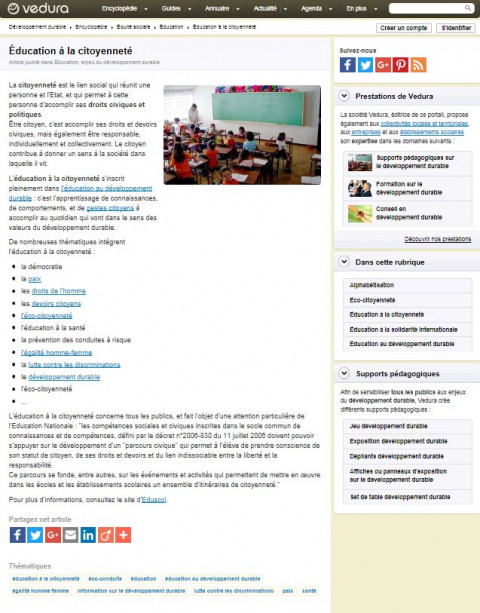 Éducation à la citoyenneté Corporate author: Vedura La citoyenneté est le lien social qui réunit une personne et l'Etat, et qui permet à cette personne d'accomplir ses droits civiques et politiques. Être citoyen, c'est accomplir ses droits et devoirs civiques, mais également être responsable, individuellement et collectivement. Le citoyen contribue à donner un sens à la société dans laquelle il vit. L'éducation à la citoyenneté s'inscrit pleinement dans l'éducation au développement durable : c'est l'apprentissage de connaissances, de comportements, et de gestes citoyens à accomplir au quotidien qui vont dans le sens des valeurs du développement durable. De nombreuses thématiques intègrent l'éducation à la citoyenneté : la démocratie la paix les droits de l'homme les devoirs citoyens l'éco-citoyenneté l'éducation à la santé la prévention des conduites à risque l'égalité homme-femme la lutte contre les discriminations le développement durable l'éco-citoyenneté ... L'éducation à la citoyenneté concerne tous les publics, et fait l'objet d'une attention particulière de l'Education Nationale : "les compétences sociales et civiques inscrites dans le socle commun de connaissances et de compétences, défini par le décret n°2006-830 du 11 juillet 2006 doivent pouvoir s’appuyer sur le développement d’un "parcours civique" qui permet à l’élève de prendre conscience de son statut de citoyen, de ses droits et devoirs et du lien indissociable entre la liberté et la responsabilité. Ce parcours se fonde, entre autres, sur les événements et activités qui permettent de mettre en œuvre dans les écoles et les établissements scolaires un ensemble d'itinéraires de citoyenneté."
  Citizenship Education in Primary School: A Study of Professional Teacher Representations in Quebec Year of publication: 2016 Author: Pierre-Luc Fillion | Luc Prud’homme | Marie-Claude Larouche Corporate author: Canadian Society for the Study of Education Considering the ambiguity of ministerial guidance relating to citizenship education, this study examines the professional representation of elementary teachers, particularly because they impact the actualization of this responsibility in the classroom. This article presents the results of a qualitative research conducted with eight teachers working in two elementary schools in Québec. The data collected through individual interviews reveal a work that is conceived as a daily, unplanned activity widely associated with the together-ness at school. The conceptualizations of the participants appear to rely on a more con-formist view of the personally responsible citizen. L’éducation à la citoyenneté à l’école primaire: étude des représentations professionnelles d’enseignantes du Québec Year of publication: 2016 Author: Pierre-Luc Fillion | Luc Prud’homme | Marie-Claude Larouche Corporate author: Canadian Society for the Study of Education Considérant l’ambiguïté des orientations ministérielles entourant l’éducation à la citoyenneté, cette étude interroge les représentations professionnelles d’enseignants du primaire, notamment puisqu’elles ont une incidence sur l’actualisation de cette responsabilité en classe. Cet article présente les résultats d’une recherche qualitative menée auprès de huit enseignantes oeuvrant au sein de deux écoles primaires du Québec. Les données recueillies à l’aide d’entretiens semi-dirigés individuels mettent en évidence que l’éducation à la citoyenneté est abordée comme une activité quotidienne, non planifiée et largement associée au vivre-ensemble à l’école. Les représentations des participantes apparaissent également s’appuyer sur une vision plus conformiste du citoyen personnellement responsable.
  La mise-en-action dans un processus d’éducation à la citoyenneté mondiale et solidaire Year of publication: 2016 Author: Hugo Roegiers Corporate author: OXFAM-Magasins du monde Les phases d’information, sensibilisation et conscientisation ne posent généralement pas trop de problèmes dans le cadre de l’éducation à la citoyenneté mondiale et solidaire. Il en va souvent autrement de la phase de mise-en-action, en particulier lorsqu’il s’agit d’une formation courte. Le pourquoi, le comment et l’objectif de la mise-en-action peuvent se révéler difficiles à appréhender, surtout dans le contexte obscur actuel.
 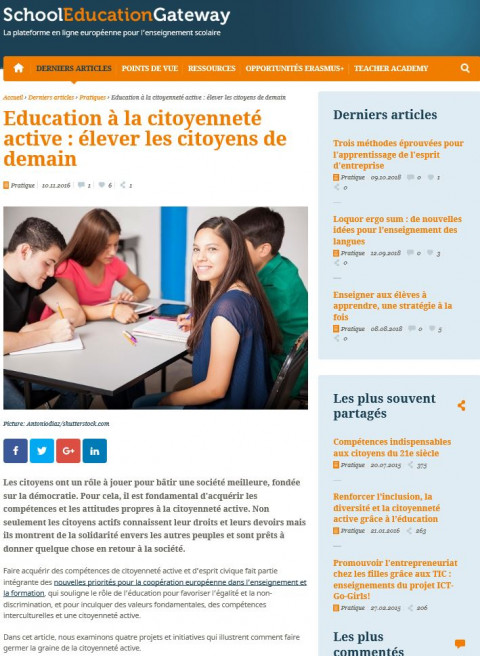 Éducation à la citoyenneté active: élever les citoyens de demain Year of publication: 2016 Corporate author: Centre européen Wergeland Les citoyens ont un rôle à jouer pour bâtir une société meilleure, fondée sur la démocratie. Pour cela, il est fondamental d'acquérir les compétences et les attitudes propres à la citoyenneté active. Non seulement les citoyens actifs connaissent leur droits et leurs devoirs mais ils montrent de la solidarité envers les autres peuples et sont prêts à donner quelque chose en retour à la société.Faire acquérir des compétences de citoyenneté active et d’esprit civique fait partie intégrante des nouvelles priorités pour la coopération européenne dans l’enseignement et la formation, qui souligne le rôle de l’éducation pour favoriser l’égalité et la non-discrimination, et pour inculquer des valeurs fondamentales, des compétences interculturelles et une citoyenneté active. Dans cet article, nous examinons quatre projets et initiatives qui illustrent comment faire germer la graine de la citoyenneté active.
 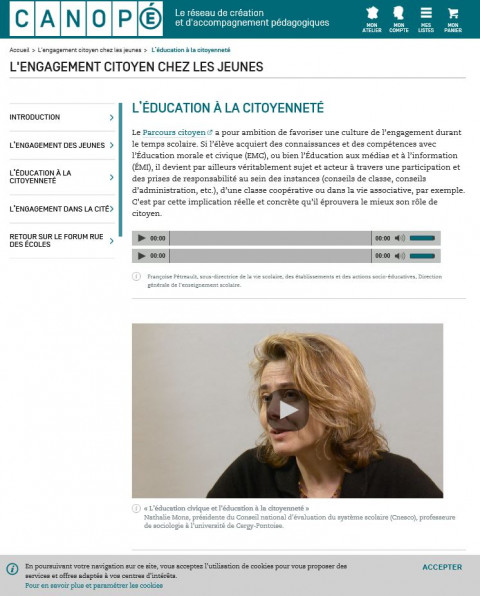 L’ÉDUCATION À LA CITOYENNETÉ Author: Nathalie Mons | Éric Favey | Jean-Michel Zakhartchouk Corporate author: CANOPé Le Parcours citoyen a pour ambition de favoriser une culture de l’engagement durant le temps scolaire. Si l’élève acquiert des connaissances et des compétences avec l’Éducation morale et civique (EMC), ou bien l’Éducation aux médias et à l’information (ÉMI), il devient par ailleurs véritablement sujet et acteur à travers une participation et des prises de responsabilité au sein des instances (conseils de classe, conseils d’administration, etc.), d’une classe coopérative ou dans la vie associative, par exemple. C’est par cette implication réelle et concrète qu’il éprouvera le mieux son rôle de citoyen.
 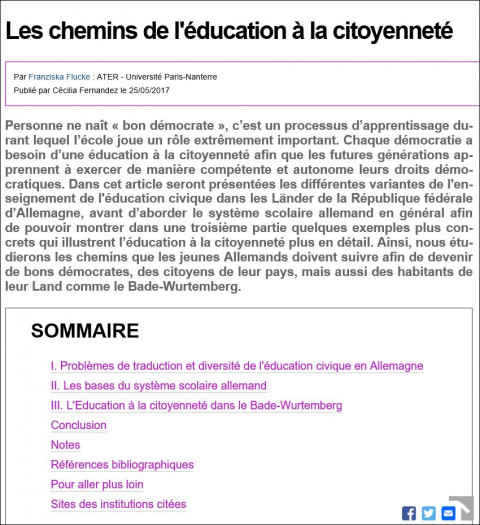 Les chemins de l'éducation à la citoyenneté Year of publication: 2017 Author: Franziska Flucke Corporate author: La Clé des Langues Personne ne naît « bon démocrate », c’est un processus d’apprentissage durant lequel l’école joue un rôle extrêmement important. Chaque démocratie a besoin d’une éducation à la citoyenneté afin que les futures générations apprennent à exercer de manière compétente et autonome leurs droits démocratiques. Dans cet article seront présentées les différentes variantes de l'enseignement de l'éducation civique dans les Länder de la République fédérale d’Allemagne, avant d’aborder le système scolaire allemand en général afin de pouvoir montrer dans une troisième partie quelques exemples plus concrets qui illustrent l’éducation à la citoyenneté plus en détail. Ainsi, nous étudierons les chemins que les jeunes Allemands doivent suivre afin de devenir de bons démocrates, des citoyens de leur pays, mais aussi des habitants de leur Land comme le Bade-Wurtemberg.