
Resources
Explore a wide range of valuable resources on GCED to deepen your understanding and enhance your research, advocacy, teaching, and learning.
1,322 Results found
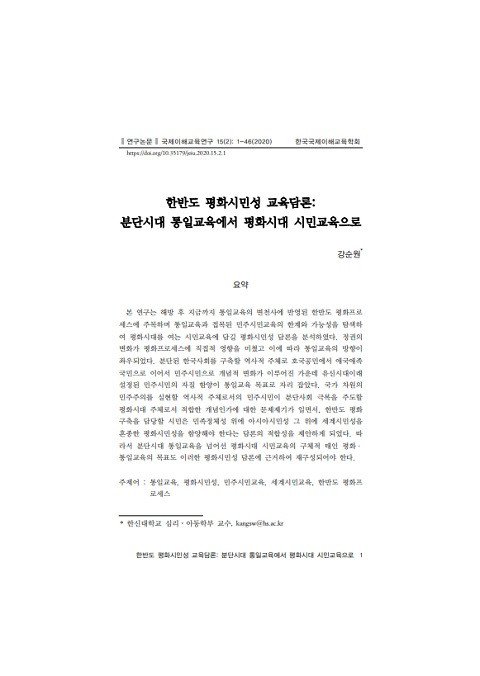 Discourse on Peace-Oriented Citizenship in the Korean Peninsula: Form Unification Education in the Divided Society Into the Citizenship Education in the Peaceful Coexistence Era (Journal of Education for International Understanding; Vol. 15, No. 2) Year of publication: 2020 Author: Soonwon Kang Corporate author: Korean Society of Education for International Understanding (KOSEIU) This paper puts emphasis on designing the peace-oriented citizenship education towards the peaceful coexistent era beyond unification education in the divided society, analyzing the limits and possibility of democratic citizenship education connected with unification education which has been reflected by the peace process of present governments since liberation from the colonial period in 1945. According to the changes of unification education connected the peace process of each government, the name of historical subjects to take the initiative to overcome the division has been changed from civics saving the country to patriotic nation and onto the democratic citizen. Since Yushin reformation period, raising the democratic citizenship has been set up as the goal of unification education. But some critics of democratic citizenship were given to the limitation of the democratic citizen on overcoming the division and realizing peaceful coexistence and to the birth of hybrid citizenship with national commonality, Asian citizenship and global citizenship to challenge Korean peninsula agenda. Thus peace·unification education beyond division should be reconceptualized on the ground of the discourse of peace-oriented citizenship, which is applied to North Korea and South Korea as a global peace education framework. 한반도 평화시민성 교육담론: 분단시대 통일교육에서 평화시대 시민교육으로 (국제이해교육연구; Vol. 15, No. 2) Year of publication: 2020 Author: 강순원 Corporate author: 한국국제이해교육학회 본 연구는 해방 후 지금까지 통일교육의 변천사에 반영된 한반도 평화프로세스에 주목하며 통일교육과 접목된 민주시민교육의 한계와 가능성을 탐색하여 평화시대를 여는 시민교육에 담길 평화시민성 담론을 분석하였다. 정권의 변화가 평화프로세스에 직접적 영향을 미쳤고 이에 따라 통일교육의 방향이 좌우되었다. 분단된 한국사회를 구축할 역사적 주체로 호국공민에서 애국애족 국민으로 이어서 민주시민으로 개념적 변화가 이루어진 가운데 유신시대이래 설정된 민주시민의 자질 함양이 통일교육 목표로 자리 잡았다. 국가 차원의 민주주의를 실현할 역사적 주체로서의 민주시민이 분단사회 극복을 주도할 평화시대 주체로서 적합한 개념인가에 대한 문제제기가 일면서, 한반도 평화구축을 담당할 시민은 민족정체성 위에 아시아시민성 그 위에 세계시민성을 혼종한 평화시민성을 함양해야 한다는 담론의 적합성을 제안하게 되었다. 따라서 분단시대 통일교육을 넘어선 평화시대 시민교육의 구체적 태인 평화·통일교육의 목표도 이러한 평화시민성 담론에 근거하여 재구성되어야 한다.
  Toolkit "Elections and Gender: International and National Practices of Supporting Women in Politics" Year of publication: 2021 Author: Denis A.S. Corporate author: UNDP Uzbekistan In the year of celebrating the 30th anniversary of state independence, cardinal transformations continue in Uzbekistan aimed at creating a New Uzbekistan, where human rights, freedom and legitimate interests are the highest value. In such an important process, special attention is paid to compliance of electoral legislation and practice with generally recognized international standards, full and broad ensuring of citizens' suffrage. Some key tasks are: achieving equal participation of women in the political sphere of Uzbekistan are raising awareness, providing public and civic education for women and men in order to improve their understanding of the importance of women's participation in political processes, and disseminating information on international and national commitments and agreements in the area of gender equality. Методическое пособие «Выборы и гендер: международные и национальные практики поддержки женщин в политике» Year of publication: 2021 Author: Denis A.S. Corporate author: UNDP Узбекистан В год празднования 30-летия государственной независимости, в Узбекистане продолжаются кардинальные преобразования, направленные на создание Нового Узбекистана, где высшей ценностью являются права человека, его свобода и законные интересы. В таком важном процессе особое внимание уделяется соответствию избирательного законодательства и практики общепризнанным международным стандартам, полному и широкому обеспечению избирательного права граждан. Cреди ключевых задач достижения равного участия женщин в политической сфере Узбекистана - повышение информированности, обеспечение общественно-гражданского образования для женщин и мужчин, с целью улучшения понимания ими важности участия женщин в политических процессах, распространение информации о международных и национальных обязательствах и соглашениях в области гендерного равенства.
 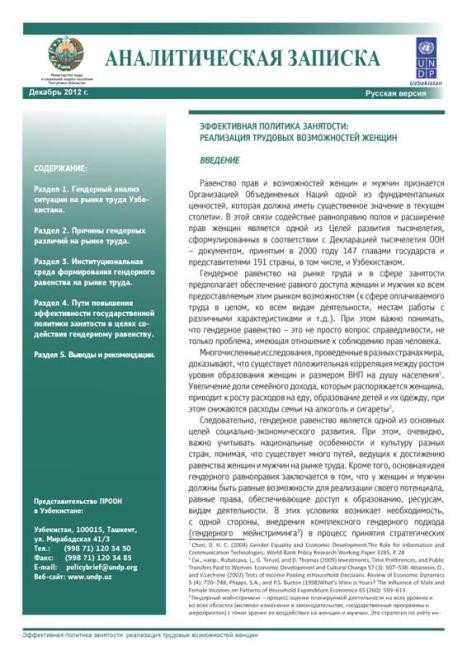 Effective Employment Policy: Realizing Women's Work Opportunities Year of publication: 2013 Author: Inna Maltseva | Alexandr Navotniy | Yana Chicherina | Gulnora Marufova | Jamoliddin Ismailov | Sherzod Kudbiev | Khaydar Tashmuradov Corporate author: UNDP Uzbekistan The analytical report aims to analyze the current situation of women and men in the field of employment, to identify the key causes of gender differences in the labor market of the country and to develop proposals for improving the effectiveness of employment policies to promote the employment opportunities of women. Эффективная политика занятости: реализация трудовых возможностей женщин Year of publication: 2013 Author: Инна Мальцева | Александр Навотный | Яна Чичерина | Гульнора Маруфова | Жамолиддин Исмаилов | Шерзод Кудбиев | Хайдар Ташмурадов Corporate author: UNDP Узбекистан Целью аналитического доклада является анализ существующего положения женщин и мужчин в сфере занятости, выявление ключевых причин гендерных различий на рынке труда страны и разработка предложений по повышению эффективности политики в сфере занятости в целях содействия реализации трудовых возможностей женщин.
 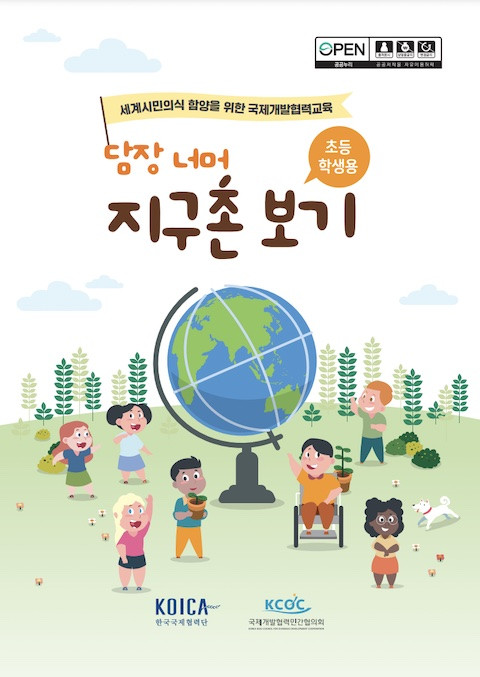 담장 너머 지구촌 보기: 세계시민의식 함양을 위한 국제개발협력교육; 초등학생용 Year of publication: 2021 Author: 이태주 | 김다원 | 김현주 Corporate author: 한국국제협력단 | 국제개발협력민간협의회 세계화, 문화다양성, 지속가능발전, 평화 등을 주제로 한 초등용 세계시민교육 교수학습자료이다.본 자료는 한국국제협력단과 국제개발협력민간협의회에서 2021년 작성하여 공공누리 제4유형으로 개방한 ‘담장 너머 지구촌 보기: 세계시민의식 함양을 위한 국제개발협력교육; 초등학생용’ 을 이용하였으며 국제개발협력민간협의회 홈페이지(http://www.ngokcoc.or.kr)에서 다운로드 하실 수 있습니다.
 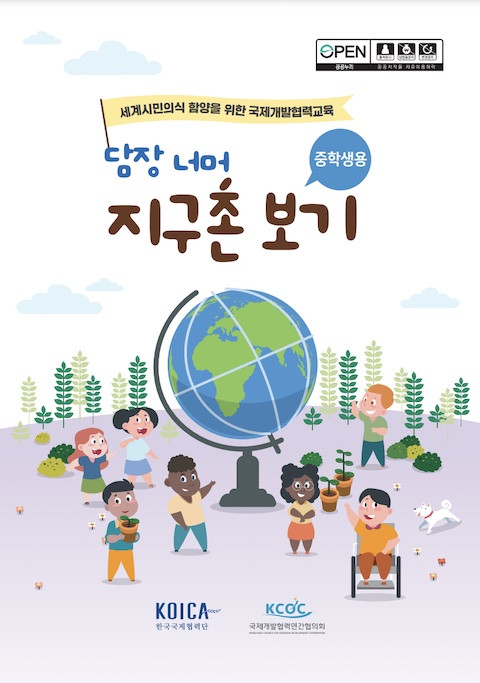 담장 너머 지구촌 보기: 세계시민의식 함양을 위한 국제개발협력교육; 중학생용 Year of publication: 2021 Author: 이태주 | 김다원 | 김현주 Corporate author: 한국국제협력단 | 국제개발협력민간협의회 세계화, 문화다양성, 지속가능발전, 평화 등을 주제로 한 중학생용 세계시민교육 교수학습자료로 다양한 모둠별 학습활동지를 담고 있다.본 자료는 한국국제협력단과 국제개발협력민간협의회에서 2021년 작성하여 공공누리 제4유형으로 개방한 ‘담장 너머 지구촌 보기: 세계시민의식 함양을 위한 국제개발협력교육; 중학생용’ 을 이용하였으며 국제개발협력민간협의회 홈페이지(http://www.ngokcoc.or.kr)에서 다운로드 하실 수 있습니다.
  교과서 너머의 이야기: 코로나 시대가 교과서에 남길 새로운 흔적 Year of publication: 2020 Corporate author: 한국교육방송공사 | 서울특별시교육청 본 자료는 코로나19이후 대안교육으로서 중요성이 부각되고 있는 세계시민성 함양 교육을 위해 학교 및 기관에서 적극 활용할 수 있도록 서울시교육청과 EBS가 공동으로 제작하고 방영한 지식채널e 세계시민교육 영상이다.
 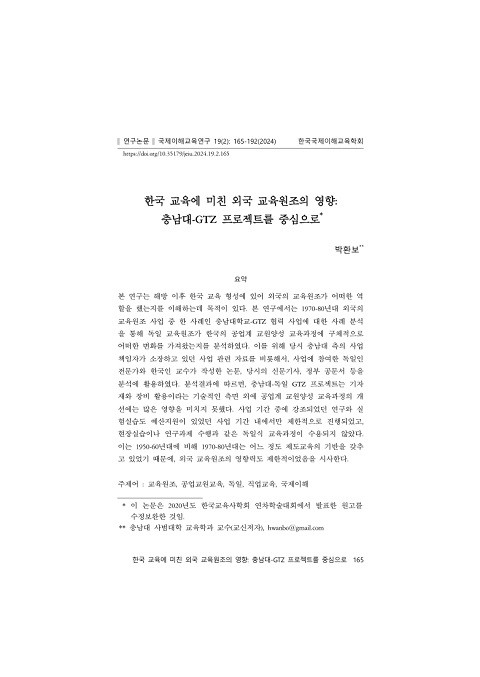 한국 교육에 미친 외국 교육원조의 영향: 충남대-GTZ 프로젝트를 중심으로 (국제이해교육연구; Vol. 19, No. 2) Year of publication: 2024 Author: 박환보 Corporate author: 한국국제이해교육학회 본 연구는 해방 이후 한국 교육 형성에 있어 외국의 교육원조가 어떠한 역할을 했는지를 이해하는데 목적이 있다. 본 연구에서는 1970-80년대 외국의 교육원조 사업 중 한 사례인 충남대학교-GTZ 협력 사업에 대한 사례 분석을 통해 독일 교육원조가 한국의 공업계 교원양성 교육과정에 구체적으로 어떠한 변화를 가져왔는지를 분석하였다. 이를 위해 당시 충남대 측의 사업책임자가 소장하고 있던 사업 관련 자료를 비롯해서, 사업에 참여한 독일인 전문가와 한국인 교수가 작성한 논문, 당시의 신문기사, 정부 공문서 등을 분석에 활용하였다. 분석결과에 따르면, 충남대-독일 GTZ 프로젝트는 기자재와 장비 활용이라는 기술적인 측면 외에 공업계 교원양성 교육과정의 개선에는 많 영향을 미치지 못했다. 사업 기간 중에 강조되었던 연구와 실험실습도 예산지원이 있었던 사업 기간 내에서만 제한적으로 진행되었고, 현장실습이나 연구과제 수행과 같은 독일식 교육과정이 수용되지 않았다. 이는 1950-60년대에 비해 1970-80년대는 어느 정도 제도교육의 기반을 갖추고 있었기 때문에, 외국 교육원조의 영향력도 제한적이었음을 시사한다.