
Resources
Explore a wide range of valuable resources on GCED to deepen your understanding and enhance your research, advocacy, teaching, and learning.
132 Results found
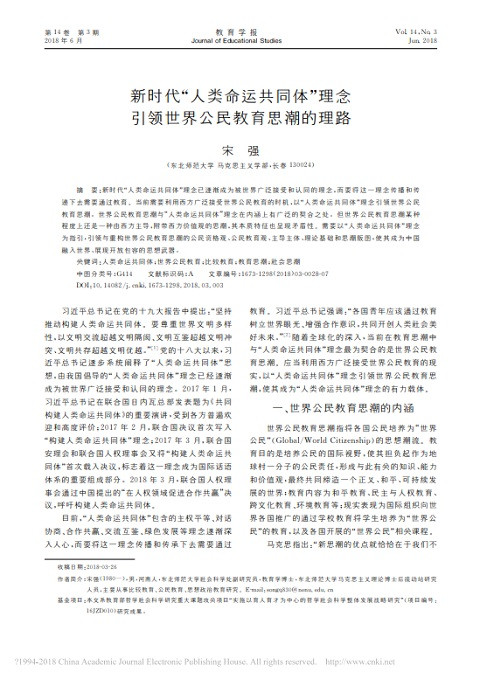 新时代‘人类命运共同体’ 理念引领世界公民教育思潮的理路 (教育学报; Vol. 14, No. 3) Year of publication: 2018 Author: Song Qiang Corporate author: Beijing Normal University 新时代“人类命运共同体”理念已逐渐成为被世界广泛接受和认同的理念,而要将这一理念传播和传 递下去需要通过教育。当前需要利用西方广泛接受世界公民教育的时机,以“人类命运共同体”理念引领世界公民 教育思潮。世界公民教育思潮与“人类命运共同体”理念在内涵上有广泛的契合之处。但世界公民教育思潮某种 程度上还是一种由西方主导,附带西方价值观的思潮,其本质特征也呈现矛盾性。需 要 以“人类命运共同体”理 念 为指引,引领与重构世界公民教育思潮的公民资格观、公民教育观、主导主体、理论基础和思潮版图,使其成为中国 融入世界、展现开放包容的思想武器。
 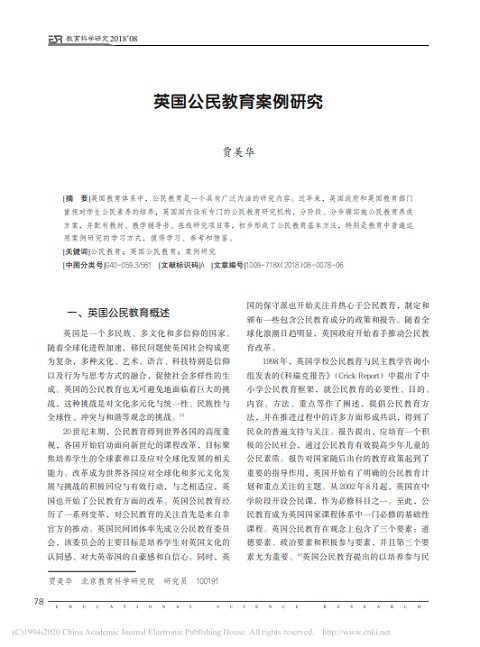 Case Study of British Citizenship Education (Educational Science Research; No. 8) Year of publication: 2018 Author: Jia Meihua Corporate author: Beijing Academy of Educational Sciences | Beijing Radio and Television University In the British education system, citizenship education is a research content with extensive connotation. In recent years, the British government and the UK education sector attention to cultivate students’ literacy of citizens, the UK has special citizen education research institutions, in stages, step-by-step implementation of civic education to develop solutions, and is equipped with teaching materials, teaching coach book, online research projects, basic method, initially formed the citizen education especially education in common use case study approach to learning, which is worthy of study and reference.
 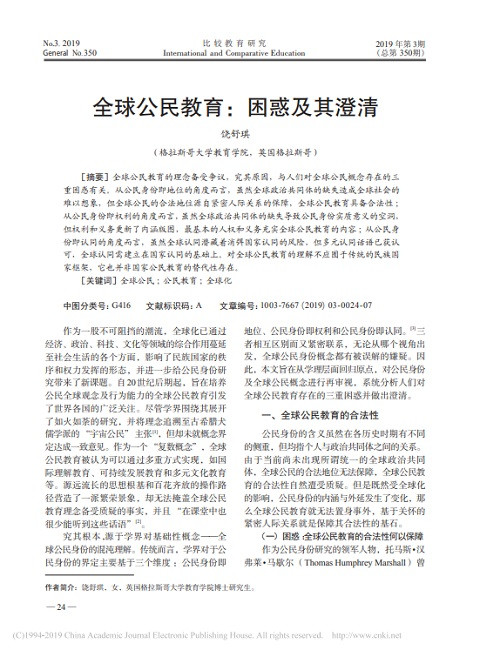 Global Citizenship Education: Confusion and Clarification (International and Comparative Education; No. 3) Year of publication: 2019 Author: Rao Shuqi Corporate author: Beijing Normal University As a debatable and controversial area, global citizenship education has not been elevated to the center of practical agenda due to three confusion surround the term. From the aspect of regarding citizenship as status, the absence of global political community makes global society unimaginable. However, as the legal status of global citizen originates from the confirmation of intimate interpersonal relationship, global citizenship education enjoys legitimacy. From the aspect of conceiving citizenship as rights, the absence of global political community leads to global citizenship vacuous in essence. However, as the landscape of rights and responsibilities has been transformed, the contents of global citizenship education are enriched by pervasive human rights and responsibilities. From the aspect of considering citizenship as identity, global identity runs a risk of diminishing the need for national identity. However, given the consensus concerning the discourse of multidimensional identity, global identity should be developed on the basis of national identity. The perception of global citizenship education should not be confined within the traditional nation-state framework. Global citizenship education is not an alternative to national citizenship education.
 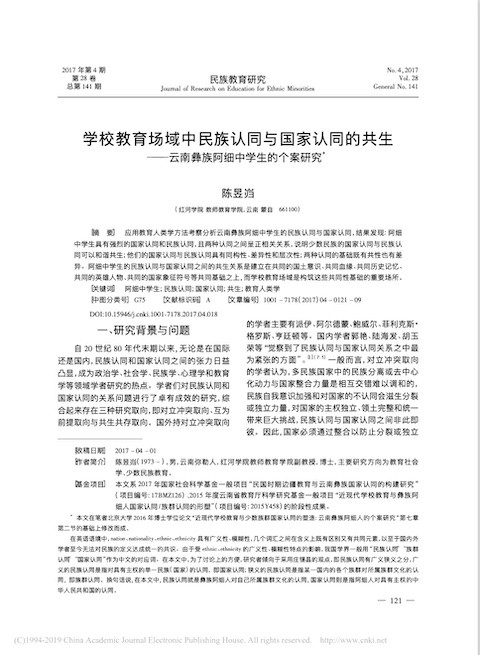 The Symbiosis Relationship Between Ethnic Identity and National Identity in School Education Field: A Case Study Of Axi Yi High School Students in Yunnan (Journal of Research on Education for Ethnic Minorities; Vol. 28, No. 141) Year of publication: 2017 Author: Chen Yukui Corporate author: Minzu University of China This paper uses educational anthropolog to examine and analyse ethnic identity and national identity of ethnic Axi Yi high school students. It finds that they have both very strong ethnic and national identities, and there is a moderate positive correlation between the two identities. This shows that the two identities can coexist harmoniously for ethnic minorities. This paper also finds that the symbiosis relationship between students’ ethnic identity and national identity is built on common foundations, such as common territorial awareness, common consanguinity,common historical memory,common heroic characters and common national symbols. This paper argues that schools are the important place where those common foundations are built. 学校教育场域中民族认同与国家认同的共生:云南彝族阿细中学生的个案研究 (民族教育研究; 第28卷, 总第 141 期) Year of publication: 2017 Author: Chen Yukui Corporate author: Minzu University of China 应用教育人类学方法考察分析云南彝族阿细中学生的民族认同与国家认同,结果发现: 阿细 中学生具有强烈的国家认同和民族认同,且两种认同之间呈正相关关系,说明少数民族的国家认同与民族认 同可以和谐共生; 他们的国家认同与民族认同具有同构性、差异性和层次性; 两种认同的基础既有共性也有差 异。阿细中学生的民族认同与国家认同之间的共生关系是建立在共同的国土意识、共同血缘、共同历史记忆、 共同的英雄人物、共同的国家象征符号等共同基础之上,而学校教育场域是构筑这些共同性基础的重要场所。
 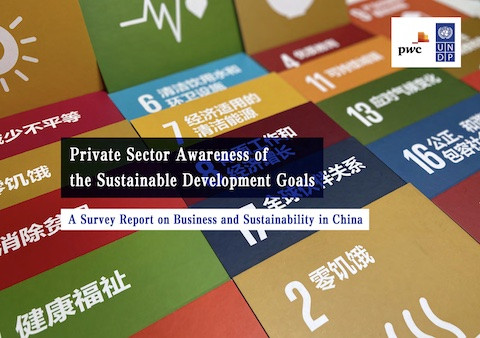 中国企业可持续发展目标实践调研报告 Year of publication: 2020 Corporate author: UNDP China 本报告针对企业可持续发展目标(SDGs)认知情况进行了基线调研。这是此类报告在华首次发布,旨在让企业领导者了解中国企业参与SDG的方式、重点领域、未来趋势;以及当企业面对2019冠状病毒病引发的“新常态”,如何更好的抵御风险,从而走出全球性危机所带来的强烈冲击。这份开创性的《中国企业可持续发展目标实践调研报告——中国企业与可持续发展基线调研》由联合国开发计划署与普华永道(中国)及中国国际商会共同完成。该报告采用在线问卷调研和案例访谈的方式,对近百家不同行业的在华企业(包括在华运营的外资公司)目前对可持续发展的认知程度与实践情况进行了综合分析。报告为企业如何进一步参与SDG提出了行之有效的建议,同时也指出了前进路上亟待应对的挑战。 Private Sector Awareness of the Sustainable Development Goals: A Survey Report On Business and Sustainability in China Year of publication: 2020 Corporate author: UNDP China This report serves as a baseline analysis of business awareness of the Sustainable Development Goals (SDGs). As a first of its kind in China, the report aims to provide business leaders a glimpse of how companies are engaging with the SDGs in China, which areas matter the most, the future trends and how – beyond normal business practices – companies can help societies to recover from shocks and crises, such as COVID-19.As a joint effort with PwC China and the China Chamber of International Commerce (CCOIC), the Report, entitled “Private Sector Awareness of the SDGs” utilized online questionnaires for self-reporting and in-depth interviews for case studies, drawing a comprehensive analysis on the current understanding and activities of sustainable development in selected enterprises including foreign-owned companies operating in China across different industries. Its findings provide insight on how best to gear businesses towards the SDGs and the challenges that must be overcome to do so.
 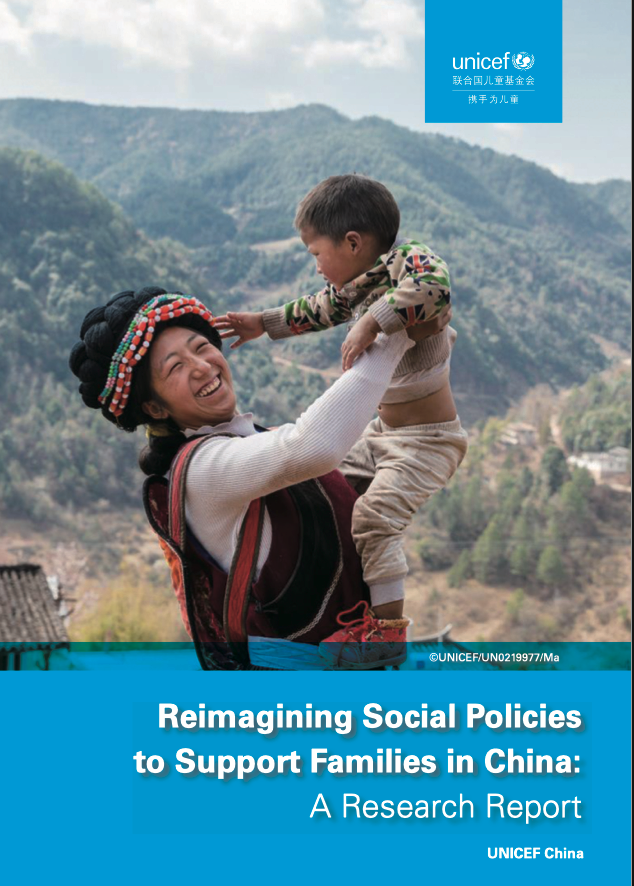 Reimagining Social Policies to Support Families in China: A Research Report Year of publication: 2023 Corporate author: 联合国儿童基金会驻华办事处 There have been significant changes in the population and society in China over recent decades. The birth rate has declined, and the population has aged. The average family size shrank from 3.1 people in 2010 to 2.8 in 2022[i], and the one-child policy has been reversed. Urbanization, rural-urban migration and the growth of the informal sector have changed how people live and work. Gender inequality persists, with women frequently facing discrimination and barriers to employment. All these changes have implications for family policy – statutory policies and government-led programmes that aim to improve conditions for adult family members, particularly those caring for children up to the age of 18.A new report, ‘Reimaging Social Policies to Support Families in China’ by UNICEF synthesizes the context and challenges of family policies in China and reviews over 180 evaluations of family policies worldwide. The report highlights case studies of policies that could be adapted and incorporated into family policy in China, and it identifies implications for designing and implementing innovative policy. 探讨适合中国的家庭友好社会政策: 研究报告 Year of publication: 2023 Corporate author: 联合国儿童基金会驻华办事处 近几十年来,中国的人口规模和结构以及社会发生了重大变化:出生率下降,人口老龄化;平均家庭户规模由2010年的一户3.1人降至2022年的一户2.8人[i];独生子女政策于2015年被取消,“三孩政策”从2021年开始实施;城镇化、农村人口向城镇地区迁移和灵活就业人员的增加改变了人们的生活和工作方式;与此同时,性别不平等现象依然存在,女性经常面临就业歧视和阻碍。上述一系列变化都影响着家庭政策——旨在支持父母等家庭成员养育儿童(18岁以下)、改善养育条件的相关法定政策及政府主导的项目。 联合国儿童基金会发布的新报告——《探讨适合中国的家庭友好社会政策》总结了中国家庭政策的背景概况和面临的挑战,并梳理了全球180多篇评估家庭政策有效性的研究。该报告重点介绍了可供中国参考借鉴的政策案例,并提出设计和实施创新政策的建议。
 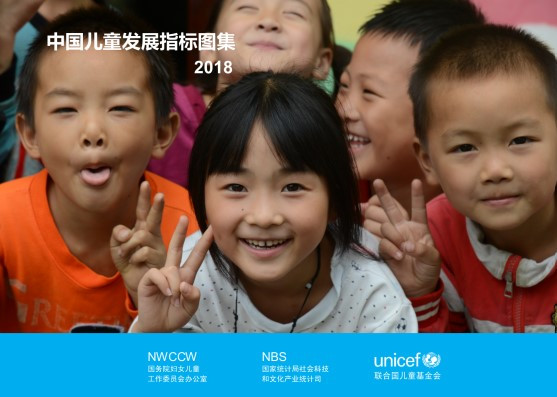 An Atlas of Social Indicators of Children in China 2018 Year of publication: 2018 Corporate author: United Nations Children's Fund (UNICEF) | National Working Committee on Children and Women (NWCCW) | National Bureau of Statistics (NBS). Department of Social, Science, Technology and Cultural Statistics By bringing together the latest authoritative, official data on the main indicators of child survival, development and protection and presenting them in a visual manner, the Atlas has faithfully reflected the achievements, as well as issues and challenges in realizing children’s rights in China.