
Resources
Explore a wide range of valuable resources on GCED to deepen your understanding and enhance your research, advocacy, teaching, and learning.
1,471 Results found
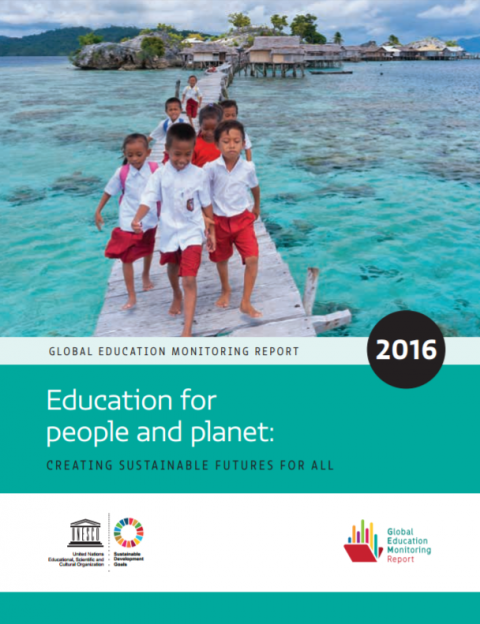 L'Education pour les peuples et la planète: créer des avenirs durables pour tous; Rapport mondial de suivi sur l'éducation, 2016 Year of publication: 2016 Corporate author: Organisation des Nations Unies pour l'éducation, la science et la culture (UNESCO) | Global Education Monitoring Report Team The GEM Report provides an authoritative account of how education is the most vital input for every dimension of sustainable development. Better education leads to greater prosperity, improved agriculture, better health outcomes, less violence, more gender equality, higher social capital and an improved natural environment. Education is key to helping people around the world understand why sustainable development is such a vital concept for our common future. Education gives us the key tools – economic, social, technological, even ethical – to take on the SDGs and to achieve them. These facts are spelled out in exquisite and unusual detail throughout the report. Yet the report also emphasizes the remarkable gaps between where the world stands today on education and where it has promised to arrive as of 2030. Informe de Seguimiento de la Educación en el Mundo, 2016: La Educación al servicio de los pueblos y el planeta: creación de futuros sostenibles para todos Year of publication: 2016 Corporate author: UNESCO | Global Education Monitoring Report Team Education for People and Planet: Creating Sustainable Futures for All explores the complex relationship between education and the new 2030 Agenda for Sustainable Development, covering six fundamental pillars – Planet, Prosperity, People, Peace, Place and Partnerships. This report shows that education will not deliver its full potential unless participation rates increase dramatically and sustainable development guides education system reform. It also warns of the destructive impact that climate change, conflict, unsustainable consumption and the increasing gap between rich and poor have on education. A huge transformation is needed if we are to create sustainable futures for all.
  Образование в области прав человека в школьной системе Европы, Центральной Азии и Северной Америки: сборник примеров успешных практик Year of publication: 2009 Corporate author: Council of Europe | UNESCO | UN. Office of the United Nations High Commissioner for Human Rights (UN. OHCHR) | OSCE. Office for Democratic Institutions and Human Rights (ODIHR) Сборник примеров успешных практик «Образование в области прав человека в школьной системе Европы, Центральной Азии и Северной Америки» включает 101 пример успешных практик в сфере образования в области прав человека в начальной, средней школе и в педагогических учебных заведениях в регионе ОБСЕ, на который также распространяются полномочия ЮНЕСКО, УВКПЧ ООН и, частично, географический мандат СЕ.Настоящее издание состоит из пяти основных разделов:Раздел I. Законодательные акты, руководящие принципы и стандарты; Раздел II. Подходы и практики улучшения учебной атмосферы; Раздел III. Учебные пособия для преподавателей и учащихся; Раздел IV. Повышение квалификации преподавателей; Раздел V. Методы оценки.Образование в области прав человека определяют как образование, обучение и информирование, направленное на формирование всеобщей культуры прав человека. Комплексное образование в области прав человека дает не только знания о правах человека и действующих механизмах их защиты, но и навыки, необходимые для продвижения, защиты и реализации прав человека в повседневной жизни. Воспитание демократической гражданственности нацелено на осуществление образовательных практик и мероприятий, призванных помочь молодым людям и взрослым принимать активное участие в жизни общества, основанного на принципах демократии, а также осуществлять свои права и обязанности в обществе. Воспитание в духе взаимного уважения и понимания подчеркивает важность самоуважения, уважения других людей и улучшения отношений между людьми, представляющими различные культурные традиции.Настоящая книга задумана как средство поддержки качества обучения в этих областях, как стимул для лиц, ответственных за формирование политики в области образования (сотрудников министерств образования и местных школьных советов), директоров, учителей, преподавателей педагогических учебных заведений, преподавателей, специалистов неформальной сферы образования и всех других заинтересованных лиц, а также как инструмент, содействующий формированию сетей и обмену опытом между специалистами в сфере образования.
 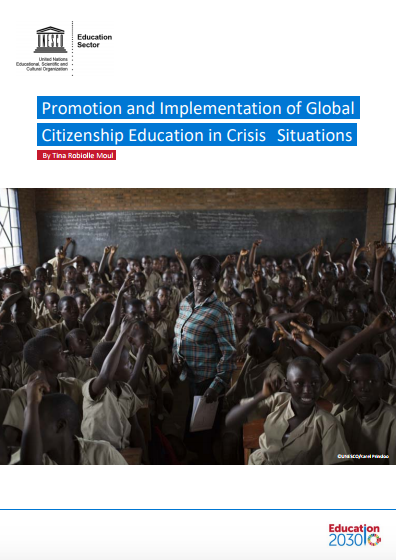 Promotion and implementation of global citizenship education in crisis situations Year of publication: 2017 Author: Robiolle Moul, Tina Corporate author: 유네스코 Crisis situations affect the realization of human rights of many people and communities across all regions of the world. Within UNESCO’s relevant areas of work, GCED is a powerful approach to education that can empower people to recover from crises and transform their communities into peaceful and sustainable societies. UNESCO commissioned a desk study that aimed at reviewing existing research on the promotion and implementation of GCED and related programs in countries affected by crisis situations, with particular attention to initiatives benefiting the refugee population. This study unveils the key challenges these programs encounter in such contexts, as well as promising practices that can guide the design and implementation of future GCED in crisis situations. This report is a synthesis of this desk study and supports the evidence that, after analyzing the context and the available means, GCED and related programs can and should be systematically adapted and implemented in crisis situations, including in response to refugee crises. L'éducation aux droits de l'homme dans les systèmes scolaires d'Europe, d'Asie centrale et en Amérique du Nord: un recueil de bonnes pratiques Year of publication: 2009 Corporate author: Conseil de l'Europe | Organisation des Nations Unies pour l'éducation, la science et la culture (UNESCO) | UN. Office of the United Nations High Commissioner for Human Rights (UN. OHCHR) | OSCE. Office for Democratic Institutions and Human Rights (ODIHR) “L'Éducation aux Droits de l'Homme dans les systèmes scolaires de l'Europe, l'Asie centrale et en Amérique du Nord: Un Recueil de Bonnes Pratiques" est une compilation de 101 exemples de bonnes pratiques dans l'éducation aux droits de l'homme dans les écoles primaires, les écoles secondaires et les établissements de formation des enseignants de l'Organisation pour Sécurité et la Coopération dans la zone Europe (OSCE), qui est également couvert par l'Organisation des Nations Unies pour l'éducation, la science et la culture (UNESCO), le Bureau du Haut Commissariat des Nations Unies aux Droits de l'Homme (HCDH) et, en partie, la situation géographique mandat du Conseil de l'Europe (CoE). Le terme «éducation aux droits de l'homme» est souvent utilisé dans cette ressource dans un sens plus large, pour inclure également l'éducation à la citoyenneté démocratique et l'éducation pour le respect et la compréhension mutuelle, qui sont toutes basées sur les normes des droits humains internationalement convenus. Ces trois domaines sont considérés comme interconnectés et essentiel dans les systèmes éducatifs afin de préparer les jeunes à être des participants actifs, responsables et dans leur communautés, ainsi qu'aux niveaux national et mondial. L'éducation aux droits de l'homme a été défini comme l'éducation, la formation et de l'information visant à la construction d'une culture universelle des droits de l'homme. Une formation approfondie dans les droits de l'homme fournit non seulement des connaissances sur les droits humains et les mécanismes qui les protègent, mais confère également les compétences nécessaires pour promouvoir, défendre et appliquer les droits de l'homme dans la vie quotidienne. L'éducation à la citoyenneté démocratique met l'aCECnt sur les pratiques et les activités visant à aider les jeunes et les adultes à jouer un rôle actif dans la vie démocratique et à exercer leurs droits et responsabilités dans la société de l'éducation. L'éducation pour le respect et la compréhension mutuelle met en évidence le respect de soi, respect des autres, et l'amélioration des relations entre les gens de différentes traditions culturelles. Ce livre vise à soutenir l'enseignement de qualité dans ces domaines et d'inspirer les décideurs éducatifs (ceux qui travaillent dans les ministères de l'éducation et les conseils scolaires locaux) et les administrateurs, les enseignants, les formateurs d'enseignants, les éducateurs non formels et tous les autres acteurs intéressés, ainsi que pour faciliter la mise en réseau et l'échange d'expériences entre les professionnels de l'éducation.
  Education 2030: Incheon Declaration and Framework for Action for the Implementation of Sustainable Development Goal 4: Ensure Inclusive and Equitable Quality Education and Promote Lifelong Learning Opportunities for All Year of publication: 2016 Corporate author: UNESCO The Incheon Declaration articulates the collective vision and commitment of the international community on global education. The 2030 Framework for Action provides guidance for the implementation of Sustainable Development Goal 4. Education 2030: Déclaration d'Incheon et Cadre d'action pour la mise en oeuvre de l'Objectif de développement durable 4: Assurer à tous une éducation équitable, inclusive et de qualité et des possibilités d'apprentissage tout au long de la vie Year of publication: 2016 Corporate author: Organisation des Nations Unies pour l'éducation, la science et la culture (UNESCO) La Déclaration d’Incheon présente la vision collective et l’engagement de la communauté internationale envers l’éducation mondiale. Le Cadre d’action 2030 fournit des directives pour l’attente de l’Objectif de développement durable 4. Educación 2030: Declaración de Incheon y Marco de Acción para la realización del Objetivo de Desarrollo Sostenible 4: Garantizar une aducación inclusiva y equitativa de calidad y promover oportunidades de aprendizaje permanente para todos Year of publication: 2016 Corporate author: UNESCO The Incheon Declaration articulates the collective vision and commitment of the international community on global education. The 2030 Framework for Action provides guidance for the implementation of Sustainable Development Goal 4. 2030年教育:仁川宣言和行动框架实现可持续发展目标4——确保包容和公平的优质教育,让全民终身享有学习机会 Year of publication: 2016 Corporate author: UNESCO 《仁川宣言》阐明了国际社会在全球教育方面的集体愿景和承诺。“2030年行动框架”为可持续发展目标4的实施提供了指导。 Education for People and Planet: Creating Sustainable Futures for All, Global Education Monitoring Report, 2016 Year of publication: 2016 Corporate author: UNESCO | Global Education Monitoring Report Team Education for People and Planet: Creating Sustainable Futures for All explores the complex relationship between education and the new 2030 Agenda for Sustainable Development, covering six fundamental pillars – Planet, Prosperity, People, Peace, Place and Partnerships. This report shows that education will not deliver its full potential unless participation rates increase dramatically and sustainable development guides education system reform. It also warns of the destructive impact that climate change, conflict, unsustainable consumption and the increasing gap between rich and poor have on education. A huge transformation is needed if we are to create sustainable futures for all.