
Resources
Explore a wide range of valuable resources on GCED to deepen your understanding and enhance your research, advocacy, teaching, and learning.
882 Results found
 State Program on Countering Religious Extremism and Terrorism in the Republic of Kazakhstan for 2018 - 2022 Year of publication: 2018 Corporate author: Government of the Republic of Kazakhstan The document contains the main provisions of the State program on countering religious extremism and terrorism in the Republic of Kazakhstan for 2018 - 2022.The geopolitical changes taking place in the world initiate a new spectrum of challenges and risks in the field of national security, which is becoming more diverse and emanating from a greater number of sources of danger. This determines the complexity and relevance of the tasks within the framework of a systematic prevention of threats of religious extremism and terrorism.Under these conditions, the current national system of combating religious extremism and terrorism needs to be further improved in the context of creating a mechanism for reliable protection of individuals, society and the state from extremist manifestations of a violent nature and threats of terrorism. Государственная программа по противодействию религиозному экстремизму и терроризму в Республике Казахстан на 2018 – 2022 годы Year of publication: 2018 Corporate author: Government of the Republic of Kazakhstan Документ содержит основные положения Государственной программы по противодействию религиозному экстремизму и терроризму в Республике Казахстан на 2018 – 2022 годы.Происходящие в мире геополитические изменения инициируют новый спектр вызовов и рисков в сфере национальной безопасности, который становится все более разнообразным и исходящим от большего числа источников опасности. Этим обусловлены сложность и актуальность задач в рамках системного предупреждения угроз религиозного экстремизма и терроризма.В этих условиях действующая общегосударственная система противодействия религиозному экстремизму и терроризму нуждается в дальнейшем совершенствовании в контексте создания механизма надежной защиты личности, общества и государства от экстремистских проявлений насильственного характера и угроз терроризма.
  Domestic Violence Year of publication: 2013 Author: Sabha Ghora Corporate author: Naif Arab University for Security Sciences (NAUSS) This article deals with domestic violence and its forms and goes on to discuss hitting children as one of the types of domestic violence. And how hitting children leads to intertwining problems in a child's life. العنف الأسري Year of publication: 2013 Author: Sabha Ghora Corporate author: Naif Arab University for Security Sciences (NAUSS) يتطرق المقال للعنف الأسري وأشكاله. ويستطرد في نقاش ضرب الاطفال كأحد أنواع العنف الأسري. وكيف يقود ضرب الأطفال لمشاكل متداخلة في حياة الطفل.
  Exposition «La Voix des Yézidis: les survivants parlent» Year of publication: 2022 Corporate author: Yahad - in Unum Comment Daech a perpétué un véritable génocide à l'encontre d’une minorité ethnique et religieuse d’Irak peu connue, les Yézidis? Cette exposition audiovisuelle interactive nous propose de remonter le fil de ce processus tragique à partir de janvier 2014. Les portraits et témoignages des jeunes victimes Yézidis sont à notre disposition afin de mieux comprendre leur histoire. How did Daech perpetuate a real genocide against Iraq's little-known ethnic and religious minority, the Yezidis? This interactive audiovisual exhibition traces this tragic process from January 2014 onwards. Portrayals and testimonies of young Yezidi victims are available to help us better understand their story.
  Violence in Schools: Thematic Report Year of publication: 2023 Corporate author: Higher Council for Education, Training, and Scientific Research (CSEFRS) | United Nations Children's Fund (UNICEF) This report presents the results of an assessment of violence in school settings conducted by the Higher Council for Education, Training and Scientific Research, through the National Evaluation Authority, in partnership with UNICEF. This report highlights the importance of a safe, violence-free school environment to ensure quality education.The main objective of this evaluation is to provide a detailed diagnosis of the situation of violence in the school environment in Morocco. Accordingly, the study focuses on measuring the extent of the spread of this phenomenon and identifying its various forms and manifestations in the school environment, as well as the actors involved in it. It does not only target the perpetrators of violence, but also its victims, including students and educational staff. La violence en Milieu scolaire: Rapport Thématique Year of publication: 2023 Corporate author: Higher Council for Education, Training, and Scientific Research (CSEFRS) | United Nations Children's Fund (UNICEF) Ce rapport présente les résultats de l’évaluation de la violence en milieu scolaire réalisée par le Conseil Supérieur de l’Éducation, de la Formation et de la Recherche Scientifique à travers l’Instance Nationale d’Évaluation en partenariat avec l’UNICEF. Il met en évidence l’importance d’un environnement scolaire sûr et sans violence pour garantir une éducation de qualité. L’objectif principal de cette évaluation est d’apporter un diagnostic détaillé sur la situation de la violence en milieu scolaire au Maroc. Elle vise ainsi à en mesurer la prévalence et à identifier les différentes formes et manifestations de celle-ci, ainsi que les acteurs impliqués, en ciblant, non seulement les auteurs de violence, mais également les victimes parmi les élèves et le personnel éducatif. Cette évaluation repose sur les résultats d’une enquête quantitative réalisée à la fin du premier trimestre de l’année scolaire 2021-2022, auprès de 260 établissements représentatifs à l’échelle nationale, avec la participation de 13 884 élèves représentant les trois cycles de l’enseignement (primaire, secondaire collégial et qualifiant), ainsi qu’une enquête qualitative menée dans 27 établissements. العنف في الوسط المدرسي:تقرير موضوعاتي Year of publication: 2023 Corporate author: Higher Council for Education, Training, and Scientific Research (CSEFRS) | United Nations Children's Fund (UNICEF) يقدم هذا التقرير نتائج تقييم العنف في الوسط المدرسي الذي أجراه المجلس الأعلى للتربية والتكوين والبحث العلمي، من خلال الهيئة الوطنية للتقييم، بشراكة مع منظمة اليونيسيف. ويسلط هذا التقرير الضوء على أهمية وجود بيئة مدرسية آمنة وخالية من العنف لضمان تعليم ذي جودة.الهدف الرئيسي لهذا التقييم يكمن في تقديم تشخيص مفصل لوضع العنـف في الوسط المدرسي في المغرب. وعليـه، تركــز الدراســة عـلـى قيــاس مــدى انتشــار هــذه الظاهــرة وتحديــد أشــكالها وتجلياتها المختلفة في الوســط المدرسي، وكــذا الفاعلـيـن المعنين بهــا، وهــي لا تســتهدف مرتكبــي العنــف فقــط، بــل أيضــا ضحايــاه مــن تلامذة وأطر تربوية.
 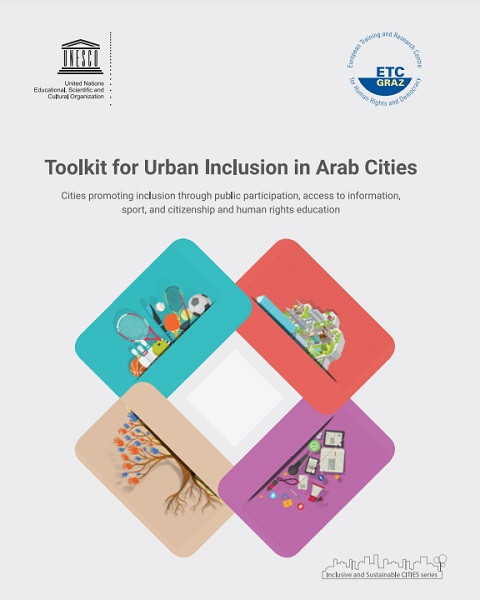 Toolkit for Urban Inclusion in Arab Cities: Cities Promoting Inclusion Through Public Participation, Access to Information, Sport, and Citizenship and Human Rights Education Year of publication: 2020 Author: Kareem Ibrahim | Deena Khalil | Marwa Barakat | Salwa Salman Corporate author: UNESCO | European Training and Research Centre for Human Rights and Democracy (Austria) | UNESCO Cairo Arab cities are witnessing an unprecedented expansion. Home to more than half of the region’s population, Arab cities have transformed into heterogeneous spaces that host diverse identities, cultures, and ethnicities. In order for this transformation to lead to prosperity, city officials must adopt a rights-based, human-centred approach, and implement inclusive policies and measures that provide equal opportunities for all.In this context, the Toolkit for Urban Inclusion in Arab Cities provides Arab city leaders and local government officials with practical tools and advice to guide their efforts towards establishing inclusive and sustainable cities. The Toolkit is based on the real experiences and practices of cities members of the Coalition of Arab Cities against Racism, Discrimination, Xenophobia and Intolerance in planning, implementing and evaluating programs and projects that promote urban inclusion and combat exclusion in all its forms.The Toolkit focuses on four topics of high priority to the Arab Coalition member cities: public participation, access to information, sport for youth inclusion, and citizenship and human rights education. Manuel des villes arabes pour l’inclusion urbaine: Promouvoir l’inclusion urbaine par la participation publique, l’accès à l’information, le sport, et l’éducation à la citoyenneté et aux droits de l’homme Year of publication: 2020 Author: Kareem Ibrahim | Deena Khalil | Marwa Barakat | Salwa Salman Corporate author: UNESCO | European Training and Research Centre for Human Rights and Democracy (Austria) | UNESCO Cairo Les villes arabes connaissent un développement urbain accéléré qui les a amenées à réunir plus de la moitié de la population régionale. Une combinaison de nombreux facteurs a transformé la majorité des villes arabes en lieux de brassage où abondent les identités, les cultures et les ethnies variées. Ces transformations peuvent contribuer à la réalisation de la prospérité sociale, à condition que les responsables des villes adoptent un programme législatif centré sur les droits de l’homme, et qu’ils mettent en œuvre des politiques et des dispositions susceptibles de réaliser l’inclusion de manière à assurer l’égalité des chances à tous leurs habitants. Dans ce contexte, le Manuel des villes arabes pour l’inclusion urbaine propose un ensemble d’outils et de conseils pratiques susceptibles de servir de guide aux édiles des villes arabes et aux responsables des gouvernements locaux dans leur quête pour la mise en place de villes inclusives et durables. Le Manuel prend pour base les acquis et expériences de la Coalition des villes arabes contre le racisme, la discrimination, la xénophobie et l’intolérance dans la planification, la réalisation et l’évaluation de programmes et de projets pour favoriser l’inclusion sociale et pour s’opposer à l’exclusion sous toutes ses formes. Le Manuel est centré sur quatre questions désignées par les villes membres parmi leurs priorités : La Participation publique, l’Accès à l’information, le Sport pour l’inclusion des jeunes, l’Éducation à la citoyenneté et aux droits de l’homme.