
Resources
Explore a wide range of valuable resources on GCED to deepen your understanding and enhance your research, advocacy, teaching, and learning.
1,726 Results found
 Embracing a Culture of Lifelong Learning: Contribution to the Futures of Education Initiative Year of publication: 2020 Corporate author: UNESCO Institute for Lifelong Learning (UIL) This report, a contribution to UNESCO's Futures of Education initiative, reflects on the potential contribution of lifelong learning both in transforming the field of education and in creating a more sustainable, healthy and inclusive future. Drawing on the insights of 12 distinguished experts from different disciplines and countries, the report presents a compelling vision for lifelong learning and the values and principles that must underpin it. It calls on the international community to acknowledge the social and private dimensions of education, and to recognize lifelong learning as a new human right. Realizing this vision, it argues, requires adopting a transdisciplinary approach that can effectively grasp the complex, multidimensional nature of the challenges faced by humanity. The report outlines the main features of the ‘enabling environment’ needed to make lifelong learning the governing principle of education policy and to offer people opportunities to learn throughout life, whatever their background or context. It concludes with a set of key messages, complemented by specific action points and a discussion of selected policy measures.
 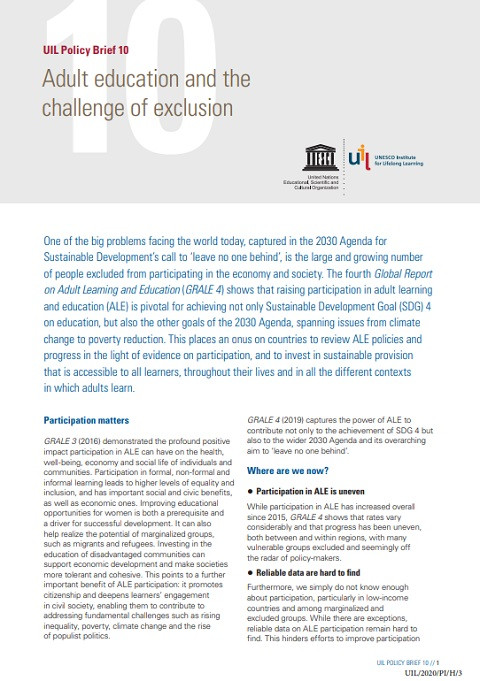 Adult Education and the Challenge of Exclusion: UIL Policy Brief 10 Year of publication: 2020 Corporate author: UNESCO Institute for Lifelong Learning (UIL) The fourth Global Report on Adult Learning and Education (G RALE 4) shows that raising participation in adult learning and education (ALE) is pivotal for achieving not only Sustainable Development Goal (SDG) 4 on education, but also the other goals of the 2030 Agenda, spanning issues from climate change to poverty reduction. This places an onus on countries to review ALE policies and progress in the light of evidence on participation, and to invest in sustainable provision that is accessible to all learners, throughout their lives and in all the different contexts in which adults learn. L’éducation des adultes face au défi de l’exclusion : Note d’orientation de l’UIL n° 10 Year of publication: 2020 Corporate author: UNESCO Institute for Lifelong Learning (UIL) Le quatrième Rapport mondial sur l’apprentissage et l’éducation des adultes (GRALE, Global Report on Adult Learning and Education) révèle qu’il est crucial d’accroître la participation à l’apprentissage et à l’éducation des adultes (AEA) pour atteindre non seulement l’objectif 4 des objectifs de développement durable (ODD) sur l’éducation, mais aussi les autres objectifs de ce Programme, qui vont du changement climatique à la réduction de la pauvreté. Cela impose aux pays d’évaluer leurs politiques en matière d’apprentissage et d’éducation des adultes, de progresser à la lumière des données factuelles sur la participation, ainsi que d’investir dans une offre durable accessible à tous les apprenants, tout au long de la vie et dans les différents contextes d’apprentissage. La educación de adultos y el desafío de la exclusion : Informe de políticas del UIL 10 Year of publication: 2020 Corporate author: UNESCO Institute for Lifelong Learning (UIL) El cuarto Informe Mundial sobre el Aprendizaje y la Educación de Adultos (GRALE 4) muestra que aumentar la participación en el aprendizaje y la educación de adultos (AEA) es fundamental para alcanzar no solo el Objetivo de Desarrollo Sostenible (ODS) 4 sobre educación, sino también los otros objetivos de la Agenda 2030, que abarcan temas que van desde el cambio climático hasta la reducción de la pobreza. Esto exige que los países revisen las políticas y los progresos del AEA de acuerdo con los datos sobre participación e inviertan en una oferta sostenible que sea accesible a todos los educandos, a lo largo de su vida y en todos los diferentes contextos en los que los adultos aprenden.
 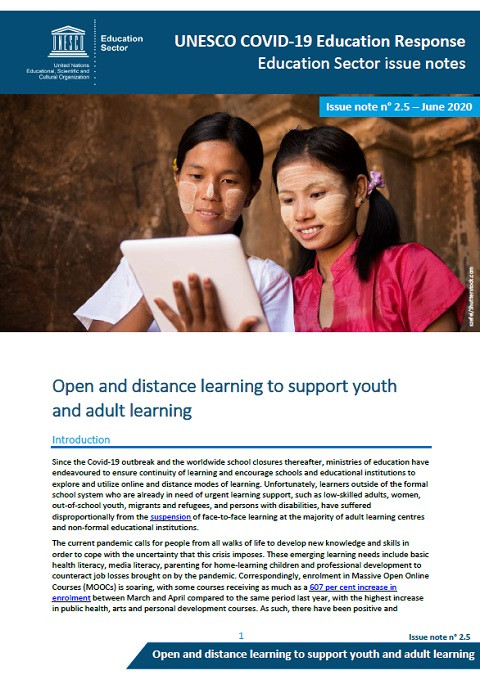 UNESCO COVID-19 Education Response: Open and Distance Learning to Support Youth and Adult Learning (Education Sector Issue Note; No. 2.5 – June 2020) Year of publication: 2020 Corporate author: UNESCO Institute for Lifelong Learning (UIL) A new UNESCO issue note, produced by the UNESCO Institute for Lifelong Learning (UIL), aims to support education policy-makers and planners in ensuring open and distance learning to support youth and adult learning in the context of the current pandemic, now and in its aftermath.Since the COVID-19 outbreak and the worldwide school closures that followed, ministries of education have endeavoured to ensure continuity of learning and encourage schools and educational institutions to explore and utilize online and distance modes of learning. Unfortunately, learners outside of the formal school system who are already in need of urgent learning support, such as low-skilled adults, women, out-of-school youth, migrants and refugees, and persons with disabilities, have suffered disproportionally from the suspension of face-to-face learning at the majority of adult learning centres and non-formal educational institutions.The current pandemic calls for people from people from all socio-economic backgrounds, wherever they live in the world, to develop new knowledge and skills in order to cope with the uncertainty that this crisis imposes. These learning needs include basic health literacy, media literacy, parenting for home-schooling children and professional development to counteract job losses brought on by the pandemic. Correspondingly, enrolment in massive open online courses (MOOCs) is soaring. As such, there have been positive and demand-driven trends in exploring alternative options, such as open and distance learning (ODL), to ensure the continuity and expansion of non-formal education and adult learning.This issue note takes stock of opportunities and challenges in using ODL, both online and offline as defined in the UNESCO Issue Note on Distance Learning Strategies, for youth and adult learners outside the formal education system. After examining key issues and illustrating promising cases from public and private sectors, it provides key messages for policy interventions to support inclusive lifelong learning for youth and adults during and after the current pandemic.UNESCO Education Sector’s issue notes cover key topics related to the COVID-19 education response.
  Annual Report 2018 : UNESCO INSTITUTE FOR LIFELONG LEARNING Year of publication: 2019 Corporate author: UNESCO Institute for Lifelong Learning (UIL) UIL’s 2018 Annual Report shows how, last year, our work contributed to fulfilling our mission to support better policy-making and strengthen the capacities of UNESCO Member States in the field of lifelong learning. UIL’s vision is for all children, youth and adults to benefit from quality lifelong learning, within the framework of sustainable development and peace, and we pursue it in the context of the United Nations 2030 Agenda for Sustainable Development, particularly Sustainable Development Goal (SDG) 4 on quality education and lifelong learning. Its publications are a valuable resource for education researchers, planners, policy-makers and practitioners.
  Implementation of the Sustainable Development Goal 4 in Korea Year of publication: 2019 Corporate author: Korean National Commission for UNESCO | Korean Educational Development Institute (KEDI) This report takes stock of progress made in Korea towards achieving SDGs and sheds light on major policy implications for its further implementation. The first chapter will touch on the background and objectives, the second on the monitoring of SDG4-Education 2030 at the global level, the third on the implementation structure of SDG4-Education 2030 in Korea, the fourth on the progress made toward meeting SDG4, and the fifth on the conclusion. 한국의 SDG4 이행 현황 연구 Year of publication: 2019 Corporate author: 한국교육개발원 | 유네스코한국위원회 SDG4 목표 달성을 위한 체계와 한국의 이행 현황 및 과제에 대한 연구 결과 보고서이다. 이 연구는 우리나라에서 추진된 지속가능발전목표의 이행 현황을 파악하는 한편, 그 주요성과 및 이슈를 분석하여 향후 지속가능발전목표의 이행을 위한 정책적 시사점을 도출하는 데 목적이 있다. 구체적으로 본 보고서에서는 다음과 같은 내용을 다룬다.첫째, 국내 SDG4-교육2030 이행 메커니즘을 소개한다. 둘째, SDG4 세부목표별 글로벌·주제별 통계 및 지표 작성 현황을 분석한다. 셋째, SDG4 세부 목표별 현안 진단과 국가지속발전목표 수립, 국내 이행을 위한 과제 등을 제시한다.
 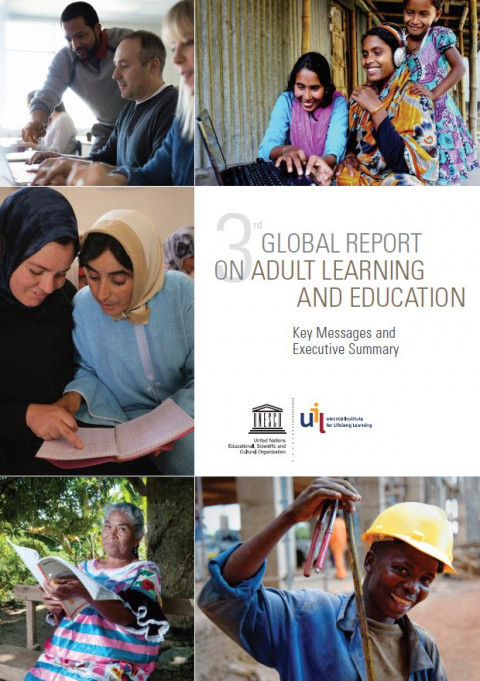 [Summary] 3rd Global Report on Adult Learning and Education: The Impact of Adult Learning and Education on Health and Well-being, Employment and the Labour Market, and Social, Civic and Community Life; Key Messages and Executive Summary Year of publication: 2016 Corporate author: UNESCO Institute for Lifelong Learning (UIL) The third Global Report on Adult Learning and Education (GRALE III) draws on monitoring surveys completed by 139 UNESCO Member States to develop a differentiated picture of the global state of adult learning and education (ALE). It evaluates countries’ progress in fulfilling the commitments they made in the Belém Framework for Action, which was adopted at the Sixth International Conference on Adult Education (CONFINTEA VI) in 2009.In addition, the report examines the impact of ALE on three major areas: health and well-being; employment and the labour market; and social, civic and community life. GRALE III provides policymakers, researchers and practitioners with compelling evidence for the wider benefits of ALE across all of these areas. In so doing, it highlights some of the major contributions that ALE can make to realizing the 2030 Agenda for Sustainable Development. This report is guided by three goals: first, to analyse the results of a monitoring survey of UNESCO Member States, and to take stock of whether countries are fulfilling the commitments they made at CONFINTEA VI; second, to strengthen the case for adult learning and education with evidence of its benefits on health and well-being,employment and the labour market, and social, civic and community life; and third, to provide a platform for debate and action at national, regional and global levels. [Résumé] 3e rapport mondial sur l'apprentissage et l'éducation des adultes: l'impact de l'apprentissage et l'éducation des adultes sur la santé et le bien-être, l'emploi et le marché du travail, et la vie sociale, civique et communautaire, points à retenir et résumé exécutif Year of publication: 2016 Corporate author: UNESCO Institute for Lifelong Learning (UIL) Le troisième Rapport mondial sur l’apprentissage et l’éducation des adultes (GRALE III) s’appuie sur les réponses de 139 Etats membres de l’UNESCO à l’enquête de suivi GRALE III et brosse un tableau nuancé de la situation de l’apprentissage et de l’éducation des adultes dans le monde. Le rapport évalue les progrès accomplis par les pays dans la mise en oeuvre des engagements qu’ils ont pris dans le Cadre d’action de Belém, document adopté lors de la sixième Conférence internationale sur l’éducation des adultes (CONFINTEA VI) en 2009.En outre, le rapport examine l’impact de l’apprentissage et de l’éducation des adultes sur trois domaines majeurs : la santé et le bien-être ; l’emploi et le marché du travail ; et la vie sociale, civique et communautaire. GRALE III fournit aux décideurs politiques, chercheurs et praticiens des preuves irréfutables des bénéfices élargis de l’apprentissage et l’éducation des adultes dans tous ces domaines et éclaire, de ce fait, les contributions essentielles qu’ils peuvent apporter à la réalisation du Programme de développement durable à l’horizon 2030.Ce rapport répond à trois objectifs : premièrement, analyser les résultats d’un suivi des États membres de l’UNESCO et établir si les pays remplissent les engagements pris à CONFINTEA VI ; deuxièmement, promouvoir l’apprentissage et l’éducation des adultes par des preuves de leurs effets positifs sur la santé et le bien-être, l’emploi et le marché du travail, ainsi que la vie sociale, civique et communautaire ; et troisièmement fournir une plate-forme de débat et d’action aux niveaux national, régional et international.