
Resources
Explore a wide range of valuable resources on GCED to deepen your understanding and enhance your research, advocacy, teaching, and learning.
3,790 Results found
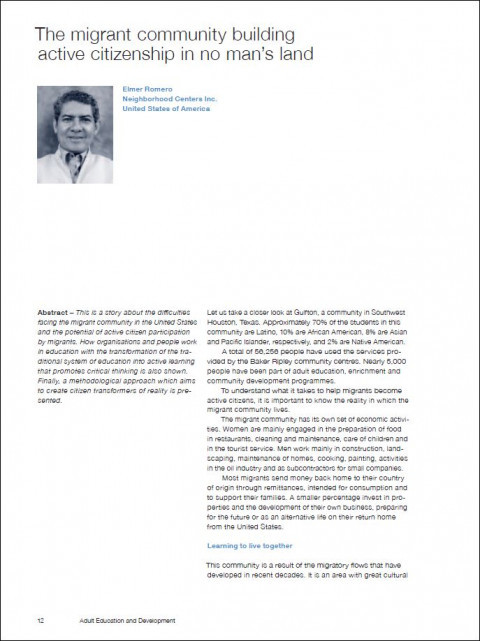 La comunidad migrante como constructora de la ciudadanía activa en tierra de nadie Year of publication: 2015 Author: Elmer Romero Corporate author: Éducation des Adultes et Développement Esta es una historia sobre las dificultades que afronta la comunidad migrante en Estados Unidos, y el potencial de participación ciudadana activa que poseen las y los migrantes. Asimismo, en esta nota se expone el papel de las entidades y personas que trabajan en el área educativa con respecto a la transformación del tradicional sistema de educación hacia un aprendizaje activo que propicie el pensamiento crítico. Por último, se da a conocer un abordaje metodológico que tiene como fin último formar a ciudadanos transformadores de la realidad. Une communauté de migrants promotrice de la citoyenneté active dans le no man’s land Year of publication: 2015 Author: Elmer Romero Corporate author: Éducation des Adultes et Développement Cet article décrit les diffi cultés auxquelles sont confrontés les migrants aux États- Unis, et le potentiel que recèle la participation citoyenne active de cette communauté. Il montre également le travail réalisé par les organisations et les personnes impliquées dans le domaine de l’éducation pour transformer le système éducatif traditionnel en un apprentissage actif, promoteur de pensée critique. Pour fi nir, il propose une approche méthodologique visant à former des citoyens capables de changer l’ordre établi.
  The role of experiential learning in Holocaust education The paper starts with a brief description and analysis of Holocaust education in Israel as a case of teaching history. The role of experiential learning is discussed, leading to the presentation of the "Journey to Poland" as a central element in teaching and learning about the Holocaust. Several evaluation studies of this journey are noted. Finally, the discussion offers some conclusions concerning the use of experiential learning in the teaching of history, its advantages, limitations and risks. (By the author)
 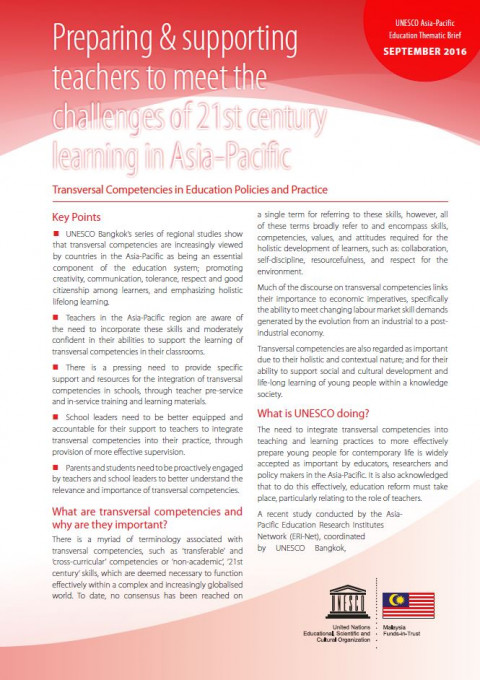 Preparing & Supporting Teachers to Meet the Challenges of 21st Century Learning in Asia-Pacific: Transversal Competencies in Education Policies and Practice Year of publication: 2016 Corporate author: Regional Bureau for Education in Asia and the Pacific | UNESCO Bangkok Preparing and supporting teachers to meet the challenges of 21st century learning in Asia-Pacific. Transversal Competencies in Education Policies and Practice. This is a summary of ERI-Net’s Phase III research into transversal competencies in education policy and practice. The regional synthesis report will be published in December 2016.
 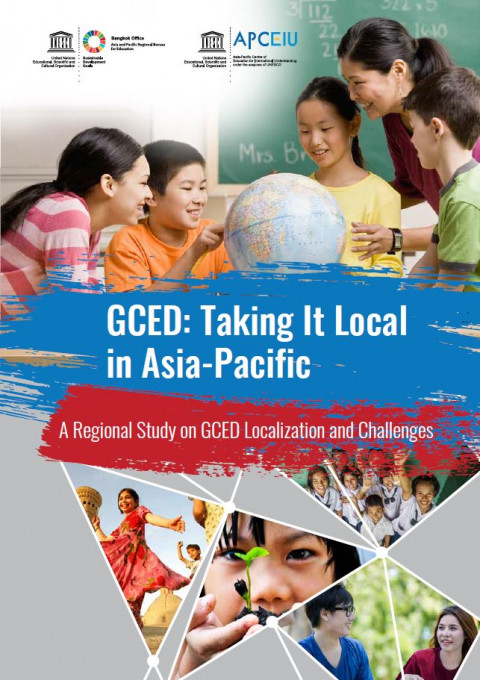 GCED: Taking It Local in Asia-Pacific; A Regional Study on GCED Localization and Challenges Year of publication: 2019 Corporate author: UNESCO Bangkok Global Citizenship Education (GCED) is often interpreted in theoretical ways, which may make GCED difficult for laypeople to understand from a local perspective. However, notions of GCED are deeply rooted in the cultures of the Asia-Pacific region and are very much related to daily life experiences.In the “Asia-Pacific Regional GCED Network 2018 Jakarta Meeting Final Report”, “Contextualize GCED in Asia-Pacific while keeping in mind the global view” has been identified as one of the actions needed for facilitating GCED implementation. Thus, this study attempts to link the concept of GCED with localized ideologies by showing some examples of the way GCED is understood in different cultural contexts in the Asia and Pacific region.
 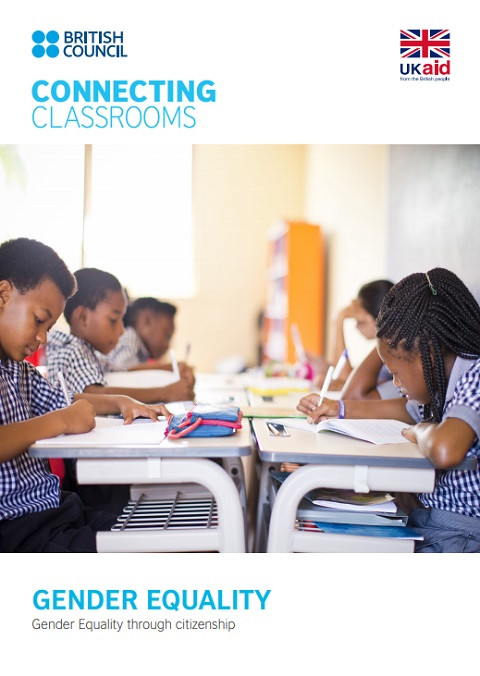 Connecting Classrooms: Gender Equality; Gender Equality through Citizenship Year of publication: 2019 Corporate author: British Council | UK aid This material shows an example of how you can support the development of pupils’ core skills such as citizenship, critical thinking, problem solving, creativity and imagination through the study and investigation of gender equality. This can be done in the context of English, citizenship, geography, history or other subjects. The materials can be used either with an international partner school or without one and instructions are provided on how to best use the resources. This learning unit will explore the Global Goals for Sustainable Development, and in particular, gender equality.
 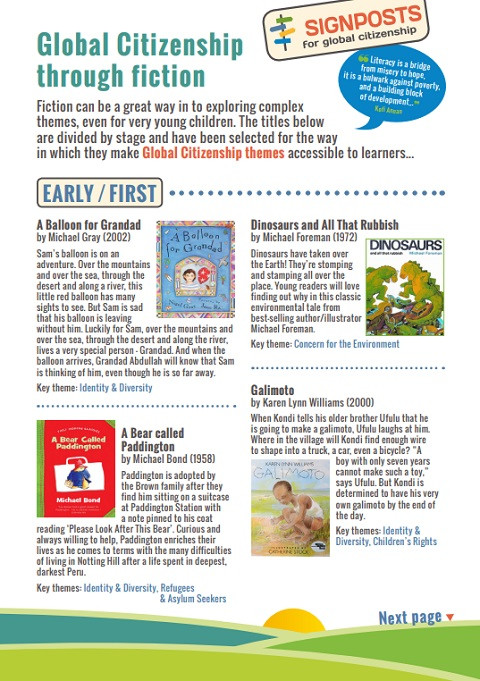 Global Citizenship through Fiction Year of publication: 2016 Corporate author: Signposts | International Development Education Association Scotland (IDEAS) This flyer summarises a selection of texts linking global citizenship and fiction. There is a synopsis of each text and texts range from Early Years to Stage 2.
  Understanding the Impact of Global Citizenship Education - Using a Theory of Change Approach: An IDEAS Report Year of publication: 2017 Corporate author: International Development Education Association Scotland (IDEAS) This report provides an overview of the range of impacts IDEAS members are working towards and discusses how best to approach their assessment. It focuses, in particular, on how global citizenship education affects teachers and pupils and how this relates to attainment. The Theory of Change that it is based around offers a forward-looking framework that will over time enable us to make the evidence for global citizenship education more accessible, approachable and coherent.
  Activism, the SDGs and Youth: Development Education & Global Citizenship Education; Resource Pack Year of publication: 2018 Author: Valerie Duffy | Dermot O’Brien Corporate author: National Youth Council of Ireland (NYCI) | Irish Aid This resource explores the issue of Activism and the Sustainable Development Goals and represents an important contribution at this moment in time where activism and action within the Global Citizenship movement is gaining momentum. It is aimed at Global Educators, Youth Workers, Development Education practitioners, trainers, activists, changemakers of all shapes and sizes but in particular those working with the current generation of young people.
 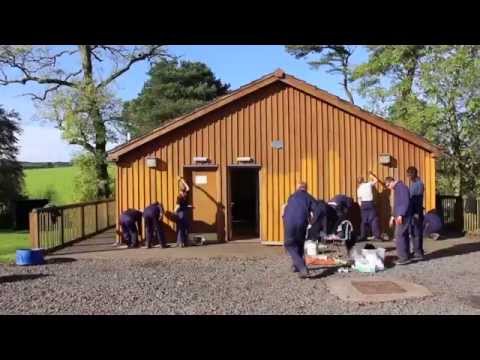 L'engagement citoyen à l'international Year of publication: 2015 Author: Jeanne Lorrain Corporate author: Educasol La citoyenneté est présentée aujourd’hui comme un enjeu prioritaire par les pouvoirs publics français. Ce vidéo montre qu'il est nécessaire de rappeler que pour être gage de sens et de qualité, le désir d’engagement se doit d’être accompagné pour permettre, à tous les âges de la vie, de découvrir les multiples possibilités d’agir et de s’engager. C’est pourquoi les associations de solidarité internationale, de volontariat, de jeunesse et d’éducation populaire travaillent depuis longtemps sur les enjeux de citoyenneté et de mieux vivre ensemble ici et là-bas.