
Resources
Explore a wide range of valuable resources on GCED to deepen your understanding and enhance your research, advocacy, teaching, and learning.
3,229 Results found
 Ecopedagogy and citizenship in the age of globalisation: connections between environmental and global citizenship education to save the planet Year of publication: 2015 Author: Greg William Misiaszek Corporate author: Wiley‑Blackwell Teaching the connections between environmentally-harmful acts and social conflict is essential but is often ignored in education. This article presents two ways in which these are not taught because of the policies of those who benefit from the ignorance of these connections: first, the avoidance of teaching global-local connectivity and second, the devaluing of non-dominant cultures. Ecopedagogy is a democratic, transformative pedagogy centred on increasing justice by critically teaching the politics of environmental issues. I argue that global citizenship education (GCE) must be an element of ecopedagogy to contextually learn globalisation's effects upon local communities. In addition, GCE's goal is to increase students' understanding of diverse cultures to respect them. Ecopedagogy is also essential to GCE to fully teach social conflicts resulting from environmentally harmful acts. I offer policy and pedagogical changes to disrupt reproductive environmental pedagogies that help to sustain environmental ills for ecopedagogy-GCE models to emerge. Ecopedagogy et Citoyenneté à l'ère de la Mondialisation: des liens entre l'environnement et l'éducation à la citoyenneté Mondiale (ECM) pour sauver la planète Year of publication: 2015 Author: Greg William Misiaszek Corporate author: Wiley‑Blackwell Enseigner les liens entre les actes nuisibles à l'environnement et les conflits sociaux est essentielle, mais est souvent ignorée dans l'éducation. Cet article présente deux façons dont ceux-ci ne sont pas enseignées à cause des politiques de ceux qui profitent de l'ignorance de ces connexions: d'abord, l'évitement de l'enseignement connectivité mondiale-locale et, deuxièmement, la dévalorisation des cultures non dominantes. Ecopedagogy est une société démocratique, la pédagogie transformative centrée sur l'augmentation de la justice par l'enseignement critique la politique des questions environnementales. Je soutiens que L'éducation à la citoyenneté Mondiale (ECM) doit être un élément de ecopedagogy apprendre contextuellement les effets de la mondialisation sur les communautés locales. En outre, l'objectif de l'ECM est d'accroître la compréhension des élèves de diverses cultures à les respecter. Ecopedagogy est également essentiel d'ECM pour enseigner pleinement les conflits sociaux résultant d'actes préjudiciables à l'environnement. Je propose des changements politiques et pédagogiques pour perturber les pédagogies environnementaux de reproduction qui aident à maintenir les maux environnementaux pour les modèles ecopedagogy-ECM à émerger.
  NISSEM Global Briefs (Volume II): Educating for the Social, the Emotional and the Sustainable; Pedagogy, Practice and Materials Year of publication: 2020 Author: Andy Smart | Margaret Sinclair Corporate author: Networking to Integrate SDG Target 4.7 and SEL skills into Educational Materials (NISSEM) The timeframe for achieving the Sustainable Development Goals (SDGs) is tight, and the world also faces the consequences of Covid-19. NISSEM Global Briefs aim to show how SDG Target 4.7 themes and social and emotional learning (SEL) can be embedded in education policies, programs, curricula, materials, and practice, to help make progress towards sustainable development.
  Les clés de l’énergie: Guide pour découvrir, enquêter et agir au sein de son établissement scolaire Year of publication: 2020 Corporate author: Eco-Ecole L’énergie est présente dans toutes les sphères de notre quotidien et favoriser sa gestion durable et responsable est un enjeu majeur dans la lutte contre le réchauffement climatique ! Afin d’aider les communautés éducatives à s’approprier ce sujet, le programme Eco-Ecole, en partenariat avec le Conseil Départemental de Seine-Saint-Denis et l’ADEME, dévoile son nouvel outil : Les clés de l’énergie : Guide pour découvrir, enquêter et agir au sein de son établissement.En abordant l’énergie à travers le bâti, l’alimentation, le numérique et les déplacements, ce guide permet aux enseignant.e.s et à leurs élèves de se questionner sur les enjeux environnementaux liés à cette thématique et de réfléchir à des solutions à mettre en place à leur échelle.Destiné principalement à être utilisé dans le secondaire, cet outil contient :• des éléments de contexte et des clés de compréhension sur le thème de l’énergie ;• des pistes d’enquête concrètes pour réaliser un diagnostic ;• des déroulés d’ateliers pour découvrir la thématique et faire émerger des idées d’actions dans son établissement ;• des supports d’activités (à photocopier, découper ou reproduire) disponibles dans le corps du guide et dans les annexes. Becoming Citizens in a Changing World: IEA International Civic and Citizenship Education Study 2016 International Report Year of publication: 2017 Author: Wolfram Schulz, John Ainley, Julian Fraillon, Bruno Losito, Gabriella Agrusti, Tim Friedman Corporate author: International Association for the Evaluation of Educational Achievement (IEA) The International Civic and Citizenship Education Study 2016 (ICCS 2016) investigated the ways in which young people are prepared to undertake their roles as citizens in a range of countries in the second decade of the 21st century. It studied students’ knowledge and understanding of civics and citizenship as well as students’ attitudes, perceptions, and activities related to civics and citizenship. Based on nationally representative samples of students, the study also examined differences among countries in relation to these outcomes of civic and citizenship education, and explored how cross-national differences relate to student characteristics, school and community contexts, and national characteristics. As the second cycle of this study, ICCS 2016 is a continuation and an extension of ICCS 2009.
  Inspiring Global Citizens - An Educator's Guide Year of publication: 2017 Corporate author: AGA Khan Foundation Canada This resource is intended for use by teachers of intermediate and secondary school grades to support education about global development and related themes such as global citizenship. The activities included in the resource are designed to assist students in increasing their understanding of the interconnectedness of the world, of the factors contributing to global inequalities, and of some effective and sustainable ways to help reduce global poverty. It is hoped that students will be inspired to take action to make their own contribution to improving lives everywhere.
  Global Citizenship in the Classroom: A guide for teachers Year of publication: 2015 Corporate author: Oxfam GB A practical and reflective guide full of practical tools and ideas that can be applied to almost any topic to develop learner participation and global learning.
 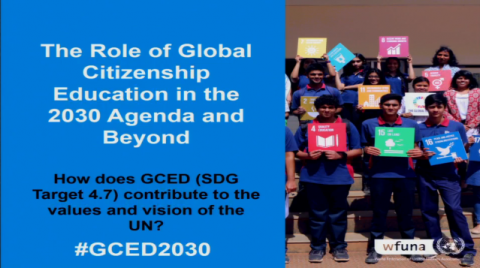 2017 UN Global Citizenship Education Seminar Year of publication: 2017 Corporate author: United Nations (UN) 2017 UN GCED SeminarThe Role of Global Citizenship Education in the 2030 Agenda and Beyond: How does global citizenship education (SDG Target 4.7) contribute to the values and vision of the United Nations? 2017联合国全球公民教育研讨会 Year of publication: 2017 Corporate author: United Nations (UN) 2017联合国全球公民教育研讨会全球公民教育在2030年议程及其后的作用:全球公民教育(可持续发展目标4.7)如何促进联合国的价值观和愿景? Educar para una ciudadanía global: construir un mundo justo desde la escuela Year of publication: 2009 Author: Colette Grech | Roderick Mallia | William Grech Corporate author: Conectando Mundos Consortium (Cidac, inizjamed, Intermon Oxfam, Ucodep) This publication is based on an initiative about the development education, intercultural education, popular education, the education of values, human rights education, education for sustainability, education for peace, education for gender equality, etc. The pedagogical proposal of Global Citizenship Education aspires to integrate in a coherent and challenging vision all these themes, keeping them in a close relationship with one another and taking into consideration the (increasing) interdependence of human beings living in a planet whose sustainability is under threat. This book is the fruit of a process that was triggered off by the joint effort of four European development NGOs, namely Cidac, Inizjamed, Intermón Oxfam and Ucodep within the frame of a project co-financed by the European Commission. These organisations set for themselves the objective to promote the acknowledgment and the inclusion of the contents and the methodology of Global Citizenship Education in the formal educational contexts in their respective countries, in order to kick-start a process of change in attitudes, values, and the beliefs of the pupils. Thanks to the initiative and efforts of the above-mentioned four organisations, and through various meetings and seminars carried out over the last three years in Spain, Italy, Portugal and Malta, groups of educators have been able to come face-to-face with each other, exchange experiences and reflect on the role of formal education with respect to the challenges of our times. Among the other experiences, the publication contains that of a key moment in the process. This took place in July 2008 in Cortona, a small and beautiful Tuscan city close to the border with Umbria, and in which many educators shared the benefit of what was the first international encounter of educators for global citizenship. The Cortona experience, in which around ninety teachers coming from Spain, Portugal, Malta, Italy, the Dominican Republic and Costa Rica have participated, was one of the stages – the starting point, in fact – of a process and a relationship that it is our aim to develop at the regional, national and international levels. In this publication, therefore, one can find theoretical cues put forward at Cortona that encourage educators to share their experiences and to compare the work done by different groups.This publication has two parts. The first part contains contributions of a theoretical type, whereas the second part concentrates on the educational experiences of the participants in the Cortona meeting.