
Resources
Explore a wide range of valuable resources on GCED to deepen your understanding and enhance your research, advocacy, teaching, and learning.
3,446 Results found
 Интеграция или инклюзия в образовании? Year of publication: 2020 Author: Dilmurod Yusupov Как создать настоящие инклюзивные условия для детей с инвалидностью и особенностями в развитии, чтобы они могли получать качественное образование и впоследствии найти достойную работу? Анализ проекта документа о развитии инклюзивного (интегрированного) образования, подготовленного МНО.
  감염병 보도 규제의 현황 및 개선 방안 (이슈와 논점 제1665호) Year of publication: 2020 Author: 김여라 Corporate author: 국회입법조사처 최근 코로나바이러스감염증-19의 확산으로 언론의 관련 보도가 증가하면서 부정확하고 자극적인 보도, 불필요한 피해자 신원 노출, 특정 집단에 대한 혐오 확산 등에 대한 우려가 높아지고 있다. 하지만 우리의 일상생활과 밀접하게 관련이 있으면서도 알려진 정보가 없는 신종 감염병과 관련하여 국민들은 정부의 발표와 더불어 추가적인 언론보도에 의존할 수밖에 없는 상황이다. 특히 코로나19의 급격한 확산으로 인해 불안감이 심해지는 상황에서 언론의 역할은 매우 중요하다. 이 글에서는 감염병 보도 관련 규제 현황과 감염병 보도의 문제점을 살펴본 후, 감염병 보도에 대한 규제를 법률적 규제와 자율적 규제로 나누어 개선방안을 제시하고자 한다.
  Global Citizenship Education in Europe: A Comparative Study on Education Policies across 10 EU Countries Year of publication: 2016 Corporate author: Global Schools | European Union (EU) This research, realised in the framework of the EU-funded project Global Schools, is a comparative qualitative analysis of educational policies of 10 European countries (Austria, Bulgaria, Czech Republic, France, Ireland, Italy, Latvia, Spain, Portugal, England) that support the introduction of Global Citizenship Education (GCE) in primary school curriculum. The analysis focuses on four main topics: 1) identification of key actors and definition of their roles; 2) conceptual and terminology analysis; 3) levels and modes of implementation of GCE in primary school; and 4) identification of barriers to introducing GCE in the primary school system.The research has highlighted that political actors, not only governmental ones, play a crucial role in implementing GCE policies, as well as in promoting GCE more generally, and in facilitating links between different actors, who in some countries may otherwise have little institutional coordination with schools. The conceptual analysis points out that, besides the choice of different wording of GCE national terms, the main topics composing GCE are very similar. The specific terminology often reflects the history, will and political discourse of the organisations promoting GCE in the different countries.
 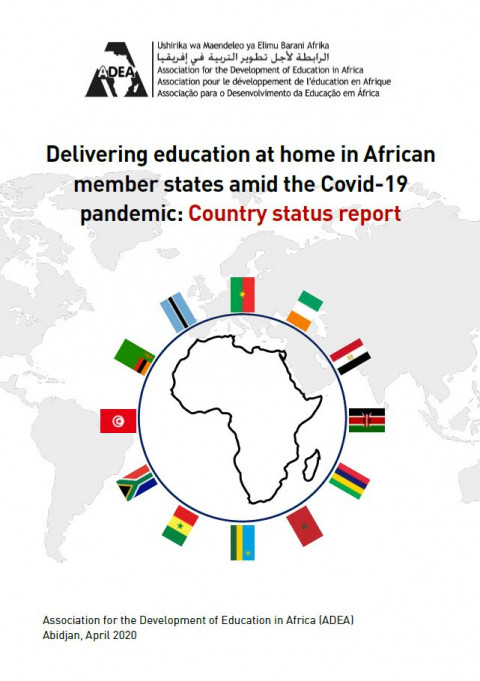 Assurer l’éducation à domicile dans les États membres africains dans le contexte de la pandémie de COVID-19 : rapport sur la situation dans les pays Year of publication: 2020 Corporate author: Association for the Development of Education in Africa (ADEA) Depuis son émergence à la fin de 2019, la maladie à coronavirus 2019 (COVID-19) est devenue une pandémie, affectant fortement la vie de milliards de personnes à travers le monde, avec un impact énorme prévu sur l'économie mondiale et l'Afrique en particulier. L'éducation est l'un des secteurs les plus touchés, la fermeture des établissements d'enseignement dans de nombreux pays africains risquant d'affecter négativement la qualité de l'éducation.Afin d'obtenir une vision plus claire de l'état de l'apprentissage au cours de cette période et de mieux soutenir les pays dans l'immédiat, à court et à long terme, l'ADEA a engagé en mars 2020 certains des pays africains les plus touchés pour schématiser la situation nationale du secteur de l'éducation. Ce qui précède est un résumé des commentaires reçus par l'Afrique du Sud, le Burkina Faso, la Côte d'Ivoire, l'Égypte, le Ghana, le Kenya, l’île Maurice, le Maroc, le Rwanda, le Sénégal, la Tunisie et la Zambie en termes de stratégies nationales, de plateformes, d'outils ou d'applications d’apprentissage, de lacunes et défis, d’engagement des partenaires, de bonnes pratiques et d’enseignements tirés avec quelques recommandations.
  Bank of Actions for Global Citizens Year of publication: 2020 Corporate author: Global Citizens Award The Bank of Actions guide can be used by anyone looking for creative inspiration to take action as global citizens. It is designed as a toolkit for engaging the public in global justice issues in meaningful ways that can help bring about positive change in our world.The Bank of Actions has been designed in the context of returned international volunteers participating in the Global Citizen Award programme.
  (Re)penser l’accès aux espaces intimes en contexte de handicap intellectuel: Une question de droit et de participation sociale (Revue générale de droit; vol. 47) Year of publication: 2017 Author: Éditions Wilson & Lafleur, inc Corporate author: Éditions Wilson & Lafleur, inc En contexte de handicap, la question de l’accès est constituée généralement de l’éventail des aménagements individuels et collectifs nécessaires afin de faciliter l’occupation d’espaces publics. A contrario, peu de choses sont dites à propos des aménagements possibles et potentiels requis afin de sécuriser l’espace privé des personnes identifiées comme ayant un handicap intellectuel. Ce sont pourtant ces lieux intimes, au sein desquels se développent et se déploient l’identité et l’expression affectives, qui sont susceptibles de contribuer à une reconnaissance plus soutenue de l’identité affective et de la citoyenneté sexuelle de ces personnes. Inspirée par les théories d’Erving Goffman et de Michel Foucault, une analyse phénoménologique interprétative (API) fut réalisée auprès des personnes ayant un handicap intellectuel et de leurs proches aidants afin d’explorer cette situation. Nos constats préliminaires suggèrent l’existence d’un processus de négociation complexe des acteurs, des lieux et des moments nécessaires afin de favoriser le développement de la vie affective et sexuelle. De ce fait, trois modes d’existence semblent cohabiter au sein d’une matrice complexe : la dépossession, l’habitation et l’occupation des espaces de socialisation et d’expression affective. Il est proposé d’aborder cette problématique en tant que dynamique géopolitique intégrant les processus d’exclusion des pratiques sexuelles des espaces privés, leur projection dans des espaces publics et, finalement, la juxtaposition de ces deux sphères, publique et privée dans des espaces mixtes. Nous discuterons enfin des implications de cette réflexion sur la « question de l’accès» et sur les politiques publiques visant à diminuer la discrimination systémique ciblant les personnes identifiées comme ayant un handicap intellectuel.
  De la capacité, de la compétence, de l’empowerment, repenser l’anthropologie de la participation (Politique et Sociétés; vol.34, no.1) Year of publication: 2013 Author: Jean-Louis Genard Corporate author: Société québécoise de science politique Le plus souvent étudiée dans le contexte des évolutions du politique et du passage présumé d’une démocratie représentative vers une démocratie davantage participative ou délibérative, la question de la participation est abordée ici sous l’angle d’une transformation de nos coordonnées anthropologiques. Les exigences et les attentes de participation se retrouvent en effet dans de multiples domaines qui excèdent de loin la seule sphère du politique, allant du monde de l’entreprise et de ses cercles de qualité jusqu’à la production de biens en kit sollicitant les capacités de montage des acheteurs. Cette extension du domaine de la participation s’appuie en réalité sur un certain nombre de présupposés anthropologiques. Ceux-ci prêtent aux acteurs des capacités et des compétences qu’ils sont censés détenir, à moins qu’ils ne soient appelés à les enrichir par des stratégies d’empowerment si elles leur font défaut ou sont insuffisantes. Ils leur attribuent aussi un potentiel de motivation indispensable à l’actualisation de ces compétences et capacités. Le texte soutient que l’évaluation des personnes ainsi que la configuration de nombreux dispositifs sociaux récents tendent de plus en plus à s’ajuster à ce nouveau référentiel anthropologique. Il en va ainsi de la participation politique bien sûr, mais aussi des nouvelles politiques sociales, des formations au «pouvoir d’agir », des objectifs éducatifs, des politiques de développement ou de santé. Revenant plus spécifiquement sur la question de la participation politique, le texte montre comment ces nouvelles coordonnées anthropologiques reconfigurent la question de l’expertise en réorganisant les partages entre expertises ordinaire et spécialisée et, du coup, le partage entre les espaces où peut prendre place une démocratie participative et ceux qui demeurent confiés à l’expertise technocratique.
  Teaching and Learning about Child Rights: A Study of Implementation in 26 Countries Year of publication: 2015 Author: Lee Jerome | Lesley Emerson | Laura Lundy | Karen Orr Corporate author: Queen’s University Belfast | United Nations Children's Fund (UNICEF) This research contributes to the global debate on child rights education (CRE). It explores implementation of CRE in early childhood education, primary and secondary schools in 26 countries with a UNICEF National Committee presence. It includes a literature review, results from an on-line survey completed by national experts, seven country case studies and a series of benchmarking statements for CRE implementation.
  Well-Being and Safety of Women: OSCE-Led Survey on Violence Against Women Year of publication: 2019 Corporate author: Organization for Security and Co-operation in Europe (OSCE) This report presents the cross-regional, comparable findings of the OSCE-led Survey on the Well-being and Safety of Women, which was implemented in 2018 in Albania, Bosnia and Herzegovina, Montenegro, North Macedonia and Serbia, Moldova3 and Ukraine. The research was also conducted in Kosovo.The OSCE-led survey included a quantitative and qualitative component and was undertaken with the goal of providing comparable data on different forms of violence women experience in their childhood and throughout the course of their lives. The research examined violence that women experience in conflict and non-conflict settings, as well as the impact violence has on women, including its lasting consequences. Questions on norms and attitudes connected to violence against women were asked to better understand the underlying causes of violence.The area covered by this research is diverse and has different historical, social and economic contexts. Rather than focusing on the findings from particular locations, the report aims to provide an overview of women’s experiences and to highlight the issues – often similar – that persist and continue to hamper the well-being and safety of women throughout the area covered by the research.
 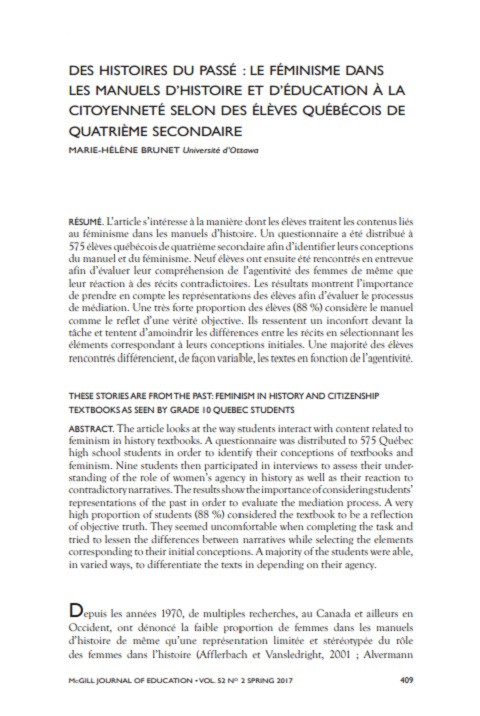 These Stories are From the Past: Feminism in History and Citizenship Textbooks as Seen by Grade 10 Quebec Students (McGill Journal of Education; Vol. 52, No. 2) Year of publication: 2017 Author: Marie-Hélène Brunet Corporate author: McGill University. Faculty of Education The article looks at the way students interact with content related to feminism in history textbooks. A questionnaire was distributed to 575 Québec high school students in order to identify their conceptions of textbooks and feminism. Nine students then participated in interviews to assess their understanding of the role of women’s agency in history as well as their reaction to contradictory narratives. The results show the importance of considering students’ representations of the past in order to evaluate the mediation process. A very high proportion of students (88 %) considered the textbook to be a reflection of objective truth. They seemed uncomfortable when completing the task and tried to lessen the differences between narratives while selecting the elements corresponding to their initial conceptions. A majority of the students were able, in varied ways, to differentiate the texts in depending on their agency.