
Resources
Explore a wide range of valuable resources on GCED to deepen your understanding and enhance your research, advocacy, teaching, and learning.
3,446 Results found
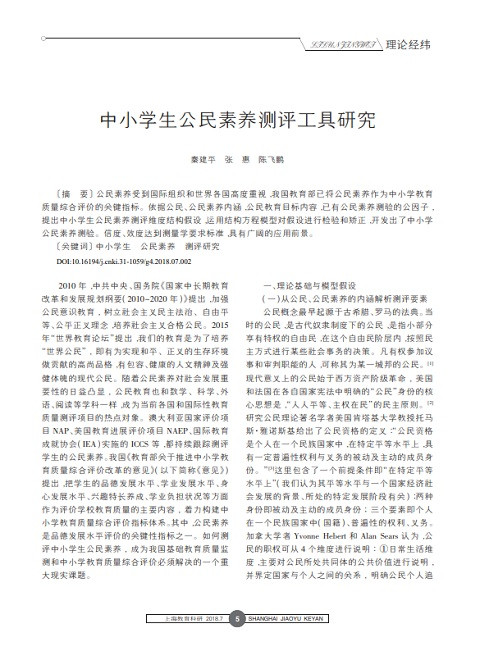 Research on Civic Literacy Assessment Tools for Primary and Middle School Students (Journal of Shanghai Educational Research; No. 7) Year of publication: 2018 Author: Qin Jianping | Zhanf Hui | Chen Feipeng Corporate author: General Education Research Institute | Shanghai Academy of Educational Sciences Civic literacy is highly valued by international organizations and countries all over the world. China’s Ministry of Education has taken civic literacy as a key indicator for the comprehensive evaluation of the quality of primary and secondary education. Based on citizen, civic literacy connotation, civic education objective content, and common factors of civic literacy test, the dimensional structure hypothesis of civic literacy assessment for primary and middle school students was proposed, and the hypothesis was tested and corrected by using structural equation model, and the civic literacy test for primary and middle school students was developed. The reliability and validity meet the requirements of measurement and have a broad application prospect.
 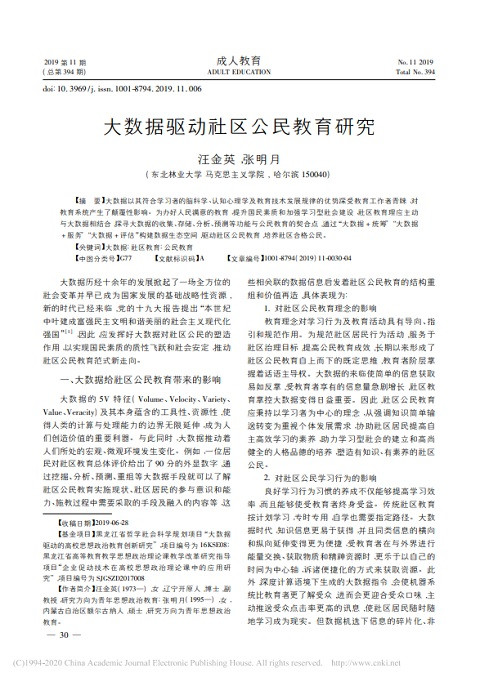 大数据驱动社区公民教育研究 (湖北成人教育学院学报; No. 11) Year of publication: 2019 Author: Wang Jinying | Zhang Mingyue Corporate author: Heilongjiang Education College 大数据以其符合学习者的脑科学、认知心理学及教育技术发展规律的优势深受教育工作者青睐,对 教育系统产生了颠覆性影响。为办好人民满意的教育,提升国民素质和加强学习型社会建设,社区教育理应主动 与大数据相结合,探寻大数据的收集、存储、分析、预测等功能与公民教育的契合点,通过“大数据 + 统筹”“大数据 + 服务”“大数据 + 评估”构建数据生态空间,驱动社区公民教育,培养社区合格公民。
 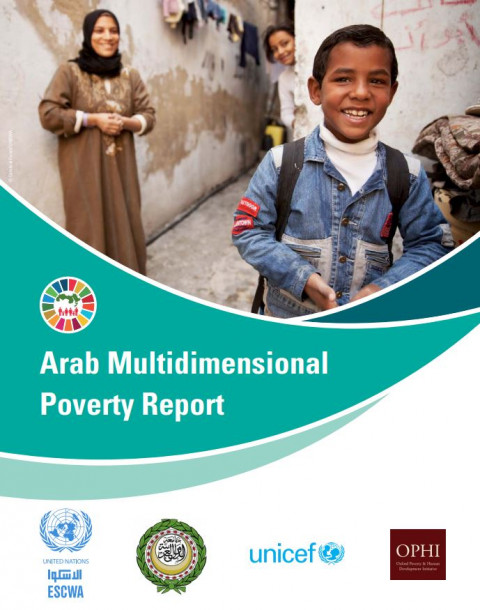 التقرير العربي حول الفقر المتعدد الابعاد Year of publication: 2017 Corporate author: UN. Economic and Social Commission for Western Asia (UN. ESCWA) | United Nations Children's Fund (UNICEF) | Oxford Poverty and Human Development Initiative (OPHI) التقرير العربي حول الفقر المتعدد الأبعاد هو الأول من نوعه منذ إطلاق خطة عام 2030. ونتج التقرير عن تعاون استمر لثلاثة أعوام بين المجلس الوزاري للشؤون الاجتماعية في جامعة الدول العربية، ولجنة الأمم المتحدة الاقتصادية والاجتماعية لغربي اسيا (الإسكوا)، ومنظمة الأمم المتحدة للطفولة (اليونيسف)، ومبادرة أكسفورد للفقر والتنمية البشرية. Arab Multidimensional Poverty Report Year of publication: 2017 Corporate author: UN. Economic and Social Commission for Western Asia (UN. ESCWA) | United Nations Children's Fund (UNICEF) | Oxford Poverty and Human Development Initiative (OPHI) The Arab Multidimensional Poverty Report, the first of its kind following the launch of the 2030 Agenda, is the result of three years of collaboration between the League of Arab States’ Council of Arab Ministers for Social Affairs, the Economic and Social Commission for Western Asia (ESCWA), the United Nations Children's Fund (UNICEF), and Oxford Poverty and Human Development Initiative (OPHI).
 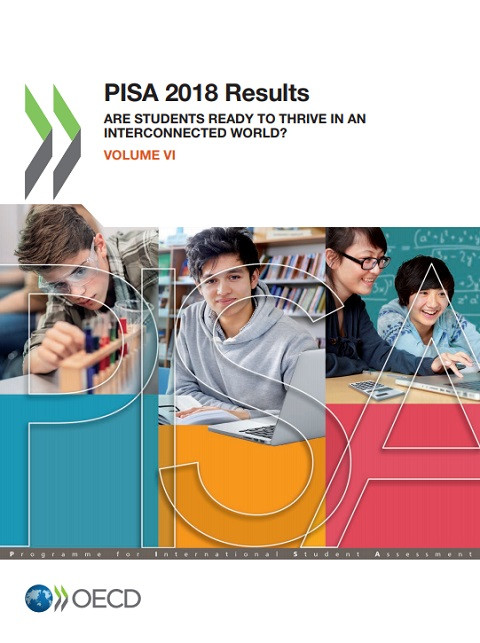 PISA 2018 Results (Volume VI): Are Students Ready to Thrive in an Interconnected World? Year of publication: 2020 Corporate author: Organisation for Economic Co-operation and Development (OECD) The OECD Programme for International Student Assessment (PISA) examines what students know in reading, mathematics and science, and what they can do with what they know. It provides the most comprehensive and rigorous international assessment of student learning outcomes to date. Results from PISA indicate the quality and equity of learning outcomes attained around the world, and allow educators and policy makers to learn from the policies and practices applied in other countries. This is one of six volumes that present the results of the PISA 2018 survey, the seventh round of the triennial assessment. Volume VI: Are Students Ready to Thrive in an Interconnected World? explores students’ ability to examine issues of local, global and cultural significance; understand and appreciate the perspectives and worldviews of others; engage in open, appropriate and effective interactions across cultures; and take action for collective well-being and sustainable development. The volume explores students’ outcomes on the cognitive test and corresponding questionnaire in addition to their experiences of global and intercultural learning at school and beyond.
  A Discussion of the Concept of ‘Community of Human Destiny’ Guiding the World Citizenship Education Ethos in the New Era (Journal of Educational Studies; Vol. 14, No. 3) Year of publication: 2018 Author: Song Qiang Corporate author: Beijing Normal University In the new era, the concept of “Community of Human Destiny” has gradually been accepted and recognized by the world, and it is necessary to spread and pass this concept by means of education. It is of significance to seize the opportunity of world citizenship education, which is widely accepted in the west, and guide the World Citizenship Education Ethos by the concept of “Community of Human Destiny”. In terms of connotation, the World Citizenship Education Ethos corresponds with the concept of “Community of Human Destiny”. However, the World Citizenship Education Ethos, to some extent, is still Western-oriented and attached with Western values. Its essential features are also presented with conflict. Based on the concept of “Community of Human Destiny”, it is of necessity to guide and reconstruct the concept of citizenship, the concept of citizenship education, the dominant party, the theoretical basis and the thought domain of the World Citizenship Education Ethos using the concept of “Community of Human Destiny”, and empower it to become an ideological weapon helping China to integrate into world and exhibit its open-mindedness and inclusiveness. 新时代‘人类命运共同体’ 理念引领世界公民教育思潮的理路 (教育学报; Vol. 14, No. 3) Year of publication: 2018 Author: Song Qiang Corporate author: Beijing Normal University 新时代“人类命运共同体”理念已逐渐成为被世界广泛接受和认同的理念,而要将这一理念传播和传 递下去需要通过教育。当前需要利用西方广泛接受世界公民教育的时机,以“人类命运共同体”理念引领世界公民 教育思潮。世界公民教育思潮与“人类命运共同体”理念在内涵上有广泛的契合之处。但世界公民教育思潮某种 程度上还是一种由西方主导,附带西方价值观的思潮,其本质特征也呈现矛盾性。需 要 以“人类命运共同体”理 念 为指引,引领与重构世界公民教育思潮的公民资格观、公民教育观、主导主体、理论基础和思潮版图,使其成为中国 融入世界、展现开放包容的思想武器。
  [Summary] Rethinking Learning: A Review of Social and Emotional Learning for Education Systems; Summary for Decision Makers Year of publication: 2020 Corporate author: Mahatma Gandhi Institute of Education for Peace and Sustainable Development (MGIEP) The publication, titled “Rethinking Learning: A Review of Social and Emotional Learning (SEL) for Education Systems” was worked upon from 2018 to 2020. The purpose of this publication was to review the latest research on SEL and to present scientific evidence for why SEL is key to education, and by that corollary, to achieving the United Nations (UN) Sustainable Development Goals (SDGs), specifically SDG 4, Target 7 that focuses on building peaceful and sustainable societies through education.This summary, aimed at decision makers, synthesises and integrates the main findings, challenges and recommendations from the eight chapters of the full Review. The key questions that guided the Review were: (i) What constitutes an SEL intervention; (ii) Why and when SEL interventions are necessary; (iii) The science and evidence supporting SEL interventions; (iv) How can SEL be implemented; and (iv) The cost and benefits of SEL interventions.
  Lack of Modern Students' Well-Ordered Public Life and the Construction Way—From the Perspective of Schools' Civic Education Year of publication: 2019 Author: Gao Fengqing Corporate author: Shanxi Academy of Educational Sciences | Shanxi Educational Association Public life is a practical communication activity for citizens that takes place in the public sphere to promote public awareness, public affairs and public morality. The lack of students’ public life is likely to lead to the lack of relationship in schools’ civic education, the weakening of students’ micro-public space consciousness and publicity in the Internet age, and the removal of cultural intimacy of civic education. Schools’ civic education should be based on the construction of the whole social public space, so that students’ public life will be organically linked with the global social public space. Schools should solve the conflicts between public expression and individual discourse expression by activating the student citizenship, pay attention to the shaping of students’ cultural emotions through public life experience of national history and Confucianism, and promote the achievement of students’ social emotions and social consensus. 当代学生良序公共生活的匮乏及构建途径: 基于学校公民教育视角 (教育理论与实践; Vol. 39, No. 16) Year of publication: 2019 Author: Gao Fengqing Corporate author: Shanxi Academy of Educational Sciences | Shanxi Educational Association 公共生活是发生在公共领域中的以促进公共意识、公共事务和公共道德品行养成的公民实践交往活动,学生公共生活的匮乏容易造成学校公民教育的关系性存在缺失、互联网时代学生微公共空间意识和公共性的弱化、消解公民教育的文化亲密性。学校公民教育应立足建构全域的社会公共空间,使学生公共生活与全域的社会公共空间形成有机联系,通过激活学生公民身份解决公共表达和个体话语表达的冲突,重视国家历史和儒家立场的公共生活经验对学生文化情感的形塑,促进学生社会情感和社会共识的达成。