
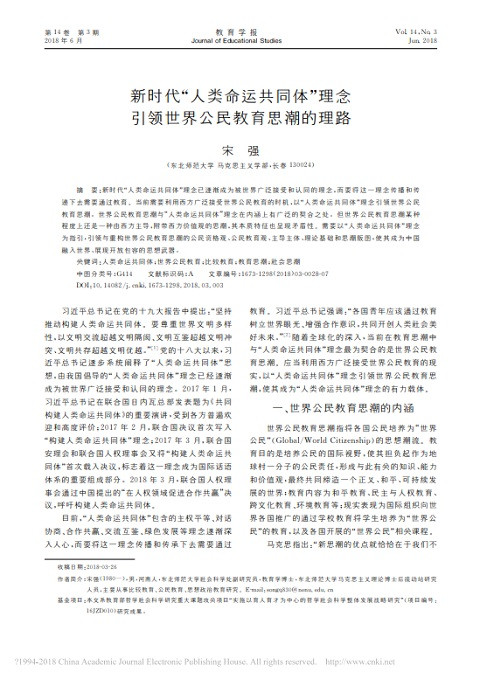
A Discussion of the Concept of ‘Community of Human Destiny’ Guiding the World Citizenship Education Ethos in the New Era (Journal of Educational Studies; Vol. 14, No. 3)
- Author
- Song Qiang
- Corporate Author
- Beijing Normal University
- ISBN
- ISSN 1673-1298
- Collation
- p. 28-34
- Resource Language
- Chinese
- Year of publication
- 2018
- Resource Type
- Research papers / journal articles
- Level of education
- Non-formal educationOthers
- Region
- Asia and the Pacific
- Place of publication
- Beijing
In the new era, the concept of “Community of Human Destiny” has gradually been accepted and recognized by the world, and it is necessary to spread and pass this concept by means of education. It is of significance to seize the opportunity of world citizenship education, which is widely accepted in the west, and guide the World Citizenship Education Ethos by the concept of “Community of Human Destiny”. In terms of connotation, the World Citizenship Education Ethos corresponds with the concept of “Community of Human Destiny”. However, the World Citizenship Education Ethos, to some extent, is still Western-oriented and attached with Western values. Its essential features are also presented with conflict. Based on the concept of “Community of Human Destiny”, it is of necessity to guide and reconstruct the concept of citizenship, the concept of citizenship education, the dominant party, the theoretical basis and the thought domain of the World Citizenship Education Ethos using the concept of “Community of Human Destiny”, and empower it to become an ideological weapon helping China to integrate into world and exhibit its open-mindedness and inclusiveness.
Related Resources
-
 IIEP-UNESCO 12th Medium-Term Strategy: 2026–2029
 -
 Advancing Intergenerational Learning: Identifying Challenges and Opportunities for Older Adults; Integrated Case Study Report
 -
 Digital Empowerment for Lifelong Learning and Transformative Andragogy (DELTA) for Adult Educators: Introduction to the DELTA Framework and Resources
 -
 Bridging the Grey Digital Divide: Enhancing ICT Learning for Older Adults; Research Report